Showing posts with label europe. Show all posts

Tuesday, November 03, 2015

On how the 1991 image of the Vlora and its Albanian refugees is being misrepresented


I have a Tumblr account. Tumblr is a platform that is good for sharing images and so a natural adjunct to my interest in amateur photography, but it's also a platform good for sharing--sometimes quite widely--all sorts of links, and for starting all sorts of discussions. On the weekend, I saw the below pop up on my dashboard.


This image caught my attention, not least because I was completely unaware of any such desperate and massive movement of refugees from Europe to North Africa. Yes, there were some refugee movements by Europeans to Africa, this June 2012 article in New African Magazine looking at some interesting Polish communities in East Africa, while the Greek government-in-exile was based in Cairo in an Egypt that had long been a node in the Greek diaspora. Such a large and desperate flight of refugees as indicated in the photo, though, was nothing I'd heard of before. Where would these refugees have come from? Where would they have been going?

That's when I noticed the name on the ship. "Vlora" is one rendition of the name of the Albanian port city of Vlorë. As it happens, that ship is closely associated with one massive flight of refugees, one so noteworthy that it even earned an article in Italian Wikipedia. It's just that it's a different refugee movement from the one described by the above photo's caption.


Someone, I don't know who, engaged in a bit of creative photo editing, converting the colour photo above to a black-and-white one and cropping the image somewhat. That might be justifiable on creative grounds. What is not justifiable, at all, is the lie someone chose to tell about this image, one of the iconic images from the initial mass emigration of Albanians in the early 1990s.

On August 7, 1991, Albanians boarded the Vlora in the hope of heading to Italy on its way from Cuba where it had shipped 10,000 tons of sugar. The real number of people that crammed onto the ship is unknown with some figures ranging from 10,000 to 20,000.

The ship crossed the Adriatic. As the ship approached Italian ground some fell to sea to approach Italy a moment sooner, unable to handle the crushing atmosphere aboard. Others screamed “Italia! Italia!” on the ship.

Thomas Jones also noted this particular falsification at the blog of the London Review of Books this September.

On 7 August 1991, the Albanian ship Vlora docked at the Port of Durrës, twenty miles west of Tirana, with a cargo of Cuban sugar. Thousands of people, desperate to leave Albania in the first throes of its ‘transition’ from communism, boarded the ship and prevailed on the captain to take them to Italy. The Vlora arrived in Bari the next day. According to a Parliamentary Assembly of the Council of Europe report from January 1992:

After several hours of waiting in the port of Bari, the Italian authorities allowed the Albanians to disembark for humanitarian reasons and led them to La Vittoria Sports Stadium. As the Italian authorities started forced repatriation using military transport planes and ferries, clashes broke out between policemen and Albanians. The Albanians barricaded themselves in the stadium refusing to return to their country; some 300 succeeded in escaping.

[. . .]


Photographs of the Vlora’s passengers disembarking in Bari have been circulating on the internet this month: first with claims that they show migrants from Libya or Syria heading to Europe now; then, a few days later, with the facts, setting the historical record straight. (I was sent them by someone who thought they were Europeans bound for North Africa during the Second World War.) Falsification can turn out to be a useful reminder of the past, once you’ve identified it.

Another blog, The Cryptic Philosopher, also debunked this misrepresentation of the image in September. Still another blog, looked at a very similar image this September, including a brief documentary on the 1991 Vlora crisis. That blog noted that its variant was being used to represent Syrian refugees fleeing to Europe.


France 24, meanwhile, placed this image in the context of multiple other faked and misrepresented images used in relation to the refugee crisis.

Issues of misattribution are themselves annoying. It's even more annoying if this misattribution is intentional. It's particularly annoying if these images have gone viral. Most if not all of the various sources I encountered debunking this misrepresentation date to September, but I ran into this image entirely independent of these sources at the end of October. I did debunk them, first on Tumblr and later on Facebook, but I have no confidence that those debunkings, or this one, will put an end to the various misrepresentations of the 1991 image of the Vlora. This is a shame: It's already difficult enough to talk about issues without falsehoods confusing the issue.

Thursday, June 04, 2015

Some assorted blog links


While I'm assembling some original material, I thought I'd point readers to some population-related blog links that appeared on my RSS feed in the past month or so.
  • Considering the Mediterranean migration crisis, Crooked Timber featured one essay arguing that European restrictionism is culpable for deaths, while the New APPS Blog praised the bravery of migrants.
  • The Dragon's Tales noted that immigration from China and India to the United States has surpassed that from Mexico.
  • The Everyday Sociology Blog considered, in the wake of the Nepali earthquake, the ill-regulated international market in birth surrogacy.
  • Kieran Healy noted how popular estimates of the composition of the American population are frequently quite wrong, going back to the errors of popular wisdom.
  • The Power and the Money's Noel Maurer noted that rates of childlessness among American women with post-graduate educations has plummeted. More discussion at the blog.
  • The Russian Demographics Blog had a whole slew of interesting posts, including looks at the changing composition of migrants from Russia and changing destinations and volumes of flows to and from the country, along with examinations of problematic data on HIV/AIDS in Russia and an old forecast of the epidemic.
  • Window on Eurasia reported on how one Muslim commentator in Russia thinks Russian Muslims should respond to the prospects of a Muslim majority in Russia. (I find it unlikely, and of note mainly as a case study of crude demographic boosterism.).

If you've suggestions as to new blogs I should follow, please, submit them--and any especially interesting posts--in the comments.

Tuesday, January 13, 2015

On recent post-colonial immigration to Africa


The ever-interesting blog 3 Quarks Daily linked earlier today to another article by Jenni Marsh in the South China Morning Post Magazine, "The town that China built: tourism boom at Zambia's Victoria Falls thanks to Chinese makeover".

"My husband is the best Chinese chef in Zambia," says Liu Xiuyi, a former takeaway employee from Chongqing. "Whenever the president has Chinese guests in Lusaka, my husband is hired to cook for them."

Twenty years ago, with no savings or formal education, the couple emigrated to Zambia when Liu's husband was hired as a chef by a Chinese state-owned construction company contracted to build roads in dusty Lusaka.

Now in their 50s, the Lius have just built a 15 million kwacha (HK$18.3 million) three-star hotel and restaurant, called the Golden Chopsticks, in the former British colonial outpost of Livingstone. They also own property in the Zambian capital; employ about 100 staff, local and Chinese; and rub shoulders with presidents and diplomats.

The Lius are among the estimated 20,000 to 100,000 Chinese living in the copper-rich southern African nation - weak census practices mean precise figures are elusive - and were among the first wave of daring migrants who sought their fortune here.

This Chinese immigrant presence in Zambia is part of a much larger wave of Chinese migration towards Africa. Yoon Jung Park and Anna Ying Chen's recent article "Recent Chinese Migrants in small Towns of Post-apartheid South Africa" takes a look at this migration in connection to South Africa. Much more broadly, Chinese migration to Africa is explored at length in American journalist Howard French's excellent recent book China's Second Continent, excerpted at Quartz and reviewed in The Economist. Substantial Chinese investment has been accompanied by substantial Chinese migration.

For more than a decade, the Chinese government has invested hugely in Africa. The foundation for this partnership was laid in 1996, when President Jiang Zemin proposed the creation of the Forum on China-Africa Cooperation (FOCAC) in a speech at the Organization of African Unity headquarters in Addis Ababa. Four years later, FOCAC convened triumphantly for the first time, gathering leaders from forty-four African countries in Beijing. China pledged, among other things, to double assistant to the continent, create a $5 billion African development fund, cancel outstanding debt, build new facilities to house the OAU (later replaced by the AfricanUnion), create “trade and economic zones” around the continent, build 30 hospitals and 100 rural schools, and train 15,000 African professionals. Fitch Ratings estimated that China’s Export-Import Bank extended $67.2 billion in loans to sub-Saharan African countries between 2001 and 2010—$12.5 billion more than the World Bank.

Although there are no official figures, evidence suggests that at least a million private Chinese citizens have arrived on African soil since 2001, many entirely of their own initiative, not by way of any state plan. This “human factor” has done as much as any government action to shape China’s image in Africa and condition its tics to the continent. By the timeI met Hao, in early 2011, merchants in Malawi, Namibia, Senegal, and Tanzania were protesting the influx of Chinese traders. In the gold-producing regions of southern Ghana, government officials were expelling Chinese wildcat miners. And in Zambia, where recent Chinese arrivals had established themselves in almost every lucrative sector of the economy, their presence had become a contentious issue in national elections.

As we left the capital, we passed the new national stadium, nearing completion by Chinese work crews at the edge of town. Built to support the country’s bid to host the 2013 continent-wide Africa Cup of Nations, it was a showcase gift from the Chinese government,intended as a statement of generosity and solidarity. China has become an avid practitioner of this kind of prestige-project diplomacy. I asked Hao whether a $65 million stadium was the best sort of gift for Mozambique, one of the ten poorest countries in the world.

“Chinese government projects in Mozambique have all failed,” he said. “That’s because the Chinese ganbu [bureaucrats] don’t know how to communicate on the same level with the blacks.” He shook his head and wagged a stubby index finger excitedly.

I asked him about his early days in the country. A prior attempt to do business overseas,in Dubai, had gone bad. Chinese agricultural experts there who had been on African aid missions planted a very powerful idea in his mind: Go to Africa, where you can acquire good land cheaply. He had flown to Maputo alone, and no one had greeted him at the airport. “I didn’t understand a fucking word thatwas being said to me.” On his own, he made his way into town and found a flophouse. Making little headway—he spoke neither Portuguese nor English—he soon gave in to the temptation to call up some fellow Chinese he had found online while still in China.


Post-colonial migration to Africa is not a new phenomenon. Even immediately after decolonization, large French communities grew in the politically stable and closely France-linked Côte d'Ivoire and Gabon, as did British immigration to South Africa. Elsewhere in Africa, Ghana came to host a relatively large community of African-Americans, attracted to Ghana by that country's early self-positioning as a home for the African diaspora.

More recently, European immigration to Africa has grown sharply, propelled by hard times in southern Europe as much as by African prosperity. Portuguese migration to oil-rich Angola and even Mozambique exploded after the beginning of the Great Recession. Most recently, there has even been migration south across the Strait of Gibraltar, from a recession-prone Spain to a Morocco that is at least experiencing some growth.

Morocco may seem like a strange preference for a Spaniard. With its GDP one-sixth of Spain’s and an unemployment rate estimated at 30 percent, “Morocco is in a deeper crisis than Spain,” says Mehdi Lahlou, an economics professor at Morocco’s National Institute for Statistics and Applied Economics. Still, Mr. Lahlou says it makes sense that Spaniards would consider moving to Morocco for work.

Spaniards do not need a visa to enter Morocco for a stay of up to three months, and only need to step on Spanish soil – which includes Spanish enclaves in Morocco, such as Ceuta and Melilla – to renew their stay. (Moroccans, on the other hand, must receive a visa to legally enter Spain.)

Plus, with the euro to Moroccan dirham exchange rate currently at 10 to 1, Lahlou says Spaniards who work for European companies in Morocco or come with savings from home can “live like kings” in the country. These advantages, he says, allow Spaniards to easily move back and forth between continents looking for work wherever it may arise.

Moving to Morocco was his best opportunity for employment, according to Martinez. But it has come at a price.

Martinez’s family has lived in Galicia, a region of northwest Spain, for generations. Rubbing his thumb on the heel of his hand, Martinez says Galicia is like a stain on the skin. “Moriña,” he said, a Galician word that means an intense longing for one's homeland. No matter where you go in the world you will always be Galician, says Martinez.

Though Tangier is only eight miles away from Spain, Morocco is “a world away,” says Martinez. From the call to prayer projected over loudspeakers five times per day to the disapproval of alcohol consumption, Martinez says Morocco feels very different from Spain.


Migration isn't simply a matter of people moving from poor countries to rich countries. It bears noting that migration in fact involves individuals who move from one area of the world to another in pursuit of opportunities. There's absolutely no reason why a stable Africa might not offer people with useful skills or experience more lucrative opportunities than in their homelands. Does Africa has a skills deficit? There may be plenty of people living around the world who would have these skills. Back in 2012, Hein de Haas wrote about what this migration, a reversal of the direction of migration we're used to, means.

This portrayal of "Africa = misery" is misleading in the first place, and goes back straight to colonial times, when Europeans fabricated stereotypes about African "backwardness", tribalism, chaos and poverty as a justification for their "civilizing" colonial mission.

Although violence and poverty have frequently occurred in several places and regions, other parts of Africa have been relatively prosperous and peaceful, and have in fact attracted migrants.

What many people ignore on top of that, is that some African economies are growing fast, and can nowadays offer better opportunities to skilled, entrepreneurial Europeans than the stagnating economies of Southern and European Europe. In addition, many African economies have been sheltered from the worst effects of the Global Economic Crisis because their banking sectors are less liberalized and therefore better protected.

It is impossible to predict what the future holds. Of course, if European economies pick up again, it is likely that emigration will fall and immigration increases again - Although it remains a question to what extent and when economic recovery occurs, as the current crisis seems to be a protracted one, and may last for many more years. It would also be dangerous to exaggerate African growth and to deny that many Africans continue to live in conditions of extreme poverty insecurity. And it would also be naive to think that Africans will stop migrating themselves.

However, it is important to go beyond colonial stereotypes of Africa as a continent of misery and to stop thinking that the whole world wants to come to Europe. In fact, this hardly concealing the idea the Europeans are superior.

Wednesday, January 07, 2015

A few thoughts on the Eurabia of Houellebecq


I've a certain fondness for Michel Houellebecq. I read his The Elementary Particles, the North American translation of his 1998 Les Particules élementaires when I was younger and perhaps more impressionable. The stylish bleakness of his worldview appealed to me. This evening, a Bloomberg article appeared on my RSS feed noting the controversy over the author's newest book.

“Submission,” a book by Michel Houellebecq released today, is sparking controversy with a fictional France of the future led by an Islamic party and a Muslim president who bans women from the workplace.

In his sixth novel, the award-winning French author plays on fears that western societies are being inundated by the influence of Islam, a worry that this month drew thousands in anti-Islamist protests in Germany. In the novel, Houellebecq has the imaginary “Muslim Fraternity” party winning a presidential election in France against the nationalist, anti-immigration National Front.

“A pathetic and provocative farce,” is how Liberation characterized the book in a Jan. 4 review that scathingly said the novelist is “showing signs of waning writing skills.” Political analyst Franz-Olivier Giesbert in newspaper Le Parisien yesterday was kinder, calling it a “smart satire,” adding that “it’s a writers’ book, not a political one.”

National Front’s leader Marine Le Pen, who appears in the 320-page novel, said on France Info radio on Jan. 5 that “it’s fiction that could become reality one day.” On the same day, President Francois Hollande said on France Inter radio he would read the book “because it’s sparking a debate,” while warning that France has always had “century after century, this inclination toward decay, decline and compulsive pessimism.”

[. . .]

Houellebecq’s book is set in France in 2022. It has the fictional Muslim Fraternity’s chief, Mohammed Ben Abbes, beating Le Pen, with Socialists, centrists, and Nicolas Sarkozy’s UMP party rallying behind him to block the National Front.

Ben Abbes goes on to ban women in the workplace, advocates polygamy, pushes Islamic schools on the masses and imposes a conservative and religious vision of society. The French widely accept the new environment, hence the book’s title.

Submission has gotten quite a lot of reaction in France; Les Inrockuptibles has a broad selection. Libération's article on the book, referenced in the above Bloomberg article, is here. Anglophones might be interested in The Independent's article, perhaps still more in Houellebecq's English-language translated interview in The Paris Review with Sylvain Bourmeau

Where did you get the idea for a presidential election, in 2022, that came down to Marine Le Pen and the leader of a Muslim party?

Well, Marine Le Pen strikes me as a realistic candidate for 2022—even for 2017 … The Muslim party is more … That’s the heart of the matter, really. I tried to put myself in the place of a Muslim, and I realized that, in reality, they are in a totally schizophrenic situation. Because overall Muslims aren’t interested in economic issues, their big issues are what we nowadays call societal issues. On these issues, obviously, they are very far from the left and even further from the Green Party. Just think of gay marriage and you’ll see what I mean, but the same is true across the board. And one doesn’t really see why they’d vote for the right, much less for the extreme right, which utterly rejects them. So if a Muslim wants to vote, what’s he supposed to do? The truth is, he’s in an impossible situation. He has no representation whatsoever. It would be wrong to say that this religion has no political consequences—it does. So does Catholicism, for that matter, even if the Catholics have been more or less marginalized. For those reasons, it seems to me, a Muslim party makes a lot of sense.

But to imagine that such a party might find itself poised to win a presidential election seven years from now …

I agree, it’s not very realistic. For two reasons, actually. First—and this is the most difficult thing to imagine—the Muslims would have to succeed in getting along with each other. That would take someone extremely intelligent and with an extraordinary political talent, qualities that I give to my character Ben Abbes. But an extreme talent is, by definition, an unusual occurrence. But supposing he existed, the party could take off, but it would take longer than seven years. If we look at the way the Muslim Brotherhood has done it, we see regional networks, charities, cultural centers, prayer centers, vacation centers, health care, something not unlike what the Communist Party did. If you ask me, in a country where poverty will continue to spread, this party could attract a lot more than just “average” Muslims, if I can put it that way, because really there is no longer such a thing as an “average” Muslim since we now have people converting who are not at all of North African origin … But such a process would take several decades. The sensationalism of the media plays a negative role, really. For example, they loved the story of the guy living in a little village in Normandy, as French as he could be, not even from a broken home, who converted and went off to wage jihad in Syria. But we can reasonably assume that for every guy like that there are several dozen who convert and don’t go off to wage jihad in Syria, who don’t do anything of the kind. After all, one doesn’t wage jihad for the fun of it, that sort of thing only interests people who are strongly motivated by doing violence, which is to say, necessarily a minority.


I'm inclined to agree with Laurent Joffrin, a literary critic quoted in 20 Minutes who calls Submission the work that marks the return of the far right and its theses to literary prominence in France. The whole idea of a Muslim takeover is ridiculous. As I noted way back in 2004 when I took time from grad school to write my "France, its Muslims, and the Future", and as--for instance--the Pew Research Group noted in 2011 with its projection that Muslims of all background would amount to a tenth of the French population circa 2010, the numbers just aren't there. Presuming, as Houellebecq does in his scenario, that somehow this disparate and divided religious minority would become a unified bloc capable of taking over a much larger country, assumes a view of human behaviour that is simply not credible. This should be no surprsie: as an Economist article on Muslims in Marseille in May 2014 noted, Muslims in that French city at least are assimilating, moving beyond the left to vote for the parties they like, including the French right. Houellebecq would seem to know very little indeed about what is actually going on indeed, and in so doing is narrowing the forum for rational discussion of matters of immigration and cultural change and assimilation that much more. Submission does little good, save perhaps Houellebecq himself and his publisher with their succès de scandal.

I mentioned at the beginning of this blog post that I had found the bleakness of Houellebecq's worldwide appealing when I was younger. I wonder what I would find on re-reading. Would this turn out to be merely adolescent angst?

Wednesday, February 27, 2013

The Shortgage of Bulgarians Inside Bulgaria

Oh, there's a hole in my bucket, dear Liza, a hole......

Wenn der Beltz em Loch hat -
stop es zu meine liebe Liese
Womit soll ich es zustopfen -
mit Stroh, meine liebe Liese

According to Angela Merkel, speaking in the German city of Mainz in mid February,  European countries struggling with the fallout of the euro-area debt crisis have much to learn from East Germany’s experience with economic overhaul following the fall of the Berlin Wall. In the main she was speaking about the need for reform, something on which we can all agree. “At the beginning of the 21st century", she said, "Germany was the sick man of Europe and that we are where we are today also has to do with reforms we carried out in the past. That’s why we can say in Europe that change can lead to good.”

But there was one tiny little detail she forgot to mention. During the post unification period East Germany's population went into melt-down mode. New York Times Columnist Nicholas Kulish put it like this:
Unemployment in the former East Germany remains double what it is in the west, and in some regions the number of women between the ages of 20 and 30 has dropped by more than 30 percent. In all, roughly 1.7 million people have left the former East Germany since the fall of the Berlin Wall, around 12 percent of the population, a continuing process even in the few years before the economic crisis began to bite.

And the population decline is about to get much worse, as a result of a demographic time bomb known by the innocuous-sounding name “the kink,” which followed the end of Communism. The birth rate collapsed in the former East Germany in those early, uncertain years so completely that the drop is comparable only to times of war, according to Reiner Klingholz, director of the Berlin Institute for Population and Development. “For a number of years East Germans just stopped having children,” Dr. Klingholz said.

The newspaper Frankfurter Allgemeine Zeitung reported recently that although 14,000 young people would earn their high school diplomas this year in Saxony, only 7,500 would do so next year. Since 1989, about 2,000 schools have closed across the former East Germany because of a scarcity of children.
Now this situation is quite serious, and needs a long term solution, but it is not as serious as what is currently happening to Latvia, or Bulgaria, or a number of the other former communist states. Unless, of course, the lesson Angela would like to draw our attention to is that East Germany managed to salvage something from what would otherwise be population wreckage by sneaking in under the shelter of another state, with a centralized system of support for pensions and health care. Somehow I doubt it, but perhaps this is what we need to think more about. The EU needs a pan European health and pension system, to distribute the burden equitably. This is the conclusion I reached during my last visit to Riga. It isn't just a Euro related issue, it is to do with having a unified labour market, with people able to move to where the jobs exist, and the pay is better. For years people complained about the absence of labour mobility in the EU. Now we have it, the flaw in the institutional infrastructure is obvious.

Young people are moving from the weak economies on the periphery to the comparatively stronger ones in the core, or out of an ever older EU altogether. This has the simple consequence that the deficit issues in the core are reduced, while those on the periphery only get worse as health and pension systems become ever less affordable. Meanwhile, more and more young people follow the lead of Gerard Depardieu and look for somewhere where there isn't such a high fiscal burden, preferably where the elderly dependency ratio isn't shooting up so fast.

I am sufficiently concerned about this issue, which I think ultimately endangers possibilities of economic recovery all along the periphery, to have created a dedicated facebook page, campaigning for one single issue - that the EU Commission and the IMF give a greater priority to trying to measure these flows, and understand their consequences. I am simply asking that they pressure EU member states to improve their statistics gathering, treat the issue as a priority, and identify an indicator to incorporate in the Macroeconomic Imbalance Procedure (MIP) Scoreboard. Really it doesn't matter whether you are in favour of austerity, or against it, feel more Keynesian than Austrian, or vice verse, all I am asking for is that this problem be taken more seriously, measured and studied.

Bulgaria The Classic Case?

Really there has been a before and after to the financial crisis, at least insofar as awareness of the demographic dimension is concerned. Really, before the onset of the crisis very few people really attached much importance to the question. Since the arrival of the European sovereign debt crisis, and the fiscal cliff debate in the United States, awareness has grown that population ageing probably will slow economic growth, and that previous expectations about levels of pension and health care provision may have been way too optimistic. The latest example of this has been Nobel Laureate Paul's Krugman's comments on how Japan's demographics may be influencing its growth rate. In a tellingly graphic expression he explains that the root of Japan's ailment might be that the country is suffering from a growing "shortage of Japanese".

Once you realise that population shortage may be a problem in Japan, you start  wondering where else it might be one. And then, once you begin to look you start seeing the issue springing up like mushrooms all over the place. In Bulgaria for example.

According to the 2011 census, Bulgaria has lost no less than 582,000 people over the last ten years. In a country of 7.3 million inhabitants this is a big deal. Further, it has lost a total of 1.5 million of its population since 1985, a record in depopulation not just for the EU, but also by global standards. The country, which had a population of almost nine million in 1985, now has almost the same number of inhabitants as in 1945 after World war II. And, of course, the decline continues.


As well as shrinking the population is ageing. In 2001 16.8% of the population were over 65. Just 10 years later the equivalent figure had risen  to 18.9%. Naturally this means the median population age is rising steadily. It is precisely part of my argument that this surge in median age over 40 has important consequences for saving and borrowing patterns at the aggregate level, patterns which have not yet been adequately measured and identified. Thus the macroeconomic dynamics of a country change. The impact of these changes has not yet been incorporated into the traditional models most analysts use in forecasting.


 Naturally the workforce itself is in rapid decline.


The causes of Bulgaria's rapid ageing and shrinking population problem are twofold, low fertility and emigration. This is what makes the country look more like the old DDR and less like Japan. In fact Bulgaria's situation is an extreme case of what is happening in many East European countries, especially Romania and the Baltics. If you want another reference point, Ukraine would be in this group, but even worse, since it is even outside the EU. 


Details of migrant numbers are scarce, and at best hedgy. The data we have is surely a significant underestimate, as the OECD pointed out in its latest country migration report:
Figures on declared emigration show an increase from 19 000 in 2009 to 27 700 in 2010. However, actual outflows are considered to be much greater, based on immigration statistics of th e main destination countries. Spain, the most important destination country in recent years, recorded 10 400 Bulgarians entering in 2010, 7% more than in 2009. Outflows of Bulgarian citizens from Spain also increased in 2010, to 7 600 from almost 5 000 in the previous year (+52%). The number of Bulgarians in Spain increased by 14 500 in 2010, and a further 13 000 in 2011. There are no consistent data for Greece, the second main destination of Bulgarian immigrants in recent years, but it seems that the stock increased less in 2010 than in previous years. 

Remittances data gathered by the World Bank give the general picture. Basically there was a large surge following the severe crisis of the late 1990s, and since that time the level of payments has only weakened slightly, on the back of the severity of the crisis in the main destination countries.


Bulgaria is also pretty much what the old DDR would look like if it hadn't fused with Western Germany, namely it much more similar to Hungary than it is to Japan (in the sense I discussed in this post) as it has a significant negative balance on the net international investment position (though not as large as Hungary's), which means as well as being quite poor it is totally unprepared for rapid population ageing (since the text book way to sustain pension and health benefits in a context of increasingly weaker headling GDP growth is normally thought to be to draw down on overseas assets).


Bulgaria  also bears comparison with Hungary for the way it has carried out a rapid correction on its external position. This is due largely to remittances and services exports, since the goods balance is still in deficit. But still, the turnround is impressive.

As elsewhere exports have performed very strongly.


But again to no real avail, since domestic demand is deflating so strongly that the economy struggles to find air...... and growth. In this sense it is hard to agree with the IMF Executive Directors when they state in their latest Public Information Notice, following conclusion of the Fund's 2012 Article IV consultation,  they "broadly agreed that the currency board arrangement has served Bulgaria well". If allowing a country to drift towards long term melt-down is doing well, I would hate to see what something which they thought was an impediment would do! Some thing is rotten in the state of Denmark, and that something isn't being identified or dealt with.


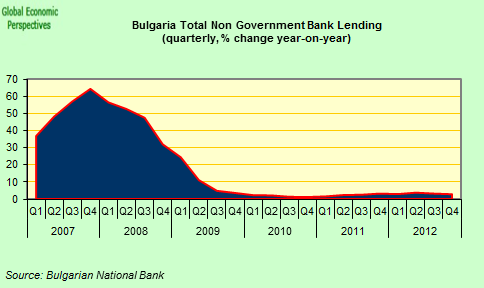
Naturally part of the problem is that the flow of credit has dried up.


But the other part is surely the one Krugman identified in Japan, the growing shortage of Japanese (sorry, Bulgarians). It is hard to see how you can get serious retail sales growth in a population that is shrinking so rapidly. The end result is that the economy grew steadily into the global crisis, and subsequently has stagnated. This stagnation isn't simply conjunctural anymore, it has become structural, as the decline in domestic demand associated with ongoing deleveraging and population ageing and shrinkage precisely offsets the positive impact of all that export growth.


Not everyone is convinced, of course. The IMF expect the Bulgarian economy to return to a rate of growth of between 3% and 4% after 2014, but looking at the demographics and comparing it with what we are seeing elsewhere that seems pretty unrealistic. What is the expression Christine Lagarde would use? "Wishful thinking" perhaps?

In any event, in the short term the country looks set to significantly underperform any such rosy expectations. FocusEconomics Consensus Forecast panellists expect the economy to expand 1.4% this year. In 2014, the panel expects economic growth to reach the impressive rate of 2.4%.

Growing Political Discontent

 Since Bulgaria is a small country, and a poor one to boot, most of the above had been going on virtually unnoticed by the rest of the world. Then last week the Bulgarian government suddenly resigned en bloc. The immediate cause of the crisis which lead to the resignation was  the continuing rise in energy costs, a rise which was largely blamed on the Czech provider CEZ. To appease the street protestors the government has now initiated a procedure to revoke the company's licence, a move which has started to raise concerns about institutional protection in the country.

According to the report in Bloomberg:
Bulgaria’s State Financial Inspection Agency started a probe into CEZ’s Bulgarian units last year and submitted a report on Feb. 8, saying that CEZ ‘‘evaded requirements of the Law for Public Tenders,” the Energy and Economy Ministry in Sofia said on Feb. 18. The ministry asked the authority to conduct a similar investigation into the local units of Austria’s EVN AG and Prague-based Energo-Pro, it said. Bulgaria sold seven power distributors in 2005 to EON SE, CEZ and EVN before joining the European Union. EON sold its Bulgarian companies to Energo-Pro in 2011.
Czech Prime Minister Petr Necas was not slow to respond:
“I regard the statements by Bulgarian officials about CEZ and other foreign companies as very non-standard and see the whole issue as highly politicized because of the approaching parliamentary elections,” Necas said. “I expect Bulgaria, as a member of the European Union, to stick to its international obligations, European law and its own laws on protection of foreign investments.”
Naturally energy prices are not the only issue. The population is tiring of austerity, and living standards that don't rise even as unemployment does.


One symptom of this is that Bulgaria's government sacked Finance Minister Simeon Djankov at the start of last week. Djankov was closely identified with austerity policies, and it isn't hard to read his departure as an attempt to curry favour with voters in elections which are due this summer.

Having said that, the country's government debt at under 14% of GDP is incredibly low, so there is room for flexibility, if it wasn't populist flexibility. The real issue is that simply spending more this year, or next, won't fix the underlying problem, and that problem is unlikely to be addressed until it is recognized as a problem by the institutions responsible for economic policy formulation. As someone once said, de-nile is not only a river in Egypt.

This post first appeared on my Roubini Global Economonitor Blog "Don't Shoot The Messenger".

Postcript

 According to wikipedia: "There's a Hole in My Bucket" (or "...in the Bucket") is a children's song, along the same lines as "Found a Peanut". The song is based on a dialogue about a leaky bucket between two characters, called Henry and Liza. The song describes a deadlock situation: Henry has got a leaky bucket, and Liza tells him to repair it. But to fix the leaky bucket, he needs straw. To cut the straw, he needs a knife. To sharpen the knife, he needs to wet the sharpening stone. To wet the stone, he needs water. However, when Henry asks how to get the water, Liza's answer is "in a bucket". It is implied that only one bucket is available — the leaky one, which, if it could carry water, would not need repairing in the first place.


The origin of this song seems to go back, oddly enough, to the German collection of songs known as the Bergliederbüchlein. Ironically Henry's Q&A with Liza fits the quandry facing the countries on Europe's periphery and their lack of constructive dialogue with their core peers about the roots of their problems to a tee.

Friday, December 30, 2011

A note on ethnic conflict and demographics: the Czech Republic

The population of the Czech Republic is similar to that of most European populations in its broad outlines: long life expectancies, below-replacement fertility rates, more-or-less substantial net immigration, all can be found in the Czech Republic. The most notable distinguishing factor of the Czech Republic's demographics lie in its size, now and in the relatively distant past: the Czech Republic is one of the very few countries in the world with a smaller population now than in 1945.

The population of the Czech Republic reached a peak of nearly 11.2 million in 1940 but fell to a mere 8.8 million in 1947, not as a consequence of an especially high wartime death rate but rather primarily because of the expulsion of the roughly three million Sudeten Germans. The population has since grown to 10.5 million, this growth the product first of post-war natural increase then--despite a recent partial recovery in fertility rates--because of substantial net immigration.

Beginning with post-war internal migrants from Slovakia (Slovaks and Roma alike) to the labour-hungry Czech lands, immigration into the Czech Republic became more globalized with a later wave of Vietnamese immigrants who made use of Communist Czechoslovakia's recruitment of Vietnamese students and guest workers in the 1970s and 1980s, to the Ukrainians who left their country in the 1990s to earn a living in a neighbouring country with a strong labour market and permeable borders. (As an aside, I wonder if the Ukrainian presence in the Czech Republic is at all linked to historical Czech interactions with the Carpathian Ruthenia that was historically almost an eastern extension of Slovakia, specifically with the Zakarpattia Oblast that was actually part of Czechoslovakia from independence until its 1945 cession to the Soviet Union.) Bulgarians, Chinese, Russians, and Mongolians are some of the newer groups to appear in the Czech Republic. As a high-income European country the Czech Republic would already be an attractive destination, but that the cultural links maintained by the Czechs with other Slavic populations in central and eastern Europe and the Communist-era political and military links established with countries such as Vietnam and Mongolia has advantaged the Czech Republic relative to its neighbours. From what I can tell, this immigration has been substantially less politically problematic than in most other European countries.

None of this couldt have been the case without the catastrophic ethnic violence of the 1940s, the Nazis' colonization and brutalization of the Czechs being followed by the expulsion of nearly the entire ethnic German population from the Czech Republic's territory after the Nazi defeat. Ethnic conflict determined the demographics of the Czech Republic.

Let's start with immigration. Over at my blog I note that Czechoslovakia came apart so quickly and peacefully because Czechs and Slovaks weren't particularly close, for good and for ill; mild resentments and a certain romantic nostalgia characterized, and characterize, relations between the two largest ethnic groups in the former Czechoslovakia. Czechs and Slovaks were separate groups, and each had its own discrete territory unthreatened by the other. The same wasn't true for Czechs and Germans in the modern Czech Republic. I've argued at my blog that the expulsion of the Sudeten Germans was only possible because of long-standing Czech fears that German influence could be the death of their nation, whether metaphorically through assimilation or actually through genocidal colonization. After the Second World War, the expulsion of the Sudeten Germans was probably inevitable. In a counterfactual scenario where the expulsion of the Sudeten Germans wasn't nearly so complete, where the border regions of the Czech Republic were bicultural if not outright German-majority, I can imagine immigration being a contentious issue. In Québec, immigration has been controversial because of concerns about the impact of immigrants on the language balance. Would the post-Communist immigration-driven population growth of the Czech Republic been possible otherwise?

The demographic and economic geography of the Czech Republic would also be radically different. Before 1945, the population density of the Czech lands was relatively uniform, with many of the Czech lands' borders--the same borders home to the Sudeten Germans--being superbly industrialized. The expulsions changed this, depopulating the areas once populated by Germans and then repopulating them only partially with migrants from elsewhere in Czechoslovakia, the expulsions additionally undermining once-strong regional economies. The net result was to make population, making wealth and industry concentrate that much more strongly in the centre of the Czech Republic, in Prague and environs, and in turn creating peripheries. Some people have noted that these peripheries, in turn, suffered disproportionately from overindustrialization and pollution, as the regions' unsentimental new residents saw their new home as a space where industrial modernity could operate untrammelled by tradition, as a site for mass production and mass consumption regardless of the human and environmental cost. According to a recent study (PDF format), the regions which saw the strongest divergence from Czech and European Union averages (as measured by GDP per capita, not by household income) were the border regions that formed the core of the former German zone of settlement. This peripheralization, coupled with the only partial repopulation of the Czech republic's peripheries after 1945, could plausibly encourage the continued concentration of Czechs and their wealth in the geographic centre of their country. Could these border regions of the Czech Republic have evolved very differently if not for the replacement of their populations?

In the past at Demography Matters, we've looked at how changing norms of gender, trivial connections formed by flows of guest workers or tourists, political concerns, the different ways in which people form families, similarities of language and culture between different populations, even geographic adjacency have led to demographic change of one kind or another. One thing that I don't think that we've ever before taken a look at is the role of ethnic conflict, culminating in ethnic cleansing and even genocide, in triggering demographic change. Thinking about this, I find it more than a bit disturbing since more than a few of the populations we've taken a look at--in Germany, Poland, East Africa, the former Yugoslavia, of course the Czech Republic--have been very strongly influenced by the long-term consequences of ethnic conflict. This will change in the new year.

Wednesday, July 13, 2011

On African immigration to Latin America

A Deutsche Welle English-language article pointed me to an interesting new phenomenon, that of African immigration with Latin America as a final destination--most notably Argentina, but also Brazil. I first heard about the phenomenon back in 2009, but this largely anecdotal phenomenon seems to be getting more attention of late.

It's rush hour on Avenida Rivadavia in the buzzing, pulsating quarter of Once in Buenos Aires. On the pavement, street vendors have put up small stands every two meters: Earrings, watches and sunglasses are spread out on big shawls on the floor, they pile up in suitcases, or dangle from umbrellas.

"It's cold," says one of the vendors, rubbing his hands. Koaku Bu Date Rodrigue was born in Ivory Coast. The 25-year-old came to Argentina two years ago.

"My country is in a civil war. I was forced to fight in a rebels' group," says Koaku. "One morning I managed to escape. I made my way to San Pedro port and hid in the container room of a ship." Koaku doesn't remember just how long he had to hide for. When the ship stopped moving he was in Argentina.

Every year, hundreds of thousands of Africans leave their home countries. Many want to go to Europe. But the EU has been sealing off its external frontiers.

"I had heard of Europe, but I didn't know how to get there. You need money and you need to know people," says Koaku.

Like Koaku, many Africans are therefore now considering other destinations, such as Latin America. In Argentina, the number of African migrants and refugees has more than doubled since 2005.

The national refugee commission CO NA RE has registered more than 3,000 over the past five years. Illegal immigrants from Africa today make up the second largest group of asylum seekers in Argentina. Most of them come from Senegal or Ivory Coast. Neighbouring Brazil reports similar developments.


Senegal and Côte d'Ivoire, it's worth noting, are arguably the two West African countries most closely integrated with global migration flows. A Reuters article goes into greater detail.

In Brazil, Africans are now the largest refugee group, representing 65 percent of all asylum seekers, according to the Brazil's national committee for refugees.

There are now more than 3,000 African immigrants living in Argentina, up from just a few dozen eight years ago. The number of asylum seekers each year has risen abruptly, to about 1,000 a year, and a third of them are African.

"We're seeing a steep increase in the number of Africans coming to the country and seeking asylum," said Carolina Podesta, of the Argentine office of the U.N. High Commissioner for Refugees.

This is still low compared to the tens of thousands of immigrants who make the journey to Europe each year, but Africans are expected to come to Latin America in increasing numbers.

"It's a search for new destinations," Podesta said, adding that many were being pushed by tougher European immigration and security policies put in place after September 11, 2001.

[. . .] Africans might arrive on cargo ships or commercial planes and then seek asylum or overstay tourist visas. In Argentina, they can obtain temporary work visas shortly after arriving and renew them every three months.

"The migratory policies of the country are very favorable," said Manzanares. "It's a reflection of history. What happened with European immigrants 100 years ago is now happening with African immigrants."


The Democratic Republic of Congo is also a major source of migrants, given the ongoing horrors, while Brazil has been connected with Lusophone Africa--Angola and Mozambique particularly--even since the post-independence migrations.

The accounts of African immigration to Argentina and Brazil emphasize the similarities between this 21st century migration and the migrations from Europe to South America which began in the late 19th century, driven by the search for economic opportunity. (Parallels with the African slave trade that inflicted so much suffering, thankfully, haven't been raised.) The critical difference between these two migrations is that the African migrants number in the thousands, while the Europeans numbered in the millions. This may change--with the increasing difficulty of getting into Europe or even the Maghreb, the relative attractiveness of Argentina and Brazil as immigration destinations, the apparent relative ease of legalization in Argentina, and what may be the beginning of chain-migration networks set up by these first African immigrants, the phenomenon may indeed take on the proportions of the earlier European migration. Certainly it merits watching.

Tuesday, April 12, 2011

On the Portuguese predicament

The title of Barry Hatton's Associated Press article "Europeans seek new lives in old colonies" is a bit misleading. The article doesn't deal with "Europeans" generally, but rather is concerned almost entirely with Spain and Portugal, with passing mention of Greece and Ireland.

Portuguese are packing their bags for booming Angola and Mozambique in Africa, and for emerging economic powerhouse Brazil, where there is a shortage of engineers to prepare the country for the 2014 World Cup and 2016 summer Olympics in Rio de Janeiro. Spaniards are being drawn to their former colonies in Latin America.

While analysts say the true scale of the new migration is still hard to determine because official statistics lag behind trends, anecdotal evidence and fragmentary data point to what's going on.

Portugal's Emigration Observatory says the number of Portuguese registered at consulates in Brazil jumped from 678,822 in 2009 to 705,615 the following year. In Angola, the number went from almost 57,000 in 2008 to just over 74,500 in 2009. The number of Mozambican residence permits granted to Portuguese in 2010, meanwhile, was up almost 13 percent on the previous year, to nearly 12,000.

Spanish electoral registers show around 30,000 Spaniards moved to Argentina between June 2009 and November 2010 — an 11 percent increase over that period. Some 6,400 went to Chile — a jump of 24 percent in the same timeframe — and 6,800 headed for Uruguay, an increase of 16 percent.


Between Spain and Portugal, Hatton implies that the situation in Portugal is much more serious. Before the economic crash, Spain not only enjoyed sustained--if unviable--economic growth and became a very significant net receiver of immigrants. Portugal, in contrast, suffered a lost decade with little economic growth, a consequence of low productivity and underdeveloped human capital, competition from China and post-Communist Europe in low-end manufactures, and a strong Euro that weakened competitiveness.

"The emerging markets are where it's happening, that's where the jobs are," says Jorge Borges, a 35-year-old Portuguese civil engineer.

Disheartened by bleak career prospects in Portugal, whose crippling debt crisis pushed it this week to seek a bailout like Greece and Ireland, Borges crossed the border five years ago and tapped into Spain's building boom.

Then the overleveraged Spanish economy also collapsed, and Borges recently lost his job. Now he wants to move on again, but Europe's wretched economies are not an option — and his online job hunt is targeting vacancies in Brazil and Angola, distant Portuguese-speaking countries.

"The first chance I get, I'm going overseas," Borges said from Zaragoza, Spain, where he is awaiting the call to go abroad.

Brazil in particular is a magnet. The Latin American giant is recruiting foreign civil engineers and architects to meet demand for major public works projects, including more than $200 billion — close to Portugal's annual GDP — in energy infrastructure. Brazil's economy grew 7.5 percent in 2010, the highest growth rate since 1986, and is expected to expand by more than 5 percent a year through 2014.


Angola and Mozambique, too, are absorbing large numbers of Portuguese emigrants. Lusophone countries are hardly the only destinations for Portuguese: large Portuguese communities exist elsewhere, in Canada and the United States, in France and Switzerland and Luxembourg, and now in Germany, the Netherlands, and the United Kingdom. If Portuguese go abroad, they have options. Not so in their homeland.

Portugal's low-voltage economy can't absorb the best-educated generation in its history.

More than 60,000 graduates are idle in their prime. Many more are in low-pay, dead-end jobs.

A recent song by pop group Deolinda set young people's grievances to music and went viral online as it struck a chord with a generation. The song, called "What a fool I am," lists their gripes, including being stuck at home with their parents despite investing years to polish their CVs.

One group of twenty-something graduates turned the music into a battle cry. Through a Facebook page they organized national protest marches last month, and more than 100,000 turned out in a dozen Portuguese cities.

"Not taking advantage of our generation ... is national suicide," says 25-year-old Alexandre Carvalho, one of the organizers.

Carvalho and his co-organizers want to pursue careers in Portugal but, he says, "it's hard to stay. We'll probably end up going abroad."


"Parva que Sou" is a moving song.


The mass emigration is something I commented on back in 2009. The situation has deteriorated further, bad news for the future since a recent Eurostat press release notes that fertility has fallen sharply from 1.44 children per woman in 2003--definitely sub-replacement, but higher than elsewhere in southern Europe--to 1.32. Portugal is fast running out of its existing youth cohorts and isn't going to replace them in the long run.

(As João Peixoto and Catarina Sabino, in their 2009 Real Institut Elcano paper "Immigration, Emigration and Policy Developments in Portugal", observe, the immigrants from the Lusophone world and eastern Europe who came in the 1990s have been leaving for some time. Replacement migration is not an option.)

Saturday, March 12, 2011

On migration and the future of North Africa

The prominence of migrants in--not from, but in--North Africa brought up by Libya is something that's explored, in three related (and two somewhat surprising) contexts, in Julio Godoy's Inter Press Service article "For Migrants, Crisis Worsens Economic Situation At Home". Godoy began the article by making the point that the flight of millions of labour migrants from Libya to the countries where their remittances were supporting families will hurt things badly.

[International Labour Organization economist] Schmidt told IPS that these workers’ exodus from Libya is increasing the social and economic upheaval in their countries of origin.

"For Egypt and other countries, the return of the migrant workers from Libya is fatal," Schmidt explained. "On the one hand, the migrant workers come to increase the number of unemployed youth, already very high. On the other hand, the remittances they were sending back home, and which supported economically their families, are over now."

The ILO estimates that the total remittances from Libya to Egypt, Tunisia, Sudan, Bangladesh and other countries amounted to one billion U.S. dollars per year. About half of this money went to Egypt.

Globally, according to World Bank figures, Egyptian nationals working abroad sent 7.6 billion U.S. dollar to their families at home in 2010.

Schmidt warned that without foreign economic aid and an immediately successful national economic policy, Egypt and Tunisia won’t be able to cope with the return of the migrant workers.

"In Tunisia, unemployment jumped to 17 percent after the migrant workers returned home from Libya, up from 14 percent," Schmidt said. Without immediate economic perspectives, Maghreb youth would again leave the country, most likely to Europe, the ILO expert added.


Uncontroversial, the above. The below, now, is quite controversial.

The Maghreb countries cannot cope with the social and economic consequences of the mass exodus from Libya, warned Robert Holzmann, research director at the Labour Mobility Program of the Marseille Centre for Mediterranean Integration. "In the short term, there won’t be a mass exodus," Holzmann said. "But in the middle term, Europe must prepare for rising immigration from the Maghreb region."

Holzmann, an Austrian national, recalled that after the collapse of the Soviet Union and its Eastern European satellites, workers migrated to Western Europe, regardless of the economic reforms carried out in their countries of origin.

"Something similar is going to happen in the Maghreb countries," Holzmann said. "Even the most auspicious reform policies won’t be good enough to create enough jobs to cope with mass youth unemployment. Therefore, the European Union should launch now a new immigration management policy," Holzmann said.

Europe should not be afraid of the new migration. "History shows that immigration can be a positive factor in the development of societies. Despite the bloody causes of mass exodus, migration can be a source of innovation," said Thomas Straubhaar, director of the Institute for International Economics in Hamburg.


Holzmann oversimplifies things substantially: Slovenia has been a net receiver of immigrants since the 1960s, for instance, while Romania has been consistently an exporter of migrants long predating the Communist era. The different post-Communist countries now in the European Union have followed different trajectories, from the former Hapsburg lands' emergence as net destinations for immigrants to the emergence of Lithuania and Latvia as net exporters of working-age migrants on alarming scales. Expecting there to be continued pressure for migration from the Maghreb to Europe for the next decades does seem plausible, mind, in light of the income and other welfare gaps between the northern and southern shores of the Mediterranean, the intimate human and other links between the two shores, and the need for immigrants in some sectors of European economies. I'd suggest that it isn't so much the plausibility of the migration that Holzmann describes that's debatable so much as the reaction to it.

The final element of migration in the Maghreb that Godoy explores, raised by Holzmann, is perhaps the most unexpected: the emergence of the Maghreb as a destination for immigrants.

One of the many social and economic puzzles of the Maghreb region is that despite high national youth unemployment, hundreds of thousands of immigrants from sub-Saharan African and Asian countries could find jobs there, especially in the construction sector.

"For the local, relatively well-educated youth in Libya, Tunisia, and other countries in the region, jobs in the construction industry were not attractive," Schmidt explained. "For Sudanese or Bangladeshi immigrants, these jobs were the only alternative to feed themselves and their families at home."


Why not? Labour forces are never perfectly mobile within a country, and even within a country with very high unemployment there were be unpopular jobs. Hein de Haas noted in 2005 in his profile of Morocco at MIgration Information that not only were migrants in Morocco coming from outside Africa, but that many were staying. North Africa may be substantially less developed than Europe, but it's substantially more developed than West Africa.

Recently, even migrants from Asian countries, such as India, Pakistan, and Bangladesh, have transited through Morocco via the Saharan route. They are mostly flown in from Asia to West-African capitals. From there, they follow the common Saharan trail via Niger and Algeria to Morocco.

Although most migrants consider Morocco a country of transit, an increasing number of migrants who fail to enter Europe prefer to settle in Morocco on a more long-term basis rather than return to their more unstable and substantially poorer home countries. Probably several tens of thousands have settled in cities like Tangiers, Casablanca, and Rabat on a semi-permanent basis, where they sometimes find jobs in the informal service sector, petty trade, and construction. Others try to pursue studies in Morocco.

Yet sub-Saharan migrants face substantial xenophobia and aggressive Moroccan and particularly Spanish border authorities. Since most of them have no legal status, they are vulnerable to social and economic marginalization.

In September 2005, a Moroccan newspaper compared sub-Saharan African migrants to "black locusts" invading northern Morocco. Frequent round-ups have occurred in immigrant neighborhoods and in improvised ad-hoc camps close to the Spanish enclaves of Ceuta and Melilla and larger cities, and unauthorized migrants are regularly deported to the Algerian border.

There is evidence that a substantial minority of immigrants to Morocco have migrated for reasons that fall under the 1951 Geneva Convention Relating to the Status of Refugees. However, the Moroccan government assumes that virtually all sub-Saharan immigrants in Morocco are "economic migrants" on their way to Europe.

This means asylum seekers are rejected at the border or deported as "illegal economic immigrants" even though Morocco is party to the 1951 Geneva Convention, has a formal system for adjudicating asylum applications, and has an Office of Refugees and Stateless Persons (Bureau des Réfugies et Apatrides - BRA) to assist and protect refugees.


The emergence of Maghreb as a destination for immigrants has been explored in the French-language press, for instance in the algerie-dz.com article "L'Algérie devient une terre d'immigration" ("Algeria becomes a land of immigration") or bladi.net's "Le Maroc face au défi de l’immigration subsaharienne". Suffice it to say that if the rest of the Maghreb is following Morocco in hitting a demographic sweet spot with a peaking proportion of working-age adults, combining it with dynamic jobs-intensive economic growth, the attractiveness of the Maghreb for West Africans will only increase. Central Europe is transitioning from net emigration to net immigration; why not? In his later studies referenced here, de Haas suggested that immigrants are already quite numerous in Maghrebin border communities, for instance in the Algerian Saharan city of Tamanrasset with its links to the Tuareg straddling the North/West African frontier and on trade routes.

Wednesday, February 23, 2011

Joe Sacco, "Not in my country"

A tweet from Torontonian (and Maltese-Canadian) Shawn Micallef pointed me to the news that two Libyan fighter jet pilots defected (with their pilots) Monday, and one Libyan warship following yesterday. This latest episode in Libyan-Maltese relations ads a new twist in relations between the two countries, in the 1970s and 1980s quite close owing to Maltese left-wing politician Dom Mintoff's desire to move beyond dependence on Britain and Libyan interest in establishing a close relationship with some country.

This is the latest episode in unexpected--unregulated--migration from Libya to Malta. I'd like to point our readers to Maltese-American graphic novelist Joe Sacco's 2010 graphic novel "Not in my country", available online at the website of the Guardian and providing an affecting and information look on the phenomenon of unregulated/irregular/illegal migration to Malta.

From Joe Sacco, "Not in my country"

While trans-Mediterranean migration is a major issue for southern Europe, it's a particular issue for a small insular Malta that already has one of the higher population densities in Europe and few ways for these migrants to make it to the European mainland--an Italy that would be the logical (and, likely, preferable) next step is unreachable. Sacco goes into detail in his work.

Go, read.

Tuesday, February 01, 2011

"Vamonos - Voting with their feet in Spain?"

Co-blogger Claus Vistesen has, at his blog Alpha Sources, a post up taking a look at migration in post-crash Spain. It's a well-known fact that Spain, a massive net exporter of population in the 20th century, became in the first decade of the 21st century a famously important destination for immigrants. Claus' conclusion? Despite a disastrous economy, Spain needs to keep its immigrant population.

With the unemployment rate almost surely on the wrong side of 20% you could be excused for arguing what exactly the problem is here [with immigrants leaving.] Surely with this kind of excess capacity in the labour market the last thing Spain needs is for the migrants to stay competing for already incredibly scarce jobs. Indeed, the Spanish government has tried to create incentives for unemployed migrants to leave in order to free up the mismatch between supply and demand for labour.

This approach however does not hold up to basic economic intuition even if it is an understandable move from a political point of view. First of all, there is likely to be a low value added skill bias in the kind of jobs migrants are taking. This is then an often misunderstood point in the context of western societies' attempt to cherry pick the brightest graduates and lure highly skilled foreign labour to the country with lucrative tax breaks. As such, low value added labour (relative to the average level of value added in the receiving country) can provide a crucial labour input to the labour market in the form of filling up vacancies that domestic labor seekers would otherwise shy away from.

Now, you might again protest that in a severe crisis and as desperation among job seekers kick in, the matching for vacancies become subject to a general process of trading down as people accept jobs they are not qualified for simply in order to make ends meet. This is undoubtedly true but this is also the difference between a win-win and lose-lose situation then.

Migrants are ultimately attracted by work opportunities and the sharp decline in migration rates in Spain can be seen as migrants voting with their feet. In this sense, net outward migration of relatively low value added labour only to let domestic workers compete for these same jobs is not a sign of virtue let alone a recovery. I would hold this to be one of the most important structural issues to look out even if the long run effect of an economic crisis on migration is difficult to predict. In addition, and this is evident in Eastern Europe, there may be a strong (and worrying) me too effect from foreign immigrants leaving as it migh even incite Spanish young people to contemplate leaving as well especially as the labour market continues to look dire.


And indeed, the German and Spanish governments recently announced a plan to ease Spanish unemployment by recruiting Spanish professionals to work in Germany, so as to ease labour shortages. Is Spain on its way to becoming a country exporting gastarbeiter?

ARCHITECTS, engineers and other specialist technically-qualified young people from Spain have been clogging up websites offering jobs in Germany with applications ever since chancellor Angela Merkel announced that the country was seeking unemployed Spaniards.

With Spain's unemployment rate at 20.33 per cent--rising to 40 per cent among the under-35s--Merkel is now actively seeking highly-qualified jobseekers from Spain to mop up the deficit in professionals in Germany's employment market.

She intended to make this public at the Spanish-German summit meeting in Madrid on February 3, but already, thousands of jobseekers from Spain are making plans to migrate north.

Preferred industries are engineering, healthcare, education, tourism, and hotel and catering, and applicants must have at least an intermediate level of written and spoken German.


If immigrants to Spain leave in large numbers, and if Spanish citizens with professional skills start leaving in large numbers, given the rapid aging of the Spanish population it's difficult to imagine good things coming about from this. To put it mildly.

Go, read Claus' post.

Monday, December 27, 2010

On Spike Japan

Spike Japan, maintained by Tokyo blogger Richard Hendy, is one of the more interesting blogs out there, certainly among the more original blogs taking a look at the intersection of demographics with economics. Documenting his travels to areas of Japan outside of metropoli like Tokyo in acute essays and well-chosen photos, places that are slowly (or quickly) falling apart owing to a combination of two decades of slow-to-no economic growth and ever accelerating depopulation, Hendy got some international attention via this article from The Guardian written by Chris Michael earlier. How did he start? He describes Spike Japan's genesis in his introductory essay "Down the benjo: The ruin/nation of Japan".

It may come as a shock to almost all of you living outside of Japan, and to some of you living in the center of its big cities, that as we approach the summer of 2009, swathes of the country are in ruins. It came as a shock to me, too, I have to confess, having lived for almost all of the last decade in the bubble of central Tokyo and only venturing outside occasionally to get to the airport, nearby beaches, and old friends in the mountains.

As the financial results came in for Japanese companies for the last quarter of 2008, in late January and early February, they were suggestive of a complete cessation of activity in certain sectors of the economy. My interest in what happened outside of the bubble I live in was only really piqued, though, by a report in the Financial Times that many of the Brazilian emigrants to Oizumi, the town in Japan with the highest percentage of such residents, were ready to pack for Sao Paolo. I went out to investigate and was fascinated and amazed by the combination of immigration, industry, bleakness, and normality. A series of e-mails I had anyway been writing to a friend gained traction from this visit, and developed into a series titled “Down the benjo”; “benjo” is a no longer particularly polite Japanese word for “bog” or “john”. I owe inspiration for the title from a reference early in the year by Willem Buiter, Professor of European Political Economy at the London School of Economics, on his maverecon blog at the Financial Times, to the Icelandic economy having been flushed “down the snyrting”. Much the same, it struck me when I read his post back in January, was happening to the Japanese economy.

The visit to Oizumi led to another, this time to Hitachi, the home of the multinational conglomerate of the same name, which prompted a longer e-mail essay, which in turn prompted a ramble down a recently abandoned railway line less than an hour from Tokyo, which resulted in a 15,000-word essay that took the best part of a month of free time to put together.


Hendy has visited rural areas and small cities, two stand-out travelogues being his extended exploration of the northernmost and most recently settled major island of Hokkaido, and his recent sojourn to the
Amakusa islands off the west coast of Kyushu. Whether in Hokkaido, Amakusa, or elsewhere, the regions of Japan that Hendy visits are all areas located away from its prosperous industrial and urban centres, substantially rural, blighted economically and scenically by Bubble-era constructions, lacking in innovative local enterprises, heavily indebted, and sharing in the general drain of the young to the cities. After the recent financial crisis, the prospects that these regions might receive the investment that might turn things around--making them destinations for retirees, say--are trivial. The dream of a return to the land is ridiculous.

According to the Rural Depopulation Research Association, "There are probably a lot of people who would like to move to the countryside if the conditions were right, (but) it's difficult to see how the number could increase with the present situation. The local communities need to maximize their areas' resources."

The "I-turn" movement (moving from the city to the country) and the "U-turn" movement (people from the country heading to the city, then back again) have been around since the 1980s. However, the things that discourage more young people from moving to the countryside are the same as ever.

"As things are," says Yuzawa. "Even if people want to go back the countryside, often there is nowhere for them to work and nowhere for them to live."

[. . .]

A survey by the Rural Depopulation Research Association in 2000 found that "company work" is the most popular choice for those that have already moved to the countryside. In other words, they avoid the shortage of work by commuting to the city. Relatively few work in the government construction industry, which plays a major part in the rural economy. Other U-turn and I-turn employment ranges from tourism to geriatric care to traditional crafts.

With the help of the help of the organization, local governments try and match jobs to candidates; but the right work isn't always available, and sometimes idealism isn't enough to persuade young people to give up city salaries.

But the Japanese country needs help from somewhere.

In a 2000 survey, more than a third of Japan's municipalities were classified as depopulated more than half Japan's land area. All had lost more than a quarter of their residents since the 1960s.


The thing is, what's happening to rural and marginal Japan is going to happen to urban and core Japan sooner or later. Trend economic growth, as Hendy observes, is inexorably trending downwards towards nothing, as the workforce continues to contract, the dependency ratio tips crazily, productivity stagnates and foreign competition grows and infrastructure ages.

It might just be, however, that despite recent evidence to the contrary, Japan has embarked on a vicious demographic spiral, in which a variety of complex feedback mechanisms set to work: aging results in declining international competitiveness, which results in greater economic hardship at home, which results in a suppressed birthrate; aging results in ballooning fiscal deficits, which in the absence of debt issuance must result in higher taxes or cuts to government spending, which cause economic pain, driving down the birthrate; aging, as the elderly dissave, results in a decline in the pool of domestic savings on which government borrowing is an implied claim, reducing room for fiscal maneuver and resulting in less ability to withstand exogenous shocks; aging further entrenches conservative attitudes to everything from pension reform to immigration, resulting in greater government outlays and smaller government receipts; aging leads the electorate to fear for the future of the pension system, resulting in more saving by the economically active, depressing consumption, which drives manufacturers offshore and raises unemployment, which is strongly correlated with the birthrate.


Japan might be an extreme case, not least because of its lack of immigration--South Korea has become much more of an immmigrant country in a shorter period of time--but it's certainly not the only global economic power out there with lowest-low fertility. There's Germany, say, and certainly the various descriptions of the former East Germany's rapid population aging and shrinkage doesn't sound out of kilter with what Hendy has been writing about and photographing.

Spike Japan is one of those blogs that works on two different levels, as a personal travelogue and as an extended meditation on the existential economic problems of post-growth societies. Visit it for both of these reasons.