Showing posts with label bulgaria. Show all posts

Friday, March 01, 2013

Three notes on historical patterns of migration from Bulgaria


Edward Hugh's essay earlier this week at A Fistful of Euros, "The Shortage of Bulgarians Inside Bulgaria", got a non-trivial amount of attention, including linkage by Marginal Revolution's Tyler Cowen. (See also Economonitor which mirrors the post though not the comments, and, of course, here at Demography Matters.) Within the European Union, Bulgaria really does constitute an exceptional case: among the poorest European Union member-states, with one of the lowest fertility rates of any European Union member-state, and with some of the highest rates of emigration, Bulgaria is quite likely because of its rapidly shrinking population to experience the serious economic and other problems other countries are likely to experience in the near future. The country's population has fallen by a sixth from its peak in 1985, in fact.

Bulgaria has lost 582,000 people over the last ten years, a nationwide census has revealed. The EU newcomer, who has now 7,351,633 inhabitants, has lost 1.5 million of its population since 1985, a record in depopulation not just for the EU, but by global standards too.

Bulgaria, which had a population of almost nine million in 1985, now has almost the same number of inhabitants as in 1945 after World war II, the Bulgarian media writes.

The census also found that the Bulgarian population is ageing fast, that the number of young people is declining and that villages are becoming depopulated as big cities grow.

People of more than 65 years of age in 2001 constituted 16.8% of the population, while this year their rate has grown to 18.9%. At the same time, the number of children has declined, which is a clear sign that ever fewer employed people will have to provide for a growing number of elderly people[.]


Bulgaria of some interest to me in that it's a new country, in many respects newer than my Canada. Yes, Bulgarians have lived in Bulgaria for centuries without any experience of historical discontinuity as severe as that experienced by Canada, which has been almost completely repopulated by Old World migrants. Still, the Bulgarian state is a young entity: the Principality of Bulgaria was established by the Great Powers in 1878; Bulgaria was unified with adjacent and autonomous Eastern Rumelia in 1885; Bulgaria declared its independence from the Ottoman Empire in 1908; Bulgaria's current borders were only definitively settled in 1946 as the Cold War began. As much as Bulgaria is a modern European nation-state now, its history--including its migration history--bears the marks of its recent past.

1. Let's start with the migration patterns of Bulgaria's Turks and Muslims.

Bulgaria Census Chart (1880-1910)


Taken from here, this chart shows basic census results by ethnicity between 1880 and 1910 in Bulgaria. Noteworthy is the near-doubling of the Bulgarian population over this timeframe while the Turkish population falls by a third. The Turkish population of Bulgaria may have fallen further, in fact: one estimate in the Wikipedia article on Turks in Bulgaria claims that in the Danube Vilayet, which occupied most of northern Bulgaria along with parts of what are now coastal Romania, Christians of all ethnicities formed barely half of a population of almost 2.4 million people. The high proportion of Muslims in mid-19th century Bulgaria makes sense if you think of Bulgaria not as a peripheral European nation, but as a collection of provinces which formed part of the core of the Ottoman Empire, in the hinterland of the capital, even.

Muslims in Bulgaria, like Muslims elsewhere in the independent states emerging from the Ottoman Empire in the Balkans, and in the lands conquered by the Russian Empire in the Caucasus, were generally unwelcome presences in these newly Christian lands. As detailed by--for instance--Berna Pekesen in the essay "Expulsion and Emigration of the Muslims from the Balkans", Muslims of all backgrounds--people of indigenous Balkan background like Slavs and Albanians, members of Turkic groups, and peoples of the Caucasus like the Circassians--were subjected to what would be called ethnic cleansing. Millions of muhajir ended up settling in the Turkish core of the Ottoman Empire, starting off that country's modern tradition of immigration. (Various estimates claim that a high proportion of Turks, some up to one-third, are descended from these refugees.) In Bulgaria's case, Pomaks--people of Bulgarian language but Muslim religion--were separated from the Turkish population by various governments, which hoped to assimilate the Pomaks into a Bulgarian ethnic identity.

Bulgaria kept a larger Turkish and Muslim population that many other Balkan countries, but towards the end of the Communist period a variety of violent policies mandating the assimilation of all Muslims, including forced renamings and closing down specifically Muslim facilities, culminating in the May 1989 expulsion of most Bulgarian Turks from their country of birth into adjacent Turkey. The terrible international reaction and the economic consequences of the mass expulsion helped bring down the Communist government and fairly quick restitution made to the Turks (and Pomaks) as part of the democratization process. Today, Turks and Muslims in Bulgaria seem--some concerns aside--to be well-integrated in their homeland as respected players, with their political party, the Movement for Rights and Freedoms, being a major political player. Even so, perhaps a third of the million people claiming an identity as Bulgarian Turks currently live in Turkey, a country where they have put down roots. The Bulgarian emigrant community in Turkey, in fact, is the largest community of Bulgarian emigrants, the half-million Bulgarians in Turkey outnumbering registered Bulgarian emigrants in the rest of the European Union combined.

2. Bulgaria's borders are not what many had hoped.

Bulgaria according to the Treaty of San Stefano (1878)


Initially in 1878 Bulgaria under Russian sponsorship would have been a large country indeed, including within its borders not only modern Bulgaria but almost all of the historical region of Macedonia. The negative reaction of other powers to such a large Bulgaria, seen as a Russian pawn threatening Constantinople and the Straits, led to the creation of a smaller Bulgaria. Despite fighting numerous wars at great cost with the aim of gaining these territories, Bulgaria never did manage to gain more than a small piece of Macedonia. After multiple ethnic cleansings all around which saw the deportal of most of the region's Muslims to Turkey and the eventual expulsion and forced assimilation of most Slavs in an Aegean Macedonia that received many of the Greeks expelled from Turkey in 1922, and the creation in Tito's Yugoslavia of a Macedonian national identity separate from the Bulgarian, Bulgaria was left with only a portion of eastern Macedonia. As for Bulgarian communities scattered further afield, whether in neighbouring Balkan countries or in old immigrant communities on the northern shore of the Black Sea (Moldova, Ukraine, Russia), they were left out of the Bulgarian national project.

After 1989 and the collapse of Yugoslavia, Bulgarian citizenship laws were slowly transformed so as to give people claiming an identity as ethnic Bulgarians, including those living in countries immediately adjoining Bulgaria as well as those living in the Black Sea diaspora. This was merely the most prominent part of a policy of outreach to these diasporids that includes gifts of school books in Serbia or vice-presidential visits in Ukraine. As noted by Marko Žilović in an essay at the website Citizenship in Southeastern Europe, citizenship in Bulgaria--a country on track to join the European Union, no less--could be a potent economic advantage.

On a usual working day in the village of Ivanovo in Serbia there are three cars with Bulgarian license plates parked in front of the small elementary school. This is not because a delegation from Bulgaria is visiting this village of little more than 1000 inhabitants. Importing used cars licensed in Bulgaria was a well-known scheme to circumvent restrictive Serbian regulations that protect the Zastava company, the only domestic car producer. The scheme worked best if the buyer had a Bulgarian passport. It is thus no coincidence that several cars with Bulgarian license plates found their way into the Ivanovo, for it is one of the few places where fleeing Roman Catholic Slavs from northern Bulgaria settled in the 18th century. Today, about a fifth of Ivanovo’s population declare themselves ethnic Bulgarians, though probably only a handful of them have obtained Bulgarian passports. However, among the owners of the Bulgarian-licensed cars, and passports, is also a local math teacher who declares himself an ethnic Serb. He tells of having some ethnic Romanians in his family tree a few generations ago, but no Bulgarian connections whatsoever.


By far the biggest number of people claiming Bulgarian ethnic identity to get Bulgarian citizenship are from Macedonia. While Bulgaria recognizes Macedonian independence, it does not recognize the separate existence of a Macedonian nationality, leaving open the possibility for Macedonian Slavs--of which there are 1.2 million in the former Yugoslav republic--to declare themselves Bulgarians. Given Macedonia's likely continued exclusion from the European Union owing to the name dispute with Greece and an emergent history dispute with Bulgaria, claiming a Bulgarian ethnic identity makes sense. Joanne van Selm's June 2007 profile of Macedona notes this.

It goes without saying that this is exceptionally controversial in Macedonia.

The Bulgarian case is fairly represented in Milena Hristova's February 2010 article for the Sofia News Agency, "Bulgarian Passports for Macedonians: Debunking Myths".
Macedonians strive to obtain Bulgarian citizenship for a number of reasons – to migrate to Bulgaria, to travel and work freely across the European Union and also due to the faith in the protection that the Bulgarian state can give them. “I would risk saying that this emotional factor is the most important and most often cited reason,” says Mandzhukova. She vehemently denies that the real motives are more pragmatic. “To say that Macedonians obtain Bulgarian citizenship as a passport to Europe is a stereotype that gives a very distorted reflection of the truth,” she says. According to her the influx of Macedonians to Bulgaria did not increase significantly after the country's accession to the European Union on January 1, 2007. “The first signs f the hype came much earlier when Bulgarian institutions agreed that the document our agency issues is enough to claim Bulgarian origin. This is when the real increase in applications came due to the streamlining of the process.” While in Macedonia many Macedonians try to cover the fact that they have signed such a declaration. “Well, certainly nobody will shout it at the top of his lungs. But first of all if someone considers what the Macedonian authorities think important, he would not sign the declaration in the first place, “ Mandzhukova says.

(A April 2012 essay by the Sofia News Agency argues the Bulgaria gives Bulgarian nationality to many fewer Macedonians than Romania gives Romanian nationality to many fewer Moldovans, and is more moderate.)

The Macedonian International News Agency, meanwhile, doesn't address directly the denial of Macedonian nationhood, instead challenging via articles like "Bulgarian citizen: Should my wife become Macedonian to get Bulgarian Passport?" (published earlier this month) the justice of a citizenship policy that makes it difficult for long-time residents to naturalize.

"Practically none of the Macedonans who have obtained a Bulgarian passport lives in Bulgaria. A large majority of them obtain the passport so they can work in EU countries. My wife on the other hand lives in Bulgaria for 11 years, speaks perfect Bulgarian, pays taxes, however is unable to obtain a citizenship" explains Bulgarian citizen Stefan Rusenov in an interview with Dnevnik.

In Bulgaria, you need to be a Macedonian so you can obtain a Bulgarian citizenship or passport overnight.

Macedonians in Bulgaria don't speak Bulgarian, they don't pay taxes here, but when it comes to obtaining our citizenship, they do it in record time, within a year - says Stefan Rusenov whose wife is from the Ukraine and is unable to obtain Bulgarian citizenship for years. According to Bulgarian laws, she would need to give up her Ukrainian passport to become citizen of Bulgaria.

- Instead of receiving a response in a year, we got our response in three years - that my wife can obtain a citizenship in three years, but, the condition was she must give up her Ukrainian citizenship. Then more problems. From the Ukrainian Embassy we were told she must register to fulfill her request of giving up her Ukrainian citizenship (which lasts 8 months), and only after that she can submit her request to give up her Ukrainian passport - explains Rusenov in frustrating fashion.


3. Bulgaria has long been a European periphery.

GDP per capita and Human Development Index in European countries, 1870 and 1913
Taken here, from the online version of the second volume of the Cambridge Economic History of Europe by Broadberry and O'Rourke, this draws upon the historical statistics of Arthur Maddison to come up with a ranking of European countries by economic and human development in the belle époque. Of note is the fact that Bulgaria's relative underdevelopment is a fact of long-standing, one that isn't a relatively recent artifact of Communism as in central Europe. Although income and development gaps have narrowed in the subsequent century, they are still quite large. Attempts at enforcing an agricultural specialization via Comecon's doctrine of an "International Socialist Division of Labour" never were very successful, but neither was (for instance) the attempt to develop a computer industry in the 1980s (that led, mainly, to computer viruses). The catastrophic breakup of the former Yugoslavia further hit Bulgaria. Bulgaria, now in 2013 as in 1913, is one of the poorest countries in Europe.

There is an abundant literature about migration from post-Communist Bulgaria, for instance the Open Society Bulgaria 2005 report "Bulgarian Migration: Incentives and Constellations", a 2013 fact sheet from the same organization "Is There A Threat of Bulgarian Migration to the UK?" (quick answer: no), Fatma Usheva's 2011 thesis "Emigration from Bulgaria: 1989 - Today", or Eugenia Markova's 2010 report for the Hellenic Observatory, "Effects of Migration on Sending Countries: Lessons from Bulgaria". Suffice it to say that after the end of the Soviet Union, Bulgarian migrants went first to adjacent and relatively prosperous Greece, then starting to move in large numbers to Spain in the late 1990s, with Germany recently emerging as a destination of choice. Bulgarian migrants went to places where they could find jobs easily, often in the informal sector, usually in countries that were relatively close to their homeland. Bulgarian foreign minister Nikolay Mladenov was quite right to tell The Telegraph that Bulgarians are not especially likely to move to the United Kingdom in large numbers.

These three patterns of migration, driven by ethnic identity and relative underdevelopment, seem likely to endure. The odds of Bulgaria transforming sufficiently to not be a relatively poor country with low fertility and very high rates of emigration are not, as Edward noted, high at all. Individual Bulgarians have every incentive to continue to leave their country, and with Bulgaria's full integration into the European Union's single market in labour, very few institutional barriers. It's also fair to wonder whether Turkey, just next door with relatively strong economic growth and a recent history of receiving large numbers of Bulgarian migrants, might also emerge as a destination for Bulgarians regardless of whether Turkey joins the European Union or not. Inasmuch as Macedonia, and the adjacent countries with large Bulgarian communities (Serbia, Moldova, Ukraine)

Wednesday, February 27, 2013

The Shortgage of Bulgarians Inside Bulgaria

Oh, there's a hole in my bucket, dear Liza, a hole......

Wenn der Beltz em Loch hat -
stop es zu meine liebe Liese
Womit soll ich es zustopfen -
mit Stroh, meine liebe Liese

According to Angela Merkel, speaking in the German city of Mainz in mid February,  European countries struggling with the fallout of the euro-area debt crisis have much to learn from East Germany’s experience with economic overhaul following the fall of the Berlin Wall. In the main she was speaking about the need for reform, something on which we can all agree. “At the beginning of the 21st century", she said, "Germany was the sick man of Europe and that we are where we are today also has to do with reforms we carried out in the past. That’s why we can say in Europe that change can lead to good.”

But there was one tiny little detail she forgot to mention. During the post unification period East Germany's population went into melt-down mode. New York Times Columnist Nicholas Kulish put it like this:
Unemployment in the former East Germany remains double what it is in the west, and in some regions the number of women between the ages of 20 and 30 has dropped by more than 30 percent. In all, roughly 1.7 million people have left the former East Germany since the fall of the Berlin Wall, around 12 percent of the population, a continuing process even in the few years before the economic crisis began to bite.

And the population decline is about to get much worse, as a result of a demographic time bomb known by the innocuous-sounding name “the kink,” which followed the end of Communism. The birth rate collapsed in the former East Germany in those early, uncertain years so completely that the drop is comparable only to times of war, according to Reiner Klingholz, director of the Berlin Institute for Population and Development. “For a number of years East Germans just stopped having children,” Dr. Klingholz said.

The newspaper Frankfurter Allgemeine Zeitung reported recently that although 14,000 young people would earn their high school diplomas this year in Saxony, only 7,500 would do so next year. Since 1989, about 2,000 schools have closed across the former East Germany because of a scarcity of children.
Now this situation is quite serious, and needs a long term solution, but it is not as serious as what is currently happening to Latvia, or Bulgaria, or a number of the other former communist states. Unless, of course, the lesson Angela would like to draw our attention to is that East Germany managed to salvage something from what would otherwise be population wreckage by sneaking in under the shelter of another state, with a centralized system of support for pensions and health care. Somehow I doubt it, but perhaps this is what we need to think more about. The EU needs a pan European health and pension system, to distribute the burden equitably. This is the conclusion I reached during my last visit to Riga. It isn't just a Euro related issue, it is to do with having a unified labour market, with people able to move to where the jobs exist, and the pay is better. For years people complained about the absence of labour mobility in the EU. Now we have it, the flaw in the institutional infrastructure is obvious.

Young people are moving from the weak economies on the periphery to the comparatively stronger ones in the core, or out of an ever older EU altogether. This has the simple consequence that the deficit issues in the core are reduced, while those on the periphery only get worse as health and pension systems become ever less affordable. Meanwhile, more and more young people follow the lead of Gerard Depardieu and look for somewhere where there isn't such a high fiscal burden, preferably where the elderly dependency ratio isn't shooting up so fast.

I am sufficiently concerned about this issue, which I think ultimately endangers possibilities of economic recovery all along the periphery, to have created a dedicated facebook page, campaigning for one single issue - that the EU Commission and the IMF give a greater priority to trying to measure these flows, and understand their consequences. I am simply asking that they pressure EU member states to improve their statistics gathering, treat the issue as a priority, and identify an indicator to incorporate in the Macroeconomic Imbalance Procedure (MIP) Scoreboard. Really it doesn't matter whether you are in favour of austerity, or against it, feel more Keynesian than Austrian, or vice verse, all I am asking for is that this problem be taken more seriously, measured and studied.

Bulgaria The Classic Case?

Really there has been a before and after to the financial crisis, at least insofar as awareness of the demographic dimension is concerned. Really, before the onset of the crisis very few people really attached much importance to the question. Since the arrival of the European sovereign debt crisis, and the fiscal cliff debate in the United States, awareness has grown that population ageing probably will slow economic growth, and that previous expectations about levels of pension and health care provision may have been way too optimistic. The latest example of this has been Nobel Laureate Paul's Krugman's comments on how Japan's demographics may be influencing its growth rate. In a tellingly graphic expression he explains that the root of Japan's ailment might be that the country is suffering from a growing "shortage of Japanese".

Once you realise that population shortage may be a problem in Japan, you start  wondering where else it might be one. And then, once you begin to look you start seeing the issue springing up like mushrooms all over the place. In Bulgaria for example.

According to the 2011 census, Bulgaria has lost no less than 582,000 people over the last ten years. In a country of 7.3 million inhabitants this is a big deal. Further, it has lost a total of 1.5 million of its population since 1985, a record in depopulation not just for the EU, but also by global standards. The country, which had a population of almost nine million in 1985, now has almost the same number of inhabitants as in 1945 after World war II. And, of course, the decline continues.


As well as shrinking the population is ageing. In 2001 16.8% of the population were over 65. Just 10 years later the equivalent figure had risen  to 18.9%. Naturally this means the median population age is rising steadily. It is precisely part of my argument that this surge in median age over 40 has important consequences for saving and borrowing patterns at the aggregate level, patterns which have not yet been adequately measured and identified. Thus the macroeconomic dynamics of a country change. The impact of these changes has not yet been incorporated into the traditional models most analysts use in forecasting.


 Naturally the workforce itself is in rapid decline.


The causes of Bulgaria's rapid ageing and shrinking population problem are twofold, low fertility and emigration. This is what makes the country look more like the old DDR and less like Japan. In fact Bulgaria's situation is an extreme case of what is happening in many East European countries, especially Romania and the Baltics. If you want another reference point, Ukraine would be in this group, but even worse, since it is even outside the EU. 


Details of migrant numbers are scarce, and at best hedgy. The data we have is surely a significant underestimate, as the OECD pointed out in its latest country migration report:
Figures on declared emigration show an increase from 19 000 in 2009 to 27 700 in 2010. However, actual outflows are considered to be much greater, based on immigration statistics of th e main destination countries. Spain, the most important destination country in recent years, recorded 10 400 Bulgarians entering in 2010, 7% more than in 2009. Outflows of Bulgarian citizens from Spain also increased in 2010, to 7 600 from almost 5 000 in the previous year (+52%). The number of Bulgarians in Spain increased by 14 500 in 2010, and a further 13 000 in 2011. There are no consistent data for Greece, the second main destination of Bulgarian immigrants in recent years, but it seems that the stock increased less in 2010 than in previous years. 

Remittances data gathered by the World Bank give the general picture. Basically there was a large surge following the severe crisis of the late 1990s, and since that time the level of payments has only weakened slightly, on the back of the severity of the crisis in the main destination countries.


Bulgaria is also pretty much what the old DDR would look like if it hadn't fused with Western Germany, namely it much more similar to Hungary than it is to Japan (in the sense I discussed in this post) as it has a significant negative balance on the net international investment position (though not as large as Hungary's), which means as well as being quite poor it is totally unprepared for rapid population ageing (since the text book way to sustain pension and health benefits in a context of increasingly weaker headling GDP growth is normally thought to be to draw down on overseas assets).


Bulgaria  also bears comparison with Hungary for the way it has carried out a rapid correction on its external position. This is due largely to remittances and services exports, since the goods balance is still in deficit. But still, the turnround is impressive.

As elsewhere exports have performed very strongly.


But again to no real avail, since domestic demand is deflating so strongly that the economy struggles to find air...... and growth. In this sense it is hard to agree with the IMF Executive Directors when they state in their latest Public Information Notice, following conclusion of the Fund's 2012 Article IV consultation,  they "broadly agreed that the currency board arrangement has served Bulgaria well". If allowing a country to drift towards long term melt-down is doing well, I would hate to see what something which they thought was an impediment would do! Some thing is rotten in the state of Denmark, and that something isn't being identified or dealt with.


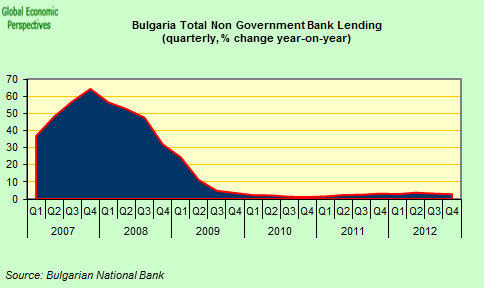
Naturally part of the problem is that the flow of credit has dried up.


But the other part is surely the one Krugman identified in Japan, the growing shortage of Japanese (sorry, Bulgarians). It is hard to see how you can get serious retail sales growth in a population that is shrinking so rapidly. The end result is that the economy grew steadily into the global crisis, and subsequently has stagnated. This stagnation isn't simply conjunctural anymore, it has become structural, as the decline in domestic demand associated with ongoing deleveraging and population ageing and shrinkage precisely offsets the positive impact of all that export growth.


Not everyone is convinced, of course. The IMF expect the Bulgarian economy to return to a rate of growth of between 3% and 4% after 2014, but looking at the demographics and comparing it with what we are seeing elsewhere that seems pretty unrealistic. What is the expression Christine Lagarde would use? "Wishful thinking" perhaps?

In any event, in the short term the country looks set to significantly underperform any such rosy expectations. FocusEconomics Consensus Forecast panellists expect the economy to expand 1.4% this year. In 2014, the panel expects economic growth to reach the impressive rate of 2.4%.

Growing Political Discontent

 Since Bulgaria is a small country, and a poor one to boot, most of the above had been going on virtually unnoticed by the rest of the world. Then last week the Bulgarian government suddenly resigned en bloc. The immediate cause of the crisis which lead to the resignation was  the continuing rise in energy costs, a rise which was largely blamed on the Czech provider CEZ. To appease the street protestors the government has now initiated a procedure to revoke the company's licence, a move which has started to raise concerns about institutional protection in the country.

According to the report in Bloomberg:
Bulgaria’s State Financial Inspection Agency started a probe into CEZ’s Bulgarian units last year and submitted a report on Feb. 8, saying that CEZ ‘‘evaded requirements of the Law for Public Tenders,” the Energy and Economy Ministry in Sofia said on Feb. 18. The ministry asked the authority to conduct a similar investigation into the local units of Austria’s EVN AG and Prague-based Energo-Pro, it said. Bulgaria sold seven power distributors in 2005 to EON SE, CEZ and EVN before joining the European Union. EON sold its Bulgarian companies to Energo-Pro in 2011.
Czech Prime Minister Petr Necas was not slow to respond:
“I regard the statements by Bulgarian officials about CEZ and other foreign companies as very non-standard and see the whole issue as highly politicized because of the approaching parliamentary elections,” Necas said. “I expect Bulgaria, as a member of the European Union, to stick to its international obligations, European law and its own laws on protection of foreign investments.”
Naturally energy prices are not the only issue. The population is tiring of austerity, and living standards that don't rise even as unemployment does.


One symptom of this is that Bulgaria's government sacked Finance Minister Simeon Djankov at the start of last week. Djankov was closely identified with austerity policies, and it isn't hard to read his departure as an attempt to curry favour with voters in elections which are due this summer.

Having said that, the country's government debt at under 14% of GDP is incredibly low, so there is room for flexibility, if it wasn't populist flexibility. The real issue is that simply spending more this year, or next, won't fix the underlying problem, and that problem is unlikely to be addressed until it is recognized as a problem by the institutions responsible for economic policy formulation. As someone once said, de-nile is not only a river in Egypt.

This post first appeared on my Roubini Global Economonitor Blog "Don't Shoot The Messenger".

Postcript

 According to wikipedia: "There's a Hole in My Bucket" (or "...in the Bucket") is a children's song, along the same lines as "Found a Peanut". The song is based on a dialogue about a leaky bucket between two characters, called Henry and Liza. The song describes a deadlock situation: Henry has got a leaky bucket, and Liza tells him to repair it. But to fix the leaky bucket, he needs straw. To cut the straw, he needs a knife. To sharpen the knife, he needs to wet the sharpening stone. To wet the stone, he needs water. However, when Henry asks how to get the water, Liza's answer is "in a bucket". It is implied that only one bucket is available — the leaky one, which, if it could carry water, would not need repairing in the first place.


The origin of this song seems to go back, oddly enough, to the German collection of songs known as the Bergliederbüchlein. Ironically Henry's Q&A with Liza fits the quandry facing the countries on Europe's periphery and their lack of constructive dialogue with their core peers about the roots of their problems to a tee.