Showing posts with label statistics. Show all posts

Sunday, January 27, 2019

Some links from the blogosphere


As a prelude to more substantial posting, I thought I would share with readers some demographics-related links from my readings in the blogosphere.
  • The blog Far Outliers, concentrating on the author's readings, has been looking at China in recent weeks. Migrations have featured prominently, whether in exploring the history of Russian migration to the Chinese northeast, looking at the Korean enclave of Yanbian that is now a source and destination for migrants, and looking at how Tai-speakers in Yunnan maintain links with Southeast Asia through religion. The history of Chinese migration within China also needs to be understood.
  • Lawyers, Guns and Money was quite right to argue that much of the responsibility for Central Americans' migration to the United States has to be laid at the foot of an American foreign policy that has caused great harm to Central America. Aaron Bastani at the London Review of Books' Blog makes similar arguments regarding emigration from Iran under sanctions.
  • Marginal Revolution has touched on demographics, looking at the possibility for further fertility decline in the United States and noting how the very variable definitions of urbanization in different states of India as well as nationally can understate urbanization badly.

Sunday, February 12, 2017

Hans Rosling, in memoriam


I was shocked and saddened to learn of the death earlier this week of Gapminder's Hans Rosling. 68 was too young for anyone, certainly too young for someone so dedicated to helping the world know itself through the truth. Scott Gilmore's article in MacLean's is one I recommend.


From Davos, to the White House, to the offices of the World Bank, Rosling could be found tirelessly preaching the gospel of facts, data, and truth. For generations, aid and charity decisions were taken for reasons of vanity, simplicity or self-interest. Billionaires gave money in ways that would grant them the most publicity. Bureaucrats channelled aid dollars to projects that were the easiest to administer. And western governments built dams in Africa solely to help their own construction companies. The real impact of aid on poverty was rarely considered and almost never measured. Rosling helped change that, by explaining to donors that ignorance is the first battle that must be fought in the war against extreme poverty.

This idea, as obvious as it seems in hindsight, was new. And it mattered. Governments listened. Donors became converts to Rosling’s religion of evidence-based policy. He was not its only apostle, but he was among its most well-known, and the only one with millions of views on Youtube.

Ironically, Rosling had a much more critical assessment of his own influence on the world. He called himself an “edutainer”, and in a 2013 interview he bemoaned the fact that the average Swede still overestimated the birth rate in Bangladesh: “they still think it’s four to five.”

“I have no impact on knowledge,” he said. “I have only had impact on fame, and doing funny things, and so on.”

The deputy prime minister of Sweden, Isabella Lövin, disagreed. After Rosling’s death was announced, she wrote: “He challenged the whole world’s view of development with his amazing teaching skills. He managed to show everyone that things are moving forward … I think the whole world will miss his vision and his way of standing up for the facts—unfortunately it feels like they are necessary more than ever at the moment.”


What can I say but that I wish that his vision be continued?

Sunday, January 01, 2017

On Max Roser's A history of global living conditions in 5 charts and the future


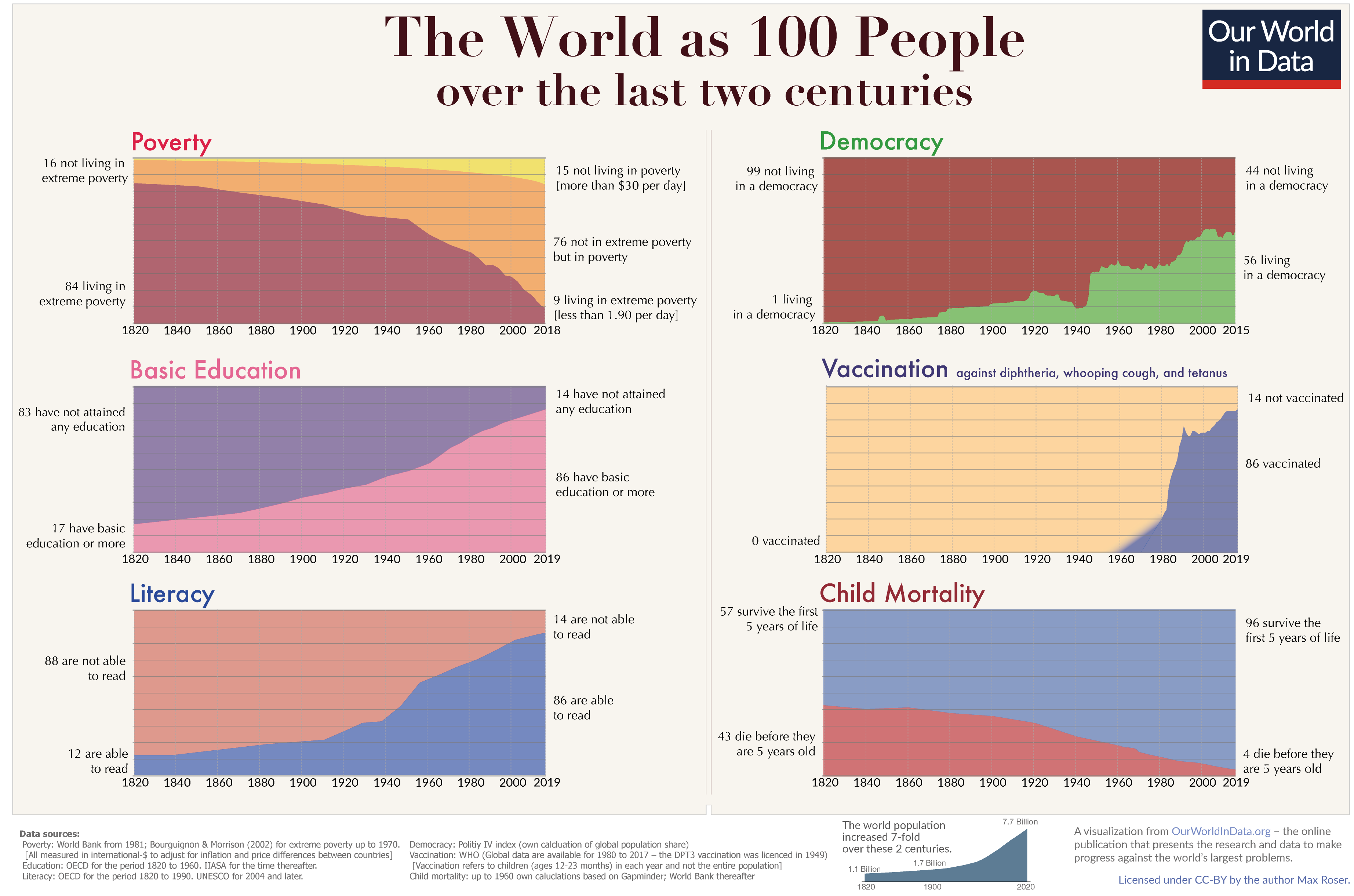
Some days ago, I saw shared on Facebook an essay, Max Roser's "A history of global living conditions in 5 charts" at the Our World in Data project. In this essay, Roser makes the argument--contrary to the zeigeist of 2016--that, in fact, in the longue durée things have been getting decidedly better for people. Extreme poverty and premature mortality have faded, rates of literacy and education have risen, and both living standards and levels of political freedom have increased hugely. (Fertility rates, Roser has noticed, have fallen markedly worldwide as a result of these trends' conjunction.) Towards the end of this, Roser created a chart exploring just how radically things have changed.


The shift has been marked. Back in December 2010, I wrote about the demographic dynamics of the Roman Empire and other pre-modern polities, noting after Vaclav Smil that there are no modern equivalents to the terrible suffering of the past anywhere on our world now. Even central Africa, probably the least developed area of the world, is better off. More, as Roser notes, the dynamics to date are positive: rates of premature mortality and undereducation are falling, for instance.

Why is there unfounded pessimism about the world's future prospects? Roser suggests that the answer can be found in our failure to adequately understand the significance of long-running trends.

One reason why the media focusses on things that go wrong is that the media focusses on single events and single events are often bad – look at the news: plane crashes, terrorism attacks, natural disasters, election outcomes that we are not happy with. Positive developments on the other hand often happen very slowly and never make the headlines in the event-obsessed media.

The result of a media – and education system – that fails to present quantitative information on long-run developments is that the huge majority of people is completely ignorant about global development. Even the decline of global extreme poverty – by any standard one of the most important developments in our lifetime – is only known by a small fraction of the population of the UK (10%) or the US (5%). In both country’s the majority of people think that the share living in extreme poverty has increased. Two thirds in the US even think the share in extreme poverty has ‘almost doubled’. When we are ignorant about global development it is not surprising that few think that the world is getting better.

The only way to tell a history of everyone is to use statistics, only then can we hope to get an overview over the lives of the 22 billion people that lived in the last 200 years. The developments that these statistics reveal transform our global living conditions – slowly but steadily. They are reported in this online publication – Our World in Data – that my team and I have been building over the last years. We see it as a resource to show these long-term developments and thereby complement the information in the news that focus on events.

The difficulty for telling the history of how everyone’s lives changed over the last 200 years is that you cannot pick single stories. Stories about individual people are much more engaging – our minds like these stories – but they cannot be representative for how the world has changed. To achieve a representation of how the world has changed at large you have to tell many, many stories all at once; and that is statistics.


Individual stories matter, but statistical trends like these also merited tracking. Let's try to do them both this coming year, here at Demography Matters and elsewhere.

Monday, December 19, 2016

Nature's Amy MaxMen on the achievements of Gapminder's Hans Rosling


In January 2011 and June 2013, I linked to two videos by Swedish statistician and popularizer Hans Rosling demonstrating different demographic trends. Today, via 3 Quarks Daily, I came across Amy Maxmen's excellent long-format article on Rosling and his accomplishments, "Three minutes with Hans Rosling will change your mind about the world". It does a great job of explaining just what Rosling, and his Gapminder Foundatin, are trying to achieve, and why.

Back in Sweden, Rosling continued to teach global health, moving to the Karolinska Institute in Stockholm in 1996. But he came to realize that neither his students nor his colleagues grasped extreme poverty. They pictured the poor as almost everyone in the ‘developing world’: an arbitrarily defined territory that includes nations as economically diverse as Sierra Leone, Argentina, China and Afghanistan. They thought it was all large family sizes and low life expectancies: only the poorest and most conflict-ridden countries served as their reference point. “They just make it about us and them; the West and the rest,” Rosling says. How could anyone hope to solve problems if they didn’t understand the different challenges faced, for example, by Congolese subsistence farmers far from paved roads and Brazilian street vendors in urban favelas? “Scientists want to do good, but the problem is that they don’t understand the world,” Rosling says.

Ola, his son, offered to help explain the world with graphics, and built his father software that animated data compiled by the UN and the World Bank. Visual aids in hand, the elder Rosling began to script the provocative presentations that have made him famous. In one, a graph shows the distribution of incomes in 1975 — a camel’s back, with rich countries and poor countries forming two humps. Then he presses ‘go’ and China, India, Latin America and the Middle East drift forward over time. Africa moves ahead too, but not nearly as much as the others. Rosling says, “The camel dies and we have a dromedary world with one hump only!” He adds, “The per cent in poverty has decreased — still it’s appalling that so many remain in extreme poverty.”

Rosling’s online presentations grew popular, and the investment bank Goldman Sachs invited him to speak at client events. His message seemed to support advice from the firm’s chief economist, Jim O’Neill. In 2001, O’Neill had coined the acronym BRIC for the emerging economies of Brazil, Russia, India and China, often considered part of the developing world. He warned that financial experts ignored these rising powers at their peril. “I used to tease my colleagues who thought in a traditional framework,” O’Neill says. “Why are we talking about China as the developing world? Based on the rate of economic growth, China creates another Greece every three months; another UK every two years.”

Rosling welcomed the new audience. “They request my lectures because they want to know the world as it is,” he says. The private sector needs to understand the economic and political conditions of current and potential markets. “To me it was horrific to realize that business leaders had a more fact-based world view than activists and university professors.”

[. . .]

Rosling’s charm appeals to those frustrated by the persistence of myths about the world. Looming large is an idea popularized by Paul Ehrlich, an entomologist at Stanford University in California, who warned in 1968 that the world was heading towards mass starvation owing to overpopulation. Melinda Gates says that after a drink or two, people often tell her that they think the Gates Foundation may be contributing to overpopulation and environmental collapse by saving children’s lives with interventions such as vaccines. She is thrilled when Rosling smoothly uses data to show how the reverse is true: as rates of child survival have increased over time, family size has shrunk. She has joined him as a speaker at several high-level events. “I’ve watched people have this ‘aha’ moment when Hans speaks,” she says. “He breaks these myths in such a gentle way. I adore him.”


Here's another clip, a video taken last year where Rosling explains the reality of a strong convergence of Mexico with the United States.


Saturday, December 10, 2016

"Census still vulnerable to political meddling, says former chief"


Canadian newsmagazine MacLean's hosts Jordan Press' Canadian Press article "Census still vulnerable to political meddling, says former chief". Wayne Smith warns that the Canadian census is still vulnerable to political interference, even with new legislation.

The federal government’s bid to protect Statistics Canada from political interference has a significant oversight that exposes the census to the possibility of government meddling, says Canada’s former chief statistician.

Wayne Smith, who resigned abruptly from the agency in September, said newly introduced legislation doesn’t change the parts of the Statistics Act that give cabinet control over the content of the questionnaire.

That leaves the census – used by governments to plan infrastructure and services – vulnerable to the sorts of changes the Conservatives imposed in 2011 by turning the long-form census into a voluntary survey, Smith said.

“That’s a major flaw in this bill,” he said. “The government brought this bill in because of the census, but it’s failing to deal with the census.”

Smith described the bill as a first step towards broadening the agency’s authority over how information on all types of subjects is collected, analyzed and disseminated, shifting that authority away from the minister.


Freedom, including access to public data both accurate and meaningful, is a constant struggle now, as it always has been.

Thursday, November 10, 2016

"Trump's Win Isn't the Death of Data--It Was Flawed All Along"


I'm going to react at greater length and in greater detail to the surprise outcome of the American presidential election. In the meantime, I'd like to point readers to Cade Metz's Wired article "Trump's Win Isn't the Death of Data--It Was Flawed All Along". It raises a lot of interesting questions about statistics collection generally, not just political polling.

The lesson of Trump’s victory is not that data is dead. The lesson is that data is flawed. It has always been flawed—and always will be.

Before Donald Trump won the presidency on Tuesday night, everyone from Nate Silver to The New York Times to CNN predicted a Trump loss—and by sizable margins. “The tools that we would normally use to help us assess what happened failed,” Trump campaign reporter Maggie Haberman said in the Times. As Haberman explained, this happened on both sides of the political divide.

Appearing on MSNBC, Republican strategist Mike Murphy told America that his crystal ball had shattered. “Tonight, data died,” he said.

But this wasn’t so much a failure of the data as it was a failure of the people using the data. It’s a failure of the willingness to believe too blindly in data, not to see it for how flawed it really is. “This is a case study in limits of data science and statistics,” says Anthony Goldbloom, a data scientist who once worked for Australia’s Department of Treasury and now runs a Kaggle, a company dedicated to grooming data scientists. “Statistics and data science gets more credit than it deserves when it’s correct—and more blame than it deserves when it’s incorrect.”

With presidential elections, these limits are myriad. The biggest problem is that so little data exists. The United States only elects a president once every four years, and that’s enough time for the world to change significantly. In the process, data models can easily lose their way. In the months before the election, pollsters can ask people about their intentions, but this is harder than it ever was as Americans move away from old-fashioned landline phones towards cell phones, where laws limit such calls. “We sometimes fool ourselves into thinking we have a lot of data,” says Dan Zigmond, who helps oversee data science at Facebook and previously handled data science for YouTube and Google Maps. “But the truth is that there’s just not a lot to build on. There are very small sample sizes, and in some ways, each of these elections is unique.”

Saturday, October 01, 2016

On the growth and the aging of Canada's population


CBC was one of the several news sources to announce earlier this week that Canada's population has grown to surpass the 36 million mark.

A record number of immigrants and refugees arriving on Canadian shores helped push Canada's official population over 36 million as of July 1, Statistics Canada says.

The data agency says there were 437,815 more people living in Canada than there were on the same day a year earlier, bringing the official population to 36,286,425.

In absolute terms, that's the biggest annual surge since 1988. In percentage terms, the population grew by 1.2 per cent.

The "increase is one of the largest increases since the baby boom in the 1950s," BMO economist Doug Porter said, "although this recent increase is driven more by immigration."

Indeed, the numbers show that some 320,932 immigrants arrived in Canada between the two Canada Days. More than 30,000 Syrian refugees are included in that figure, as they are classified as permanent residents by Immigration, Refugees and Citizenship Canada.

"The country had not received such a large number of immigrants in a single annual period since the early 1910s, during the settlement of Western Canada," Statistics Canada said in a release.


The relevant tables are here.

As Bloomberg noted in a recent article, this growth is not nearly enough, not to rejuvenate Canada's working-age cohorts and not to drive economic growth to hoped-for levels.

Bank of Canada Governor Stephen Poloz gave a blunt speech last week, saying that five decades of expansion powered by the Baby Boom generation is ending, and Canada's potential economic growth has slowed to 1.5 percent. That pace is almost a full percentage point below the average gain in gross domestic product over the last 35 years.

For Canada, at least, business leaders should now count themselves lucky to earn a "pretty good return'' of 4 percent like some companies in Asia, he said. Young people must think about working longer and saving more to fund the retirement their parents had, and governments must make tougher decisions on tax, trade and immigration policy in the hopes of salvaging marginal gains in future income growth, Poloz said.

``Those folks have been entering retirement for the past few years, and potential economic growth has been slowing as a direct result,'' Poloz said last week in Quebec City. ``We cannot just sit back and wait for these slow-moving forces to reverse.''

The biggest gain in the population over the past 12 months has been the 55 years and older set, which rose almost six times more than the so-called prime age population aged 25 to 54.

It's a trend mirrored in most industrialized nations such as Japan, where the central bank is struggling against deflation and anemic growth. Central banks around the world have set near-zero or negative interest rates aiming to regenerate inflation. Slow global growth hurts Canada's trade-dependent economy by curbing exports of crude oil, machinery and minerals.

The fading job market means the Bank of Canada's 0.5 percent policy interest rate won't need to rise as soon or as much in past economic recoveries to keep inflation in check. The so-called neutral rate that keeps the economy in balance could be as low as 0.75 percent now from as high as 5.5 percent before the global financial crisis, Poloz said.

Tuesday, September 20, 2016

On the physical constraints to the independence of Statistics Canada


Before this weekend, the biggest news relating to Statistics Canada had to do with the very high response rate to the 2016 census just concluded, 98.4% of those surveyed nation-wide responding. The news Friday that chief statistician Wayne Smith had resigned in protest caught many people off guard.

Canada's chief statistician has resigned in protest over what he says is the federal governments' failure to protect Statistics Canada's independence.

Wayne Smith says the government's decision to create Shared Services Canada and centralize all information technology services across government has compromised Statistics Canada's ability to fulfil its mandate.

"I have made the best effort I can to have this situation remediated, but to no effect," Smith said in a note to the National Statistical Council, which advises him. "I cannot lend my support to government initiatives that will purport to protect the independence of Statistics Canada when, in fact, that independence has never been more compromised,"

"I do not wish to preside over the decline of what is still, but cannot remain in these circumstances, a world-leading statistical office."

[. . .]

Shared Services was created by the previous government to centralize and standardize information technology across the federal government in a bid to save money. It has struggled to meet expectations with several agencies, including the RCMP and the Canadian Forces, which have complained of data centre crashes, red tape, bad customer service and unpaid bills.

Smith said he had issued a warning that ever since Statistics Canada began relying on Shared Services for its IT, the research department had begun losing control of the information it collects from Canadians through operations such as the long-form census.

In the note, Smith argued that Shared Services holds "an effective veto over many of Statistics Canada's decisions concerning the collection, processing, storage, analysis and dissemination of official statistics through denial or constructive denial of essential services."

"Statistics Canada is increasingly hobbled in the delivery of its programs through disruptive, ineffective, slow and unaffordable supply of physical informatics services by Shared Services Canada," he added.


(Smith's full statement is available here.)

I said "many people" above because reports about the failures of Shared Services have appeared periodically in the past year. On the 30th of January, for instance, the Ottawa Citizen published James Bagnall's article "Circuit overload: Why Shared Services Canada is struggling" looking at the problems of the service.

Shared Services is responsible for collapsing 63 federal email programs into a single system, consolidating nearly 500 data centres into seven and streamlining the government’s telecommunications. By 2020, if all goes well, the government will have invested more than $1 billion to modernize a ramshackle electronic infrastructure that is currently vulnerable to hackers and costly to run.

If it works, taxpayers can expect to save at least $60 million annually to run federal websites and online services. But on Shared Services’ present course, it may take years more than planned to complete this multi-faceted project – at a cost that can only be guessed at now.

It’s not going smoothly. Government workers are no longer surprised to receive notices that begin with the telltale line: “We have been advised by Shared Services Canada …” What usually follows is an explanation of which systems aren’t working at that particular time, with an estimate of when they’ll be restored.

Sometimes it’s an email issue. Earlier this week, for instance, employees at one of the smaller departments were informed that their emails were getting through to the public but not to government colleagues.

Other times, data centres are to blame. The failure of a power distribution unit two months ago at the government’s data centre along Aviation Parkway triggered an emergency shutdown at multiple government websites for days.


Briefly put, technological issues have combined with a far too broad a mandate to create a technological impasse. This July, CBC carried the relevant federal minister's CBC promises to make Shared Services work, perhaps ironically at the same time that it also reported on Statistics Canada's complaints that Shared Services was not meeting its needs for the 2016 census. After his resignation, Smith was interviewed by the CBC at length about the problems Statistics Canada encountered.

The Liberal government has inherited a Conservative technological initiative in government that is not working well at all in Shared Services, much as it has with the Phoenix payroll service for federal government employees. As with Phoenix, it has not made obvious signs of moving beyond this. The only conclusion to be drawn from this is the obvious: The institutional constraints to the independence of Statistics Canada that I have written about here in the past are not the only sorts of constraints. There are material constraints, too. As yet, there are no signs that these latter will be removed.

Tuesday, August 16, 2016

#CensusFail, or, how #Census2016 is not as big a hit in Australia as in Canada


I've learned that the Australian census, recently concluded, has been the subject of as much controversy as in Canada in recent years. The big difference is that, whereas Canada's census controversies were contrived by the then-ruling Conservative Party government, Australia's worries are more deeply rooted.

Bloomberg's Michael Heath authored the article "Census Boycott Gathers Momentum Amid Australia Privacy Concerns".

A backlash against Australia’s national census is gathering momentum with lawmakers joining calls to boycott Tuesday’s population count amid concern data gathered will be used to build wide-ranging profiles of individuals and violate their right to privacy.

Nick Xenophon, who leads a minority party in parliament, is refusing to provide his name to the compulsory census and thus won’t be able to submit a completed document, risking a fine of A$180 ($138) a day. Other lawmakers , including Greens Senator Sarah Hanson-Young, have also threatened to withhold their names.

Fearing a widespread boycott that could compromise data that’s essential for public service provision, the government has sought to downplay the concerns.

“Privacy matters,” Xenophon told reporters. The Australian Bureau of Statistics “has failed to make a compelling case on why names must be provided and stored for four years. All names will be turned into a code that ultimately can be used to identify you.”

The crux of the debate is over a “statistical linkage key” that will be created for an individual from the name submitted on their census form. Names will also be kept for four years rather than being destroyed after 18 months, as is the current practice.

Privacy advocates say that, irrespective of names being destroyed, the linkage keys will allow answers to future questions to be linked to census responses, enabling the government to compile a profile of a person.


Edward Johnson, also writing for Bloomberg, produced "Census Crash Spurs Australia Security Fears in Blow to Turnbull".

Prime Minister Malcolm Turnbull’s government is facing its first big test since scraping back into office last month, after an apparent overseas attack crashed Australia’s online census and threatened to derail the survey.

The five-yearly census, which is used to underpin economic planning and public service provision, was shut down late yesterday after four so-called denial of service attacks, according to the Australian Bureau of Statistics. The failure is embarrassing for the government, which has defended the integrity of the survey amid calls for a boycott over privacy concerns.

The statistics bureau shut down the site out of an “abundance of caution” to ensure the data already submitted by some 2 million Australians couldn’t be compromised, Treasurer Scott Morrison said Wednesday at a news conference with Turnbull. He joined the prime minister in urging Australians to complete the survey once the site was restored, saying it was “critical to support economic planning.”

This year’s census had already been mired in controversy as lawmakers joined calls to boycott the population count amid concern data gathered could be used to build wide-ranging profiles of individuals and violate their privacy. The debacle is an unwelcome distraction for Turnbull, who was returned to office with a wafer-thin majority of just one seat after the July 2 election -- a result that has eroded confidence in his leadership.

“The sense of trust and goodwill toward the census has been tarnished,” said Zareh Ghazarian, a politics lecturer at Monash University’s School of Social Sciences. There’s a risk that people will “have greater reservations now about completing the survey” and the data garnered will be incomplete, he said.


I have seen Australian friends actively complaining on social networking sites about their problems filing their electronic returns.

Do any readers know more about this? If you are Australian, can you explain your perspective? I'm quite curious, and I'm sure our other readers are, too.

Saturday, August 06, 2016

On the Jedi phenomenon and the Australian census


Via io9, I learned of a Brisbane Times article dealing with the Jedi phenomenon in the Australian census. Funny as the idea of claiming the faith of the Jedi Knights of Star Wars fame might be, it messes with census data.

The Jedi phenomenon began in 2001 when an email campaign mistakenly claimed the government would have to recognise it as an official religion if 8000 people selected it in the census.

Now [HKlie] Sturgess, president of the Atheist Foundation of Australia, is leading a campaign for people not to treat the census as a joke.

This is because if people fill in the "other" box in the religion section of the census with an answer such as Jedi they are counted as "not defined" rather than "no religion".

Ms Sturgess said this skews the census results by making Australia appear more religious than it is.

"People shouldn't waste their answer," she said.

"Answering the religion question thoughtfully and honestly matters because it benefits all Australians when decisions on how to spend taxpayer dollars are made on sound data that accurately reflects modern-day Australia."


This little incident says a lot about the problem with modern statistics. I will elaborate in the next few days. In the meantime, be amused with this.

Tuesday, August 02, 2016

Four article links on the aftermath of the 2016 Canada census


What, might readers of Demography Matters ask, has become of the Canadian census? Four article illustrate the contours surrounding this issue.

Last week in The Globe and Mail, Tavia Grant's article "Census response rate is 98 per cent, early calculations show" featured.

Canadians really were, it seems, enthusiastic about the census.

Statistics Canada is still calculating exact response rates, but it says early indications are that the overall response rate is 98 per cent – and about 96 per cent for the long-form census. That is higher than long-form response rates in the previous two censuses, the agency says.

“Early indications are positive,” Marc Hamel, director-general of the census program, said in an interview.

These numbers could shift up or down as results from early enumeration of Northern communities, late filers and First Nations reserves are added in, he said. “The range of error is not very high … it’s likely to move, but we’re talking most likely, at most, one percentage point.”

[. . .]

The sample size for the long-form census was increased to one in four households this year from one in five in 2006. The combination of high response rates this year and a bigger sample size will yield “incredibly precise data,” chief statistician Wayne Smith said.


Grant also had another article in The Globe and Mail, "Statistics Canada's tech issues hampering its mandate: chief".

Statistics Canada’s technological troubles have become so acute that its chief statistician says they are hampering the agency’s ability to carry out its mandate – and he places the blame squarely on one source: Shared Services Canada, the department now running the agency’s informatics infrastructure.

Statscan’s website has for months been beset by crashes, delays and outages, most notably on July 8, when its main website was down for more than seven hours on the day of the release of the labour force survey.

In an interview with The Globe and Mail at his Ottawa office, chief statistician Wayne Smith said that that outage – along with a long list of other information technology troubles – relates to problems with Shared Services.

“It’s had a significant impact on our operations,” Mr. Smith said. “Our service to the public has suffered, clearly, in ways that we would rather not have happened. Some of our relationships have suffered. … There’s a frustration among our clients.”

Canada’s statistical agency is tasked with producing quality data and analysis about the country on everything from oil exports to jobless rates, food prices and health outcomes. That mandate, Mr. Smith said, is at risk as tech glitches – stemming partly from a lack of maintenance at its data centre – have caused delayed releases, lost time in conducting quality assurance and higher costs.


The CBC carried Jordan Press' Canadian Press article "StatsCan looking for powers to make all surveys mandatory, compel data from companies".

Statistics Canada is privately floating the idea of new powers that would make all of its surveys mandatory by default and force certain companies to hand over requested data, such as credit card transactions and Internet search records.

Currently, the agency can ask for any information held by governments and businesses, but officials have long found it hard to get information like point-of-sale transactions that could give a more detailed and accurate picture of household spending.

The agency's proposal would compel governments and companies to hand over information, and levy fines to discourage "unreasonable impositions" that "restrict or prevent the flow of information for statistical purposes."

Corporate fines would depend on a company's size and the length of any delays. The changes would also do away with the threat of jail time for anyone who refuses to fill out a mandatory survey, such as the long-form census.

The recommendations, contained in a discussion paper Statistics Canada provided to The Canadian Press, would enshrine in law the agency's independence in deciding what data it needs and how to collect it.


In the National Post, John Robson's "When statisticians corrupt" counsels against this extension.

Lord Acton famously warned that “Power tends to corrupt, and absolute power corrupts absolutely.” Even, it turns out, Statistics Canada.

Now you laugh. But my colleague Kevin Libin just wrote about how Canada’s statistical agency, giddy with success in having the mandatory long-form census restored, now wants all sorts of power to compel you to reveal your intimate secrets or lack of same.

I don’t want to be seen mocking statisticians as good at math but without the personality to be accountants. Especially not now. But it is hard to imagine a less menacing bunch than the geeks at Statistics Canada, whom I have always found obliging when seeking data on deadline. They wield spreadsheets in cubicles, not pistols in dank secret police HQ basements. Yet there they are, demanding the power to compel compliance, avoid scrutiny, even run their own computers to avoid depending on their wretched colleagues for tech support.

‘Twas ever thus in the executive branch. We know best (as Libin notes, Statistics Canada has elevated itself from a good number cruncher to “a key institution in the democratic process”) and should be freed from petty restraints on our capacity to act for the greater good. But why?

Well, in Acton’s and my vision of the political problem, we need the state and it needs extensive powers to protect our freedom. But anyone to whom we grant extensive powers is liable to intrude on our freedom because, as Alexander Solzhenitsyn wrote, “The line separating good and evil passes not through states, nor between classes, nor between political parties either, but right through every human heart.”


That is where Canada is right now.

Thursday, May 12, 2016

"Theo Moudakis: Census time"


Yesterday's Toronto Star editorial cartoon by Theo Moudakis was one that I thought would appeal to readers.


That is all.

Wednesday, May 11, 2016

On #census2016 in Canada


The return of the long-form census has become a trending hashtag on Twitter, #Census2016. It was more than that: As both the CBC and the Huffington Post noted, when the census collection period began on the 2nd of May, it became a major pop-culture trend in Canada. So many people responded that the official census website was briefly knocked down.

Me, I decided to be fashionably late.

Census selfie #toronto #me #selfie #canada #census #census2016


One in four Canadian households, selected at random, received 36-page long-form questionnaire known as the National Household Survey. I, unfortunately, did not, instead clicking through ten short questions. Still, it got done. I could have received it, after all.

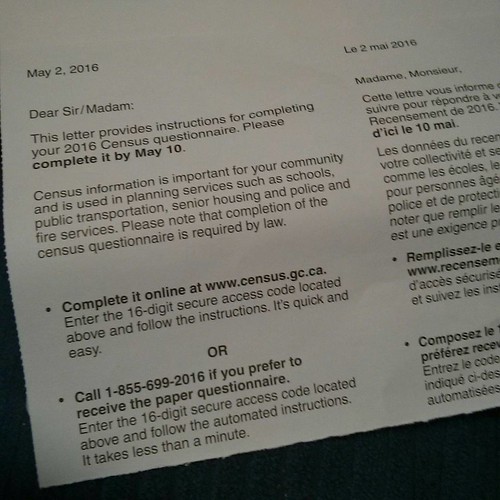
Instructions #canada #census #census2016


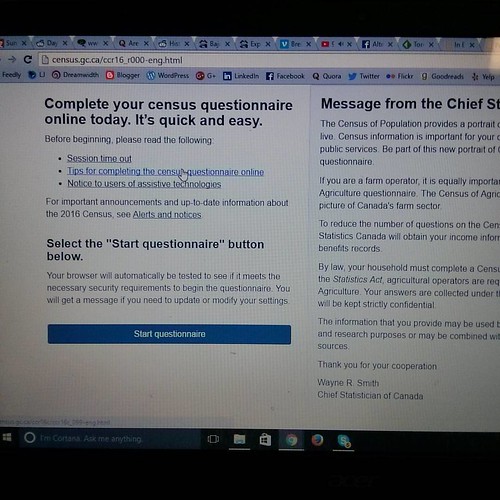
Starting #cabada #census #census2016


The whole episode has been reassuring for fans of good data. Shannon Proudfoot's MacLean's article "The census is back with a swagger" took an extended look at how the census matters, and how it became so important.

This week, the furious preparations of the agency over the last several months come to fruition: May 10 is census day, when Canadians raise their hands to be counted. The voluntary National Household Survey that replaced the long-form census in 2011 ended up being neither the pointless disaster its staunchest critics had envisioned, nor the perfectly useful replacement its proponents predicted. It had serious limitations that caused 1,100 small communities to vanish off the statistical map; it produced a few weird findings that simply didn’t look right; and it made looking for change over time all but impossible. It did, however, offer a serviceable snapshot of the country. Now that StatsCan is returning to a mandatory long-form census—and in a hurry—the question is what will become of the evolving national portrait that underpins everything from people’s bus routes and commuter highways to their children’s schools and where they can grab groceries on their way home from work.

What was once the driest and most esoteric of citizen duties—the statistical backbone of the country that, frankly, most people were oblivious to—became an unlikely flashpoint in 2010. That July, then-prime minister Stephen Harper axed the mandatory long-form census, arguing it was inappropriate to compel citizens to answer questions about their education, work, ethnicity and housing, among other topics. Critics of the move—they were nearly unanimous among those who use census data, including researchers, municipal planners and community organizations—insisted that a mandatory census was the only way to get an accurate picture of who Canadians are and what they need.

Ultimately, 68 per cent of households responded to the 2011 National Household Survey (NHS)—far short of the 94 per cent that completed the long-form census in 2006, but better than the 50 per cent response rate StatsCan projected in some of its testing. The agency’s analysts did everything they could to verify and shore up the information they had. In the end, they released the data they believed was solid, but anything below a certain quality threshold—a highly technical measure that amounts to overall non-response combined with “item non-response,” or individual questions people skipped—was simply not released. “We were very transparent in saying that at the small community level, we cannot do the same level of validation,” says Hamel. That meant that 1,100 small towns and specks on the map, representing three per cent of the Canadian population, became statistical ghost towns, except for the basic information collected on the short-form census. If you wanted to know what the 1,400 residents of Shellbrook, Sask., do for work, how much education they have or their ethnic backgrounds, you’d hit a dead end.

But even with all the quality control StatsCan conducted, there were a few odd glitches that spoke to the problems with using a voluntary survey to obtain a full portrait of your country. The NHS, for example, found that between 2006 and 2011, the largest proportion of Canada’s new immigrants came from the Philippines, followed by China. But a tiny numbered footnote attached to that observation warns that it doesn’t square with immigration records, which showed that in fact the largest slice of newcomers came from China. Presumably, a significant number of new Chinese arrivals either didn’t fill out the NHS or didn’t identify their recent country of origin.

However, the biggest problem with the 2011 survey is simply that it’s different. StatsCan told users flatly that the NHS results were useful for comparing different regions of the country at a single moment in time, but they shouldn’t be measured against 2006 or earlier census results, because the methodology had changed so fundamentally. And comparing data over time is “the most important single thing” for researchers, says Michael Veall, a professor of economics at McMaster University. Veall is quick to note that the NHS turned out better than he expected it would when he testified at a parliamentary committee hearing on the issue in 2010, but it still has serious limitations. “Statistical information is interesting when there’s a surprise, right?” he says. “So you find more people are doing this or more people are doing that. The trouble when we went from 2006 to 2011 [is] every time we see a surprise, we have to say, ‘Oh, is that because something really happened, or is that because there’s a problem with the data?’ ”


I'm glad it's back. I'm very glad that I'm not the only one. Hopefully next time I'll have a chance to fill in the long-form census.

Tuesday, May 03, 2016

On the return of the long-form census to Canada in 2016


It's time for Canadians to deal with the 2016 Census, and this year, as the Liberal government has promised, the long-form census is back. CBC News' Hannah Jackson outlined this in "The long-form census is back, it's online — and this time, it's mandatory".

Statistics Canada today officially begins mailing out access codes so Canadians can prepare to complete the 2016 census online — either the regular or the newly restored long-form version — next week.

Census Day is May 10, but Statistics Canada is encouraging Canadians to complete their census forms as soon as they receive them.

The letters will provide a 16-digit access code to allow households to complete the census online, but also gives Canadians the option of having a paper version mailed to their homes.

[. . .]

One in four randomly selected households in Canada will receive the 36-page long-form questionnaire known as the National Household Survey, while the remainder of Canadians will receive the 10-question short version. Both are mandatory.

Under Section 31 of the Statistics Act, the consequence for failing to provide information to a mandatory census or falsely answering is liable to a summary conviction carrying a fine of up to $500, imprisonment of up to three months, or both.

The import of the census is outlined in Jordan Press' Canadian Press article "Long-form census forms return to mailboxes this week after absence", published at MacLean's and the Toronto Star.

For provincial coffers, the population estimates in the census determine how much per capita funding they will receive in transfers from the federal government.

For local governments and community groups, the demographic details in neighbourhoods help with decisions on where to place new schools, transit routes, seniors’ housing and emergency services.

For companies, the census data act as a much-needed complement to what’s become known as big data.

“Some people wonder, well, why do you even need a census when we have big data?” said Jan Kestle, president of Environics Analytics.

“When you combine the kind of data we now can collect with census data, you can really get a more integrated view of what consumers want both in terms of products and services and that’s also true in terms of what citizens want from government.”


The politics behind the 2011 cancellation are also explored briefly by Press.

The previous Conservative government replaced the long-form census with the voluntary survey five years ago in a move that caught many by surprise and lit a political fuse over the depth of data Statistics Canada collected through regular population counts. The results from the 2011 count prevented comparisons to previous years, left out some small communities over quality concerns, and raised reliability questions around response rates of immigrants and aboriginals.

As one of its first acts in government, the Liberals brought back the mandatory, long-form questionnaire.

Kestle said there will remain gaps in the data collected five years ago, but the return of the long-form census this year should bridge many of them created by the one-time absence.

“To be realistic, of course there will be breaks (in data), but I think missing one (census) is not nearly as bad as if we hadn’t had it come back,” she said.


Craig Silverman's humourous article at Buzzfeed is worth reading for the chuckles.

Thursday, November 05, 2015

On the return of the long-form census to Canada


I did not want to base a post on the speculation earlier this week, but today it has been confirmed. From the Toronto Star:

The mandatory long-form census is back.

Just a day after taking office, the new Liberal government announced Thursday that the 61-question census form — axed by the Conservatives in 2010 — will be reinstated for the 2016 census.

Navdeep Bains, the newly named Minister of Innovation, Science and Development, confirmed the news to reporters on Parliament Hill, declaring that the country needed access to high quality data.

“Today, Canadians are reclaiming their right to accurate and more reliable information,” said Bains, the MP for Mississauga-Malton.

With the 2016 census, communities will “once again have access to high-quality data they require,” he said.


I, for one, am very pleased.

Friday, October 30, 2015

Some thoughts on the 2015 Canadian election (#elxn42)


Last Monday, the long-awaited Canadian federal election finally occurred and produced a rather remarkable shift.


For comparison, below is another Elections Canada map, this one from the 2011 election.


One obvious result of this shift is that the long-form census will almost certainly be restored in time for 2016. A minor election issue, there seems to be time enough to fix things for 2016. Certainly, as explained by the Ottawa Citizen's Jason Fekete, fixing the census is a cost-effective way for the new Liberal government to prove itself to its supporters.

Statistics Canada is quietly waiting for its official marching orders from a new Liberal government to quickly reinstate the mandatory long-form census and have it ready for 2016.

Justin Trudeau’s Liberals have promised to restore the mandatory long-form census that the Conservative government eliminated in 2010 and replaced with a voluntary National Household Survey that critics say has significant holes in its data.

The incoming government has also promised to make Statistics Canada “fully independent,” believing Stephen Harper’s Conservatives meddled with the data collection agency for its own political purposes.

Trudeau’s new Liberal government will be sworn in Nov. 4 and is expected to move almost immediately to restore the census to allow Statistics Canada enough time to have it ready for its rollout in May 2016.

“We will immediately restore the mandatory long-form census, to give communities the information they need to best serve Canadians,” says the Liberal platform.


(I would note, parenthetically, that this year as in 2011, I voted for the NDP candidate in my riding. In 2011, the NDP candidate won; in 2015, the same parliamentarian, incumbent, lost.)

I noted in my post here on the 2011 election that this year's election revealed and crossed some interesting fault lines. The split between Conservative and non-Conservative MPs in the Greater Toronto Area, for instance, mirrored fairly deep splits of class and ethnicity, the better-off downtown voting for non-Conservative candidates and the suburban peripheries voting for Conservative candidates. This year, the Liberals swept the entire Toronto area, and then some.

I also noted that the NDP came from nowhere to become the dominant political party in Québec, even all of French Canada. I speculated that, between its existing English Canadian base and its new dominance in French Canada, the NDP could well be on track to replace the Liberals as one of Canada's two natural parties of government. This did not happen. While the NDP does retain a strong presence in Québec, and likely has potential for recovery now, years after the taboo of a NDP presence in Québec was spectacularly breached, the party is going to take a long time to recover across Canada.

This Tuesday, I put together a collection of links about the election, noting (for instance) the disenchantment of many Canadians--including right-leaning Canadians--with a Conservative government they saw as betraying their interests for its own benefit, the renewal of the connections of newer immigrant groups with Liberals, and so on. All of these things produced what, by any account, is a Liberal landslide, one that took the Liberals from third party to governing majority and even saw the Liberals make inroads into areas of western Canada like Alberta lost since the 1960s.

What will come next? Will the splits of old recur, and how? Follow this blog.

Saturday, June 13, 2015

On saving the American Community Survey from the fate of Canada's long-form census


I have used the tag "census" here at Demography Matters a fair bit. Most of the posts relate to the abolition of the abolition of Canada's long-form census after the 2011 federal election was won with a majority by the Conservatives, following a needless din raised by them while they were a minority. Without providing convincing reasons, the Canadian government forced Statistics Canada to abandon a statistical tool that generated vital information. This, as I noted in 2014 and again observed earlier this year, caused measurable harm to Canadians by denying us the information about ourselves that we need to plan.

On Wednesday, I went to The Atlantic and discovered that the American Community Survey is facing similar challenges. Russell Berman's "Republicans Try to Rein in the Census Bureau" tells a story all too familiar to me.

Republicans have long argued that such questions are too intrusive for a mandatory survey, and for the second year in a row, House-passed spending legislation would effectively make it voluntary by prohibiting the government from enforcing criminal penalties—which can reach $5,000—against people who refuse to participate in the ACS. To its opponents, the survey is yet another front in the privacy wars, and their arguments echo the complaints about government spying in the name of national security.

“This survey is another example of unnecessary and completely unwarranted government intrusion,” wrote Representative Ted Poe in a recent op-ed. “The federal government has no right to force Americans to divulge such private information, especially information that they are uncomfortable giving away.” Poe, a conservative former judge who represents the Houston suburbs,​ wrote the amendment that House Republicans included in the annual spending bill that covers the Census Bureau. While Democrats in the Senate successfully blocked it in previous years, the provision may stand a stronger chance now that Republicans run the upper chamber. President Obama has threatened to veto the legislation, in part because of the ACS amendment and deep cuts to funding for the 2020 Census.

Senator James Lankford, an Oklahoma Republican in his first term, said he’s concerned not only about the questions on the ACS but also with the methods the Census Bureau uses to make sure they get answered. Recipients are first mailed a survey that notes, in all capital letters on the envelope, that responses are mandatory. If they don’t send it back, government officials follow up with phone calls and house visits. Lankford told me that constituents have complained to him that after they told a census official they would not participate in the survey, the official sat in his car outside the house, waited for him to leave for work, and then returned to ask his wife to answer the questions. Poe has accused the government of similar “harassment” in Texas. “It’s just really odd,” Lankford said. “It comes across as just a really intrusive way to conduct a survey.” In response to the concerns, the Census Bureau is testing out a gentler approach without the bolded warnings, but according to Science, officials have said that when they have used less aggressive methods in the past, response rates dropped significantly.

A quick look at the Census Bureau’s website reveals an extensive effort to overcome skepticism, and resistance, to many of the questions on the American Community Survey. In addition to pamphlets outlining the history of the questionnaire, the website includes documents that explain why the survey asks each question, how long the question has been asked as part of the Census, and how federal, state, and local governments (as well as the private sector) use the information they gather. So why do they ask about toilets? “We ask questions about kitchen and plumbing facilities because federal and local governments need this information to allocate funding for housing subsidies and other programs that help American families afford decent, safe, and sanitary housing,” the Bureau says. Plumbing and kitchen questions first appeared on the Census “long form” in 1940. Without the toilet question, the government might not know that even in 2015, there are nearly 2 million Americans in rural communities without indoor plumbing, said Phil Sparks, co-director of The Census Project, a nonprofit advocacy consortium. “It’s irreplaceable,” Sparks said. “There is no option B for that data.”


More, much more, is at the website of The Atlantic.

Do not let them do it. Seriously. The United States needs that information badly in order to function. How can any government formulate policies intended to deal with the issues of the communities and individuals it governs and represents without knowing the first thing about them? This, I fear, is the strongly anti-democratic motive underlying too much of this anti-ACS sentiment. Modify it if you need to, but do not undermine it. Americans, your country will be the worse for it.

Thursday, June 04, 2015

Some assorted blog links


While I'm assembling some original material, I thought I'd point readers to some population-related blog links that appeared on my RSS feed in the past month or so.
  • Considering the Mediterranean migration crisis, Crooked Timber featured one essay arguing that European restrictionism is culpable for deaths, while the New APPS Blog praised the bravery of migrants.
  • The Dragon's Tales noted that immigration from China and India to the United States has surpassed that from Mexico.
  • The Everyday Sociology Blog considered, in the wake of the Nepali earthquake, the ill-regulated international market in birth surrogacy.
  • Kieran Healy noted how popular estimates of the composition of the American population are frequently quite wrong, going back to the errors of popular wisdom.
  • The Power and the Money's Noel Maurer noted that rates of childlessness among American women with post-graduate educations has plummeted. More discussion at the blog.
  • The Russian Demographics Blog had a whole slew of interesting posts, including looks at the changing composition of migrants from Russia and changing destinations and volumes of flows to and from the country, along with examinations of problematic data on HIV/AIDS in Russia and an old forecast of the epidemic.
  • Window on Eurasia reported on how one Muslim commentator in Russia thinks Russian Muslims should respond to the prospects of a Muslim majority in Russia. (I find it unlikely, and of note mainly as a case study of crude demographic boosterism.).

If you've suggestions as to new blogs I should follow, please, submit them--and any especially interesting posts--in the comments.

Wednesday, March 04, 2015

On the potential demise of the quinquennial census of Australia

The Guardian's Oliver Milman reported last month that the Australian Bureau of Statistics might reduce the frequency of national census-taking. At present, an Australian census is held every five years, the most recent being in 2011. The plan to shift to a ten-year census cycle, with frequent surveys in between censuses to maintain data, is apparently quite controversial, for the same sort of reasons that I recognize in Canada in the debate over the long-form census. I do admit to wondering if a five-year census is practical, but I also admit to envying Australia its thorough data-collection processes.

The compilation of the 2016 census is in doubt, with the Australian Bureau of Statistics (ABS) in talks with the federal government over changes to the mass data collection exercise.

The ABS is understood to favour a shift to taking a full census once every 10 years, rather than every five years, bringing Australia into line with the US and Britain.

In the interim, the ABS would conduct smaller sample surveys on a quarterly basis to provide information on Australia’s demographics.

The ABS’s last census was in 2011, deploying 29,000 people to record the details of people living in Australia.

[. . .]

The ABS is required by an act of parliament to conduct a census every five years, and the results are used to frame various policy and spending decisions, meaning a change in the law would be required to switch to the 10-year model.

The Community and Public Sector Union said a $78m cut to the budget of the ABS over the past two years has resulted in 10% of staff leaving and the remaining workforce deals with “antiquated” computer systems.

“The news that the census might be cut or scaled back is deeply disturbing and will send shockwaves throughout the community,” said a union spokesman, Alistair Waters. “It is the bedrock of much of what the ABS does and it plays a vital role in business and society.

Tuesday, March 03, 2015

"The Tragedy of Canada's Census"


Aarian Marshall's CityLab article does a great job of examining the consequences and the causes of Canada's census mayhem. Reducing the amount of hard data reduces the ability of governent to deal with issues. That might have been the whole point.

Rosana Pellizzari, the medical officer of health of Peterborough, Ontario, knows a thing or two about bad data. The public health office she oversees is charged with running policy-driven health programs and services for the mid-size city and county, population 123,000, which makes it the 33rd largest metro in Canada, if that country's most recent census is to be believed.

Trouble is, she's not sure it can be. In 2010, with little fanfare or preparation, Prime Minister Stephen Harper’s conservative government decided that the next long-form census, completed in Canada every five years, would not be mandatory. As officials told the story, without citing any specific polls, the public had expressed concerns about their privacy when filling out the long-form census, as well as the threat of jail time should they decline to fill it out.

“We were all shocked,” says Marni Cappe, who in 2010 was the president of the Canadian Institute of Planners. “It sent a ripple through the community … They did it on a [June] afternoon when they thought, ‘Who would be paying attention?’”

So in 2011, Statistics Canada, the governmental body responsible for collecting and analyzing all of Canada’s statistics, sent out two versions of the census. The first, a mandatory short-form questionnaire, asked Canadians about their about age, sex, marital status, mother tongue, and the languages spoken at home. The second was the National Household Survey (NHS), a 40-page voluntary survey sent to 30 percent of Canadians. Munir Sheikh, then the head of Statistics Canada, resigned over the change in policy. “I want to take this opportunity to comment on a technical statistical issue which has become the subject of media discussion ... the question of whether a voluntary survey can become a substitute for a mandatory census," he wrote. "It can not.”

Today, four years after Canada’s first voluntary long-form census, and one year away from what looks to be its second, Rosana Pellizzari is still wondering how to deal with the dearth of data. Thirty-six percent of Peterborough residents sent the voluntary survey did not return it, which gave the metro the lowest NHS response rate of all Canadian cities.


Marshall does an excellent job placing this change in its full Canadian political context, and notes the worrisome possibility that it might be imitated in other countries. This is strongly recommended: go read it.