Showing posts with label census. Show all posts

Tuesday, September 20, 2016

On the physical constraints to the independence of Statistics Canada


Before this weekend, the biggest news relating to Statistics Canada had to do with the very high response rate to the 2016 census just concluded, 98.4% of those surveyed nation-wide responding. The news Friday that chief statistician Wayne Smith had resigned in protest caught many people off guard.

Canada's chief statistician has resigned in protest over what he says is the federal governments' failure to protect Statistics Canada's independence.

Wayne Smith says the government's decision to create Shared Services Canada and centralize all information technology services across government has compromised Statistics Canada's ability to fulfil its mandate.

"I have made the best effort I can to have this situation remediated, but to no effect," Smith said in a note to the National Statistical Council, which advises him. "I cannot lend my support to government initiatives that will purport to protect the independence of Statistics Canada when, in fact, that independence has never been more compromised,"

"I do not wish to preside over the decline of what is still, but cannot remain in these circumstances, a world-leading statistical office."

[. . .]

Shared Services was created by the previous government to centralize and standardize information technology across the federal government in a bid to save money. It has struggled to meet expectations with several agencies, including the RCMP and the Canadian Forces, which have complained of data centre crashes, red tape, bad customer service and unpaid bills.

Smith said he had issued a warning that ever since Statistics Canada began relying on Shared Services for its IT, the research department had begun losing control of the information it collects from Canadians through operations such as the long-form census.

In the note, Smith argued that Shared Services holds "an effective veto over many of Statistics Canada's decisions concerning the collection, processing, storage, analysis and dissemination of official statistics through denial or constructive denial of essential services."

"Statistics Canada is increasingly hobbled in the delivery of its programs through disruptive, ineffective, slow and unaffordable supply of physical informatics services by Shared Services Canada," he added.


(Smith's full statement is available here.)

I said "many people" above because reports about the failures of Shared Services have appeared periodically in the past year. On the 30th of January, for instance, the Ottawa Citizen published James Bagnall's article "Circuit overload: Why Shared Services Canada is struggling" looking at the problems of the service.

Shared Services is responsible for collapsing 63 federal email programs into a single system, consolidating nearly 500 data centres into seven and streamlining the government’s telecommunications. By 2020, if all goes well, the government will have invested more than $1 billion to modernize a ramshackle electronic infrastructure that is currently vulnerable to hackers and costly to run.

If it works, taxpayers can expect to save at least $60 million annually to run federal websites and online services. But on Shared Services’ present course, it may take years more than planned to complete this multi-faceted project – at a cost that can only be guessed at now.

It’s not going smoothly. Government workers are no longer surprised to receive notices that begin with the telltale line: “We have been advised by Shared Services Canada …” What usually follows is an explanation of which systems aren’t working at that particular time, with an estimate of when they’ll be restored.

Sometimes it’s an email issue. Earlier this week, for instance, employees at one of the smaller departments were informed that their emails were getting through to the public but not to government colleagues.

Other times, data centres are to blame. The failure of a power distribution unit two months ago at the government’s data centre along Aviation Parkway triggered an emergency shutdown at multiple government websites for days.


Briefly put, technological issues have combined with a far too broad a mandate to create a technological impasse. This July, CBC carried the relevant federal minister's CBC promises to make Shared Services work, perhaps ironically at the same time that it also reported on Statistics Canada's complaints that Shared Services was not meeting its needs for the 2016 census. After his resignation, Smith was interviewed by the CBC at length about the problems Statistics Canada encountered.

The Liberal government has inherited a Conservative technological initiative in government that is not working well at all in Shared Services, much as it has with the Phoenix payroll service for federal government employees. As with Phoenix, it has not made obvious signs of moving beyond this. The only conclusion to be drawn from this is the obvious: The institutional constraints to the independence of Statistics Canada that I have written about here in the past are not the only sorts of constraints. There are material constraints, too. As yet, there are no signs that these latter will be removed.

Tuesday, August 16, 2016

#CensusFail, or, how #Census2016 is not as big a hit in Australia as in Canada


I've learned that the Australian census, recently concluded, has been the subject of as much controversy as in Canada in recent years. The big difference is that, whereas Canada's census controversies were contrived by the then-ruling Conservative Party government, Australia's worries are more deeply rooted.

Bloomberg's Michael Heath authored the article "Census Boycott Gathers Momentum Amid Australia Privacy Concerns".

A backlash against Australia’s national census is gathering momentum with lawmakers joining calls to boycott Tuesday’s population count amid concern data gathered will be used to build wide-ranging profiles of individuals and violate their right to privacy.

Nick Xenophon, who leads a minority party in parliament, is refusing to provide his name to the compulsory census and thus won’t be able to submit a completed document, risking a fine of A$180 ($138) a day. Other lawmakers , including Greens Senator Sarah Hanson-Young, have also threatened to withhold their names.

Fearing a widespread boycott that could compromise data that’s essential for public service provision, the government has sought to downplay the concerns.

“Privacy matters,” Xenophon told reporters. The Australian Bureau of Statistics “has failed to make a compelling case on why names must be provided and stored for four years. All names will be turned into a code that ultimately can be used to identify you.”

The crux of the debate is over a “statistical linkage key” that will be created for an individual from the name submitted on their census form. Names will also be kept for four years rather than being destroyed after 18 months, as is the current practice.

Privacy advocates say that, irrespective of names being destroyed, the linkage keys will allow answers to future questions to be linked to census responses, enabling the government to compile a profile of a person.


Edward Johnson, also writing for Bloomberg, produced "Census Crash Spurs Australia Security Fears in Blow to Turnbull".

Prime Minister Malcolm Turnbull’s government is facing its first big test since scraping back into office last month, after an apparent overseas attack crashed Australia’s online census and threatened to derail the survey.

The five-yearly census, which is used to underpin economic planning and public service provision, was shut down late yesterday after four so-called denial of service attacks, according to the Australian Bureau of Statistics. The failure is embarrassing for the government, which has defended the integrity of the survey amid calls for a boycott over privacy concerns.

The statistics bureau shut down the site out of an “abundance of caution” to ensure the data already submitted by some 2 million Australians couldn’t be compromised, Treasurer Scott Morrison said Wednesday at a news conference with Turnbull. He joined the prime minister in urging Australians to complete the survey once the site was restored, saying it was “critical to support economic planning.”

This year’s census had already been mired in controversy as lawmakers joined calls to boycott the population count amid concern data gathered could be used to build wide-ranging profiles of individuals and violate their privacy. The debacle is an unwelcome distraction for Turnbull, who was returned to office with a wafer-thin majority of just one seat after the July 2 election -- a result that has eroded confidence in his leadership.

“The sense of trust and goodwill toward the census has been tarnished,” said Zareh Ghazarian, a politics lecturer at Monash University’s School of Social Sciences. There’s a risk that people will “have greater reservations now about completing the survey” and the data garnered will be incomplete, he said.


I have seen Australian friends actively complaining on social networking sites about their problems filing their electronic returns.

Do any readers know more about this? If you are Australian, can you explain your perspective? I'm quite curious, and I'm sure our other readers are, too.

Saturday, August 06, 2016

On the Jedi phenomenon and the Australian census


Via io9, I learned of a Brisbane Times article dealing with the Jedi phenomenon in the Australian census. Funny as the idea of claiming the faith of the Jedi Knights of Star Wars fame might be, it messes with census data.

The Jedi phenomenon began in 2001 when an email campaign mistakenly claimed the government would have to recognise it as an official religion if 8000 people selected it in the census.

Now [HKlie] Sturgess, president of the Atheist Foundation of Australia, is leading a campaign for people not to treat the census as a joke.

This is because if people fill in the "other" box in the religion section of the census with an answer such as Jedi they are counted as "not defined" rather than "no religion".

Ms Sturgess said this skews the census results by making Australia appear more religious than it is.

"People shouldn't waste their answer," she said.

"Answering the religion question thoughtfully and honestly matters because it benefits all Australians when decisions on how to spend taxpayer dollars are made on sound data that accurately reflects modern-day Australia."


This little incident says a lot about the problem with modern statistics. I will elaborate in the next few days. In the meantime, be amused with this.

Tuesday, August 02, 2016

Four article links on the aftermath of the 2016 Canada census


What, might readers of Demography Matters ask, has become of the Canadian census? Four article illustrate the contours surrounding this issue.

Last week in The Globe and Mail, Tavia Grant's article "Census response rate is 98 per cent, early calculations show" featured.

Canadians really were, it seems, enthusiastic about the census.

Statistics Canada is still calculating exact response rates, but it says early indications are that the overall response rate is 98 per cent – and about 96 per cent for the long-form census. That is higher than long-form response rates in the previous two censuses, the agency says.

“Early indications are positive,” Marc Hamel, director-general of the census program, said in an interview.

These numbers could shift up or down as results from early enumeration of Northern communities, late filers and First Nations reserves are added in, he said. “The range of error is not very high … it’s likely to move, but we’re talking most likely, at most, one percentage point.”

[. . .]

The sample size for the long-form census was increased to one in four households this year from one in five in 2006. The combination of high response rates this year and a bigger sample size will yield “incredibly precise data,” chief statistician Wayne Smith said.


Grant also had another article in The Globe and Mail, "Statistics Canada's tech issues hampering its mandate: chief".

Statistics Canada’s technological troubles have become so acute that its chief statistician says they are hampering the agency’s ability to carry out its mandate – and he places the blame squarely on one source: Shared Services Canada, the department now running the agency’s informatics infrastructure.

Statscan’s website has for months been beset by crashes, delays and outages, most notably on July 8, when its main website was down for more than seven hours on the day of the release of the labour force survey.

In an interview with The Globe and Mail at his Ottawa office, chief statistician Wayne Smith said that that outage – along with a long list of other information technology troubles – relates to problems with Shared Services.

“It’s had a significant impact on our operations,” Mr. Smith said. “Our service to the public has suffered, clearly, in ways that we would rather not have happened. Some of our relationships have suffered. … There’s a frustration among our clients.”

Canada’s statistical agency is tasked with producing quality data and analysis about the country on everything from oil exports to jobless rates, food prices and health outcomes. That mandate, Mr. Smith said, is at risk as tech glitches – stemming partly from a lack of maintenance at its data centre – have caused delayed releases, lost time in conducting quality assurance and higher costs.


The CBC carried Jordan Press' Canadian Press article "StatsCan looking for powers to make all surveys mandatory, compel data from companies".

Statistics Canada is privately floating the idea of new powers that would make all of its surveys mandatory by default and force certain companies to hand over requested data, such as credit card transactions and Internet search records.

Currently, the agency can ask for any information held by governments and businesses, but officials have long found it hard to get information like point-of-sale transactions that could give a more detailed and accurate picture of household spending.

The agency's proposal would compel governments and companies to hand over information, and levy fines to discourage "unreasonable impositions" that "restrict or prevent the flow of information for statistical purposes."

Corporate fines would depend on a company's size and the length of any delays. The changes would also do away with the threat of jail time for anyone who refuses to fill out a mandatory survey, such as the long-form census.

The recommendations, contained in a discussion paper Statistics Canada provided to The Canadian Press, would enshrine in law the agency's independence in deciding what data it needs and how to collect it.


In the National Post, John Robson's "When statisticians corrupt" counsels against this extension.

Lord Acton famously warned that “Power tends to corrupt, and absolute power corrupts absolutely.” Even, it turns out, Statistics Canada.

Now you laugh. But my colleague Kevin Libin just wrote about how Canada’s statistical agency, giddy with success in having the mandatory long-form census restored, now wants all sorts of power to compel you to reveal your intimate secrets or lack of same.

I don’t want to be seen mocking statisticians as good at math but without the personality to be accountants. Especially not now. But it is hard to imagine a less menacing bunch than the geeks at Statistics Canada, whom I have always found obliging when seeking data on deadline. They wield spreadsheets in cubicles, not pistols in dank secret police HQ basements. Yet there they are, demanding the power to compel compliance, avoid scrutiny, even run their own computers to avoid depending on their wretched colleagues for tech support.

‘Twas ever thus in the executive branch. We know best (as Libin notes, Statistics Canada has elevated itself from a good number cruncher to “a key institution in the democratic process”) and should be freed from petty restraints on our capacity to act for the greater good. But why?

Well, in Acton’s and my vision of the political problem, we need the state and it needs extensive powers to protect our freedom. But anyone to whom we grant extensive powers is liable to intrude on our freedom because, as Alexander Solzhenitsyn wrote, “The line separating good and evil passes not through states, nor between classes, nor between political parties either, but right through every human heart.”


That is where Canada is right now.

Thursday, May 12, 2016

"Theo Moudakis: Census time"


Yesterday's Toronto Star editorial cartoon by Theo Moudakis was one that I thought would appeal to readers.


That is all.

Wednesday, May 11, 2016

On #census2016 in Canada


The return of the long-form census has become a trending hashtag on Twitter, #Census2016. It was more than that: As both the CBC and the Huffington Post noted, when the census collection period began on the 2nd of May, it became a major pop-culture trend in Canada. So many people responded that the official census website was briefly knocked down.

Me, I decided to be fashionably late.

Census selfie #toronto #me #selfie #canada #census #census2016


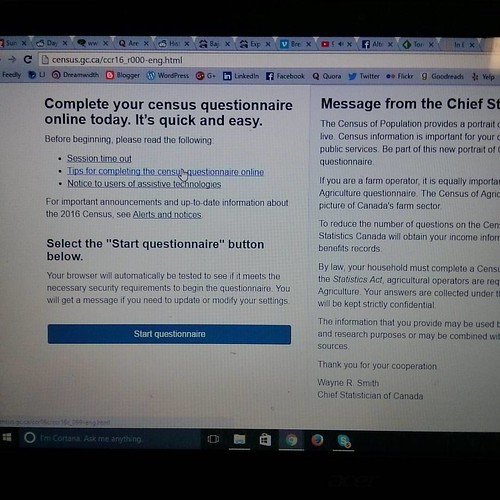
One in four Canadian households, selected at random, received 36-page long-form questionnaire known as the National Household Survey. I, unfortunately, did not, instead clicking through ten short questions. Still, it got done. I could have received it, after all.

Instructions #canada #census #census2016


Starting #cabada #census #census2016


The whole episode has been reassuring for fans of good data. Shannon Proudfoot's MacLean's article "The census is back with a swagger" took an extended look at how the census matters, and how it became so important.

This week, the furious preparations of the agency over the last several months come to fruition: May 10 is census day, when Canadians raise their hands to be counted. The voluntary National Household Survey that replaced the long-form census in 2011 ended up being neither the pointless disaster its staunchest critics had envisioned, nor the perfectly useful replacement its proponents predicted. It had serious limitations that caused 1,100 small communities to vanish off the statistical map; it produced a few weird findings that simply didn’t look right; and it made looking for change over time all but impossible. It did, however, offer a serviceable snapshot of the country. Now that StatsCan is returning to a mandatory long-form census—and in a hurry—the question is what will become of the evolving national portrait that underpins everything from people’s bus routes and commuter highways to their children’s schools and where they can grab groceries on their way home from work.

What was once the driest and most esoteric of citizen duties—the statistical backbone of the country that, frankly, most people were oblivious to—became an unlikely flashpoint in 2010. That July, then-prime minister Stephen Harper axed the mandatory long-form census, arguing it was inappropriate to compel citizens to answer questions about their education, work, ethnicity and housing, among other topics. Critics of the move—they were nearly unanimous among those who use census data, including researchers, municipal planners and community organizations—insisted that a mandatory census was the only way to get an accurate picture of who Canadians are and what they need.

Ultimately, 68 per cent of households responded to the 2011 National Household Survey (NHS)—far short of the 94 per cent that completed the long-form census in 2006, but better than the 50 per cent response rate StatsCan projected in some of its testing. The agency’s analysts did everything they could to verify and shore up the information they had. In the end, they released the data they believed was solid, but anything below a certain quality threshold—a highly technical measure that amounts to overall non-response combined with “item non-response,” or individual questions people skipped—was simply not released. “We were very transparent in saying that at the small community level, we cannot do the same level of validation,” says Hamel. That meant that 1,100 small towns and specks on the map, representing three per cent of the Canadian population, became statistical ghost towns, except for the basic information collected on the short-form census. If you wanted to know what the 1,400 residents of Shellbrook, Sask., do for work, how much education they have or their ethnic backgrounds, you’d hit a dead end.

But even with all the quality control StatsCan conducted, there were a few odd glitches that spoke to the problems with using a voluntary survey to obtain a full portrait of your country. The NHS, for example, found that between 2006 and 2011, the largest proportion of Canada’s new immigrants came from the Philippines, followed by China. But a tiny numbered footnote attached to that observation warns that it doesn’t square with immigration records, which showed that in fact the largest slice of newcomers came from China. Presumably, a significant number of new Chinese arrivals either didn’t fill out the NHS or didn’t identify their recent country of origin.

However, the biggest problem with the 2011 survey is simply that it’s different. StatsCan told users flatly that the NHS results were useful for comparing different regions of the country at a single moment in time, but they shouldn’t be measured against 2006 or earlier census results, because the methodology had changed so fundamentally. And comparing data over time is “the most important single thing” for researchers, says Michael Veall, a professor of economics at McMaster University. Veall is quick to note that the NHS turned out better than he expected it would when he testified at a parliamentary committee hearing on the issue in 2010, but it still has serious limitations. “Statistical information is interesting when there’s a surprise, right?” he says. “So you find more people are doing this or more people are doing that. The trouble when we went from 2006 to 2011 [is] every time we see a surprise, we have to say, ‘Oh, is that because something really happened, or is that because there’s a problem with the data?’ ”


I'm glad it's back. I'm very glad that I'm not the only one. Hopefully next time I'll have a chance to fill in the long-form census.

Tuesday, May 03, 2016

On the return of the long-form census to Canada in 2016


It's time for Canadians to deal with the 2016 Census, and this year, as the Liberal government has promised, the long-form census is back. CBC News' Hannah Jackson outlined this in "The long-form census is back, it's online — and this time, it's mandatory".

Statistics Canada today officially begins mailing out access codes so Canadians can prepare to complete the 2016 census online — either the regular or the newly restored long-form version — next week.

Census Day is May 10, but Statistics Canada is encouraging Canadians to complete their census forms as soon as they receive them.

The letters will provide a 16-digit access code to allow households to complete the census online, but also gives Canadians the option of having a paper version mailed to their homes.

[. . .]

One in four randomly selected households in Canada will receive the 36-page long-form questionnaire known as the National Household Survey, while the remainder of Canadians will receive the 10-question short version. Both are mandatory.

Under Section 31 of the Statistics Act, the consequence for failing to provide information to a mandatory census or falsely answering is liable to a summary conviction carrying a fine of up to $500, imprisonment of up to three months, or both.

The import of the census is outlined in Jordan Press' Canadian Press article "Long-form census forms return to mailboxes this week after absence", published at MacLean's and the Toronto Star.

For provincial coffers, the population estimates in the census determine how much per capita funding they will receive in transfers from the federal government.

For local governments and community groups, the demographic details in neighbourhoods help with decisions on where to place new schools, transit routes, seniors’ housing and emergency services.

For companies, the census data act as a much-needed complement to what’s become known as big data.

“Some people wonder, well, why do you even need a census when we have big data?” said Jan Kestle, president of Environics Analytics.

“When you combine the kind of data we now can collect with census data, you can really get a more integrated view of what consumers want both in terms of products and services and that’s also true in terms of what citizens want from government.”


The politics behind the 2011 cancellation are also explored briefly by Press.

The previous Conservative government replaced the long-form census with the voluntary survey five years ago in a move that caught many by surprise and lit a political fuse over the depth of data Statistics Canada collected through regular population counts. The results from the 2011 count prevented comparisons to previous years, left out some small communities over quality concerns, and raised reliability questions around response rates of immigrants and aboriginals.

As one of its first acts in government, the Liberals brought back the mandatory, long-form questionnaire.

Kestle said there will remain gaps in the data collected five years ago, but the return of the long-form census this year should bridge many of them created by the one-time absence.

“To be realistic, of course there will be breaks (in data), but I think missing one (census) is not nearly as bad as if we hadn’t had it come back,” she said.


Craig Silverman's humourous article at Buzzfeed is worth reading for the chuckles.

Thursday, November 05, 2015

On the return of the long-form census to Canada


I did not want to base a post on the speculation earlier this week, but today it has been confirmed. From the Toronto Star:

The mandatory long-form census is back.

Just a day after taking office, the new Liberal government announced Thursday that the 61-question census form — axed by the Conservatives in 2010 — will be reinstated for the 2016 census.

Navdeep Bains, the newly named Minister of Innovation, Science and Development, confirmed the news to reporters on Parliament Hill, declaring that the country needed access to high quality data.

“Today, Canadians are reclaiming their right to accurate and more reliable information,” said Bains, the MP for Mississauga-Malton.

With the 2016 census, communities will “once again have access to high-quality data they require,” he said.


I, for one, am very pleased.

Friday, October 30, 2015

Some thoughts on the 2015 Canadian election (#elxn42)


Last Monday, the long-awaited Canadian federal election finally occurred and produced a rather remarkable shift.


For comparison, below is another Elections Canada map, this one from the 2011 election.


One obvious result of this shift is that the long-form census will almost certainly be restored in time for 2016. A minor election issue, there seems to be time enough to fix things for 2016. Certainly, as explained by the Ottawa Citizen's Jason Fekete, fixing the census is a cost-effective way for the new Liberal government to prove itself to its supporters.

Statistics Canada is quietly waiting for its official marching orders from a new Liberal government to quickly reinstate the mandatory long-form census and have it ready for 2016.

Justin Trudeau’s Liberals have promised to restore the mandatory long-form census that the Conservative government eliminated in 2010 and replaced with a voluntary National Household Survey that critics say has significant holes in its data.

The incoming government has also promised to make Statistics Canada “fully independent,” believing Stephen Harper’s Conservatives meddled with the data collection agency for its own political purposes.

Trudeau’s new Liberal government will be sworn in Nov. 4 and is expected to move almost immediately to restore the census to allow Statistics Canada enough time to have it ready for its rollout in May 2016.

“We will immediately restore the mandatory long-form census, to give communities the information they need to best serve Canadians,” says the Liberal platform.


(I would note, parenthetically, that this year as in 2011, I voted for the NDP candidate in my riding. In 2011, the NDP candidate won; in 2015, the same parliamentarian, incumbent, lost.)

I noted in my post here on the 2011 election that this year's election revealed and crossed some interesting fault lines. The split between Conservative and non-Conservative MPs in the Greater Toronto Area, for instance, mirrored fairly deep splits of class and ethnicity, the better-off downtown voting for non-Conservative candidates and the suburban peripheries voting for Conservative candidates. This year, the Liberals swept the entire Toronto area, and then some.

I also noted that the NDP came from nowhere to become the dominant political party in Québec, even all of French Canada. I speculated that, between its existing English Canadian base and its new dominance in French Canada, the NDP could well be on track to replace the Liberals as one of Canada's two natural parties of government. This did not happen. While the NDP does retain a strong presence in Québec, and likely has potential for recovery now, years after the taboo of a NDP presence in Québec was spectacularly breached, the party is going to take a long time to recover across Canada.

This Tuesday, I put together a collection of links about the election, noting (for instance) the disenchantment of many Canadians--including right-leaning Canadians--with a Conservative government they saw as betraying their interests for its own benefit, the renewal of the connections of newer immigrant groups with Liberals, and so on. All of these things produced what, by any account, is a Liberal landslide, one that took the Liberals from third party to governing majority and even saw the Liberals make inroads into areas of western Canada like Alberta lost since the 1960s.

What will come next? Will the splits of old recur, and how? Follow this blog.

Saturday, June 13, 2015

On saving the American Community Survey from the fate of Canada's long-form census


I have used the tag "census" here at Demography Matters a fair bit. Most of the posts relate to the abolition of the abolition of Canada's long-form census after the 2011 federal election was won with a majority by the Conservatives, following a needless din raised by them while they were a minority. Without providing convincing reasons, the Canadian government forced Statistics Canada to abandon a statistical tool that generated vital information. This, as I noted in 2014 and again observed earlier this year, caused measurable harm to Canadians by denying us the information about ourselves that we need to plan.

On Wednesday, I went to The Atlantic and discovered that the American Community Survey is facing similar challenges. Russell Berman's "Republicans Try to Rein in the Census Bureau" tells a story all too familiar to me.

Republicans have long argued that such questions are too intrusive for a mandatory survey, and for the second year in a row, House-passed spending legislation would effectively make it voluntary by prohibiting the government from enforcing criminal penalties—which can reach $5,000—against people who refuse to participate in the ACS. To its opponents, the survey is yet another front in the privacy wars, and their arguments echo the complaints about government spying in the name of national security.

“This survey is another example of unnecessary and completely unwarranted government intrusion,” wrote Representative Ted Poe in a recent op-ed. “The federal government has no right to force Americans to divulge such private information, especially information that they are uncomfortable giving away.” Poe, a conservative former judge who represents the Houston suburbs,​ wrote the amendment that House Republicans included in the annual spending bill that covers the Census Bureau. While Democrats in the Senate successfully blocked it in previous years, the provision may stand a stronger chance now that Republicans run the upper chamber. President Obama has threatened to veto the legislation, in part because of the ACS amendment and deep cuts to funding for the 2020 Census.

Senator James Lankford, an Oklahoma Republican in his first term, said he’s concerned not only about the questions on the ACS but also with the methods the Census Bureau uses to make sure they get answered. Recipients are first mailed a survey that notes, in all capital letters on the envelope, that responses are mandatory. If they don’t send it back, government officials follow up with phone calls and house visits. Lankford told me that constituents have complained to him that after they told a census official they would not participate in the survey, the official sat in his car outside the house, waited for him to leave for work, and then returned to ask his wife to answer the questions. Poe has accused the government of similar “harassment” in Texas. “It’s just really odd,” Lankford said. “It comes across as just a really intrusive way to conduct a survey.” In response to the concerns, the Census Bureau is testing out a gentler approach without the bolded warnings, but according to Science, officials have said that when they have used less aggressive methods in the past, response rates dropped significantly.

A quick look at the Census Bureau’s website reveals an extensive effort to overcome skepticism, and resistance, to many of the questions on the American Community Survey. In addition to pamphlets outlining the history of the questionnaire, the website includes documents that explain why the survey asks each question, how long the question has been asked as part of the Census, and how federal, state, and local governments (as well as the private sector) use the information they gather. So why do they ask about toilets? “We ask questions about kitchen and plumbing facilities because federal and local governments need this information to allocate funding for housing subsidies and other programs that help American families afford decent, safe, and sanitary housing,” the Bureau says. Plumbing and kitchen questions first appeared on the Census “long form” in 1940. Without the toilet question, the government might not know that even in 2015, there are nearly 2 million Americans in rural communities without indoor plumbing, said Phil Sparks, co-director of The Census Project, a nonprofit advocacy consortium. “It’s irreplaceable,” Sparks said. “There is no option B for that data.”


More, much more, is at the website of The Atlantic.

Do not let them do it. Seriously. The United States needs that information badly in order to function. How can any government formulate policies intended to deal with the issues of the communities and individuals it governs and represents without knowing the first thing about them? This, I fear, is the strongly anti-democratic motive underlying too much of this anti-ACS sentiment. Modify it if you need to, but do not undermine it. Americans, your country will be the worse for it.

Wednesday, March 04, 2015

On the potential demise of the quinquennial census of Australia

The Guardian's Oliver Milman reported last month that the Australian Bureau of Statistics might reduce the frequency of national census-taking. At present, an Australian census is held every five years, the most recent being in 2011. The plan to shift to a ten-year census cycle, with frequent surveys in between censuses to maintain data, is apparently quite controversial, for the same sort of reasons that I recognize in Canada in the debate over the long-form census. I do admit to wondering if a five-year census is practical, but I also admit to envying Australia its thorough data-collection processes.

The compilation of the 2016 census is in doubt, with the Australian Bureau of Statistics (ABS) in talks with the federal government over changes to the mass data collection exercise.

The ABS is understood to favour a shift to taking a full census once every 10 years, rather than every five years, bringing Australia into line with the US and Britain.

In the interim, the ABS would conduct smaller sample surveys on a quarterly basis to provide information on Australia’s demographics.

The ABS’s last census was in 2011, deploying 29,000 people to record the details of people living in Australia.

[. . .]

The ABS is required by an act of parliament to conduct a census every five years, and the results are used to frame various policy and spending decisions, meaning a change in the law would be required to switch to the 10-year model.

The Community and Public Sector Union said a $78m cut to the budget of the ABS over the past two years has resulted in 10% of staff leaving and the remaining workforce deals with “antiquated” computer systems.

“The news that the census might be cut or scaled back is deeply disturbing and will send shockwaves throughout the community,” said a union spokesman, Alistair Waters. “It is the bedrock of much of what the ABS does and it plays a vital role in business and society.

Tuesday, March 03, 2015

"The Tragedy of Canada's Census"


Aarian Marshall's CityLab article does a great job of examining the consequences and the causes of Canada's census mayhem. Reducing the amount of hard data reduces the ability of governent to deal with issues. That might have been the whole point.

Rosana Pellizzari, the medical officer of health of Peterborough, Ontario, knows a thing or two about bad data. The public health office she oversees is charged with running policy-driven health programs and services for the mid-size city and county, population 123,000, which makes it the 33rd largest metro in Canada, if that country's most recent census is to be believed.

Trouble is, she's not sure it can be. In 2010, with little fanfare or preparation, Prime Minister Stephen Harper’s conservative government decided that the next long-form census, completed in Canada every five years, would not be mandatory. As officials told the story, without citing any specific polls, the public had expressed concerns about their privacy when filling out the long-form census, as well as the threat of jail time should they decline to fill it out.

“We were all shocked,” says Marni Cappe, who in 2010 was the president of the Canadian Institute of Planners. “It sent a ripple through the community … They did it on a [June] afternoon when they thought, ‘Who would be paying attention?’”

So in 2011, Statistics Canada, the governmental body responsible for collecting and analyzing all of Canada’s statistics, sent out two versions of the census. The first, a mandatory short-form questionnaire, asked Canadians about their about age, sex, marital status, mother tongue, and the languages spoken at home. The second was the National Household Survey (NHS), a 40-page voluntary survey sent to 30 percent of Canadians. Munir Sheikh, then the head of Statistics Canada, resigned over the change in policy. “I want to take this opportunity to comment on a technical statistical issue which has become the subject of media discussion ... the question of whether a voluntary survey can become a substitute for a mandatory census," he wrote. "It can not.”

Today, four years after Canada’s first voluntary long-form census, and one year away from what looks to be its second, Rosana Pellizzari is still wondering how to deal with the dearth of data. Thirty-six percent of Peterborough residents sent the voluntary survey did not return it, which gave the metro the lowest NHS response rate of all Canadian cities.


Marshall does an excellent job placing this change in its full Canadian political context, and notes the worrisome possibility that it might be imitated in other countries. This is strongly recommended: go read it.

Friday, February 06, 2015

"A possible compromise on the census?"


Aaron Wherry of MacLean's notes the defeat of a parliamentarian's bill to reinstate Canada's long-form census, and notes said parliamentarian's proposed compromise.

Ted Hsu’s bill to reinstate the mandatory long-form census was defeated last night by a vote of 147 to 126. Every opposition MP voted in favour, but nearly every Conservative voted against—Michael Chong was the only Conservative to vote in favour. By that turnout, Hsu would have needed another 11 Conservatives to support him.

It’s difficult to parse all those nays without a full survey, but I imagine it could conceivably be some combination of political, ideological and practical concerns with the bill (the legislation is more complicated than a simple reinstatement of the long-form census). Hsu does point to the fact that both Michael Chong and Brent Rathgeber supported his bill as “a little bit of evidence that this is not something small-c conservatives are necessarily opposed to.”

Hsu told me this morning that he’s happy with the attention his bill generated and that he’s going to continue to press the issue. He also mentioned a compromise that he has brought to the attention of Industry Minister James Moore (whose responsibilities include Statistics Canada).

The long-form census has about 50 or so questions, you don’t have to make them all mandatory. If you had eight more mandatory questions, two education, two employment, two income and two about dwelling, which are those kind of major sections of the long-form census, you could use the mandatory answers from those eight extra questions … to reduce the sampling bias from surveying the rest of the questions in a voluntary manner.

… So we know, for example, that lower income people tended to not return the national household survey, the voluntary survey. But let’s say you made one question mandatory, namely household income. Then you would have a really good idea of the income level of people and you could use the answer from that mandatory question to adjust the answers from the rest of the income questions to adjust for the fact that fewer lower income people answered the rest of the questions about income.

Just like the mandatory long-form census is used to correct the sampling error in all sorts of voluntary surveys that you do following the census, if you made a few carefully chosen questions mandatory … you could correct the sampling bias for the rest of the questions that you left voluntary.


Failing that, I would note that Canada is set to have national elections this year. If the Conservative governent falls, I doubt either of the two political parties best-placed to challenge it--the centrist Liberals and the more left-wing NDP--would be likely to have problems. The 2011 data is compromised, but future data sets will hopefully be complete.

Tuesday, February 03, 2015

"Two days to save the long-form census"


Aaron Wherry of MacLean's reports.

On Wednesday evening, the House of Commons will vote on whether or not to reinstate the mandatory long-form census. Perhaps all that’s standing between Ted Hsu’s private member’s bill and approval in principle at second reading is fewer than a dozen Conservative votes.

Hsu introduced his bill last fall. It received its first hour of debate in November and its second hour last Thursday. The government has expressed its opposition, while the Liberals and New Democrats seem lined up in support and I’m told both Green MPs will vote in favour. If every other vote of the Independents and smaller parties—seven Independents, two Bloc Québécois, two Forces et Democratie—went Hsu’s way, he’d have 143 votes. And that would leave him 10 votes short of a majority—there are currently two vacancies and the Speaker only votes in the event of a tie, so there are essentially 305 total votes in play.

Of course, that imagines perfect attendance, which is not generally achieved. For reference, consider NDP MP Kennedy Stewart’s motion on e-petitions, which passed the House last January by a count of 142-140, with eight Conservatives voting in favour.

Short of that, Hsu’s bill has at least served to highlight the mess that was created when the Harper government scrapped the mandatory long-form and replaced it with the voluntary “national household survey.” In short, researchers, city planners and hospital officials says it’s more difficult to understand what’s going on in our society—as predicted, the data produced by a voluntary survey is flawed (less reliable data coming, ironically, at a higher cost). Hsu has compiled a list of endorsements that includes the Canadian Chamber of Commerce and the Canadian Medical Association and has been posting expert explanations of why reliable data is important for good governance. (For further testimony to the problems created, see here, here and here. Former chief statistician Munir Sheikh, who resigned after Tony Clement publicly suggested Sheikh had supported the government’s decision, offered his assessment of the situation in 2013.)

In addition to restoring a long-form census, Hsu’s bill makes a number of changes to the process around the long-form census, including how the chief statistician is selected. Interestingly, Hsu’s bill would do something the government hasn’t gotten around to doing: eliminating the threat of prison time for refusing to fill out a mandatory census. Whatever the Conservatives’ concerns about that threat and whatever the government’s promises to repeal the law in question, they haven’t bothered to do anything about it. Instead, the Conservatives now point to a private member’s bill, introduced last fall and not yet debated in the House, that would remove the unused stipulation.

See also the CBC's report on the matter.

Friday, January 30, 2015

"Damage from cancelled census as bad as feared, researchers say"

On the front page of today's issue of Toronto's The Globe and Mail was Tavia Grant's article reporting that the scrapping of the long-form census once collected by Statistics Canada, ordered by the Canadian federal government for inscrutable reasons of its own, has really caused a lot of damage.
The cancellation of the mandatory long-form census has damaged research in key areas, from how immigrants are doing in the labour market to how the middle class is faring, while making it more difficult for cities to ensure taxpayer dollars are being spent wisely, planners and researchers say.

Statistics Canada developed a voluntary survey after Ottawa cancelled the long-form census in 2010. Many had warned that the switch would mean lower response rates and policies based on an eroded understanding of important trends. Now researchers – from city planners to public health units – say they have sifted through the 2011 data and found it lacking.

Their comments come as a private member’s bill to reinstate the mandatory long-form census will be debated in the House of Commons Thursday. The bill, expected to be voted on next week, has slim odds of passing, given the Conservative majority. But it is drawing attention to the impact of the switch, which has created difficulties in determining income-inequality trends, housing needs and whether low-income families are getting adequate services.

The impact isn’t just on researchers. Cities, such as Toronto, say it’s become more expensive and requires more staffing to obtain data that’s of lower quality. The key areas of concern are tracking long-term shifts and understanding what’s going on at the neighbourhood level.

The last census in 2011 cost a total of $652-million, including an extra $22-million due to the change to the voluntary National Household Survey. The total budget for the 2016 census won’t be decided until February or March, Statscan has said. But the current plan is to hold another voluntary survey. All told, 35,000 people will be hired for this effort.


The article goes on to describe groups and cities and provinces and economic classes with specific needs which can't be met by the low-quality data collected in place of the long-form census. I quite like the observation made in the final paragraph of Grant's article.

Sara Mayo, social planner at the Social Planning and Research Council of Hamilton, says the result of the census changes has been less data for more money. “In terms of fiscal prudence, this made no sense. Why would any government want to pay more for worse-quality data?”

Tuesday, December 16, 2014

On how Afghanistan shows the importance of having a census


A recent article by Joseph Goldstein in The New York Times, "For Afghans, Name and Birthdate Census Questions Are Not So Simple", caught my attention.

After long delays, false starts and squandered millions in foreign aid, the great Afghan census is finally underway. The process is more than an exercise in counting bodies but one that, officials hope, will head off the kind of voter fraud that plagued the presidential election this past year.

The census teams generally include a man and a woman who often spend considerable time waiting in front of doors that never open, often because of purdah, the custom of sequestering women indoors away from men not their husbands or relatives and requiring a burqa when outside.

[. . .]

Since census workers began knocking on doors in Kabul this year, they have registered 70,000 people — just 2 percent of the city. Optimistic Afghan officials say it will take years before the entire country is surveyed.

“We believe we will reach 70 percent of the population in five years,” said Homayoun Mohtaat, the project’s director.

Nobody knows just how many people reside in Afghanistan. The last census, in 1979, found some 14.6 million people. Afghanistan’s Population Registration Department currently has records for about 17 million Afghan citizens, according to officials.
Wikipedia's "Demographics of Afghanistan" article notes that, apart from a survey performed in 2009, Afghanistan really has no firm data on demographic trends at all. This, as Goldstein notes, can harm individual lives.

Each name is listed in a clothbound ledger book stacked on sagging metal racks in four dusty rooms in the offices of the department, a government agency.

For years, this is where citizens have come to seek a passport, join the army or change their marital status. Before that can happen, though, the petitioner’s identity must be verified in one of the books. Clerks say they almost never fail to locate an entry, except for people with the bad luck of being listed on the first or last page. Those names and photos have largely worn away from use over the decades.

The clerks who work here have the carnival-worthy ability to guess a person’s age within a year, a necessity in a place where few actually know how old they are.

Mr. Mohtaat guesses the census will yield a count of 35 million to 40 million Afghans.

As Sune Engel Rasmussen writing in The Guardian noted in the case of Kabul, the lack of firm data makes it difficult for governments and others to get a handle on the country's problems. The case of booming Kabul is the particular focus of Rasmussen's article, but doubtless similar stories could be told about other Afghan cities and regions.
Though exact data is impossible to obtain (the last official census was conducted in 1979), Kabul is estimated to be the fifth fastest growing city in the world, with a population which has ballooned from approximately 1.5 million in 2001 to around 6 million people now. The rapid urbanisation is taking a heavy toll on a city originally designed for around 700,000 people. An estimated 70% of Kabul’s residents live in informal or illegal settlements.

“The situation is putting a strain on the existing infrastructure and resources – and makes it difficult to ensure security across Kabul,” said Prasant Naik, country director of the Norwegian Refugee Council, which provides legal counselling and shelter to displaced Afghans and is one of the largest humanitarian organisations in Afghanistan.

A significant share of Kabul’s economy is driven by illicit businesses, such as the drug trade, facilitated by corruption. (According to a recent survey by the UN Office on Drugs and Crime, Afghanistan’s opium cultivation hit record levels this year.)

With economic growth slowed from 9% in 2003 to 3.2% in 2014, jobs are scarce and the vast majority of Kabul’s workers are either self-employed or casual labourers.
Afghanistan has many problems. One particularly important problem, I'd argue, is the lack of firm data about just who is living in Afghanistan and what they're doing. Without good data, many things become difficult. Here's to hoping that Afghanistan succeeds in this particular project.

Tuesday, May 20, 2014

On how gutting national statistics bureaus harms countries, e.g. Canada 2014


One of the tags used here at Demography Matters is "census". I've made the most use of this tag, I think, in my ongoing coverage of the way that Statistics Canada--Canada's official national statistical service--has been gutted by the incumbent government. Most recently, in October 2012 I noted how the removal of the long-form census made statistics on language use in Canada problematic.

Worse, much worse, has come. As journalist wrote today in the Toronto Star, bad data has undergirded much national policy in the past few years, and a good reason that bad data was allowed to persist is that critical Statistics Canada programs have been defunded or simply never launched.

For the past year, Canadians have laboured under the misapprehension that thousands of jobs go begging because no one in this country has the skills to fill them. It turned out the government was using faulty online data.

For two years, people struggled to figure out how Ottawa could close prisons while ordering judges to impose more jail sentences. The auditor general solved that riddle last week: it couldn’t. Canada’s prisons are dangerously overcrowded. “There is no link between the rate of violence and double-bunking,” Public Safety Minister Steven Blaney now says.

For eight years, the government has been cracking down on lawlessness, despite a steady drop in the crime rate. Former cabinet minister Stockwell Day insisted “unreported crime” was rising.

Through three federal elections, Stephen Harper has campaigned as the prime minister who brought fiscal discipline to the nation’s capital. In fact, federal spending ballooned on his watch. He burned his way through the $13-billion surplus left by the previous government, leaving no rainy-day fund when the 2008 recession hit. That meant he had to run the largest deficit in Canadian history. Only since 2012 have the Tories practised government-wide restraint.

Two things are noteworthy about this pattern of disinformation.

One is that it has lasted so long. Until recently there was no systematic questioning of the “facts” dispensed by Harper and his associates.

The other is that it is locked in. The Tories have downsized Statistics Canada, the country’s chief information gathering agency, so severely that future governments will have to rely on blunt — and sometimes unreliable — tools to monitor socio-economic developments.

Half of the agency’s workforce is gone. Hundreds of its programs have been dropped. The mandatory long-form census has given way to a voluntary household survey. It would cost tens of millions of dollars to reverse these changes — and any government that tried would face resistance from taxpayers conditioned to regard number-crunchers as a needless public expense.


Goar's Toronto Star column of the 13th of May takes a special look at claims that the Canadian labour market was characterized by a skills shortage, with many jobs going wanting for skilled Canadians to take them up. This data, it turns out, was based on information provided by Kijiji, an eBay affiliate.

One journalist in particular, Bill Curry of the Globe and Mail, was determined to find out where the government was getting its information. The only hint he had was a cryptic reference to “Wanted Analytics” in former finance minister Jim Flaherty’s 2013 budget.

The Quebec-based company describes itself as the leading source of real-time business intelligence for the talent marketplace. It offers clients data pulled together from online job postings, government statistics, reports of hiring intentions by individual businesses and trade associations, and its own soundings. The government said the firm’s methodology was protected by commercial confidentiality. Curry was temporarily stymied.

But one of Wanted Analytics’ other clients – the Conference Board of Canada – had developed its own suspicions. It reported them to the Parliamentary Budget Officer, who launched an investigation.

Jean-Denis Fréchette and his staff examined each of the company’s inputs and pinpointed the culprit: Kijiji, an online classified ad service operated by eBay. It allowed employers to post the same vacancy under several headings – jobs, services, community – creating double and sometimes triple counting.There was no immediate response from the government, but in the days that followed Kenney ratcheted down his rhetoric, referring to isolated shortages in specific regions. This month, the skill shortage that the Tories had been trumpeting for more than a year quietly disappeared from the government’s job vacancy survey.


The aforementioned Bill Curry, meanwhile, observed that on account of budget cuts, Statistics Canada is incapable of producing fine-grained data sets, looking at employment in specific metropolitan areas within a province, for instance. This, in a physically vast country where many provinces have the populations of mid-sized European countries, is a major failing.

Auditor-General Michael Ferguson reported this week that the existing data from Statscan leave many users wanting more detailed information. While Statscan reports national monthly job vacancy numbers broken down by province, the information does not reveal which regions of a province are experiencing shortages or which specific skills are in demand.

What that missing data might show is central to the heated debate over the federal government’s reforms of the temporary foreign worker program and employment insurance, which have been changed in response to perceived labour shortages.

“I know a lot of people are talking about wanting very detailed occupation [data] for very small levels of geography,” said Ms. Hale. “From my experience, those are the expensive surveys.”

Because of that high cost, she said there are no current plans to produce that missing information.

“We recognize there’s a gap. People would be interested in having detailed job vacancy information, but currently, within the program that we have funding for, the information that we have out now is what we can produce,” she said.


Via MacLean's earlier this month, I came across Lucas Kawa's article in Business in Canada, "Yet Another Chapter Added To The Canadian Data Disaster Story". All this aggravated existing weaknesses in Statistics Canada's data collection methods.

While Statistics Canada is often the scapegoat for all of Canada’s data-related ills, Alex Usher, President of Higher Education Strategy Associates, reminds us not to blame everything on just one agency.

“Part of the issue here is that we defer to StatsCan for everything,” he told Business in Canada. “In other countries, much richer data sets are produced by line departments.” For instance, there isn’t a StatsCan equivalent in the United States – a number of government agencies (like the Bureau of Labour Statistics and the Department of Education) produce data in a less centralized, more narrowly focused manner. Compared to other nations, “We expect less from our government agencies in terms of data collection,” Mr. Usher said. In addition, he noted that Statistics Canada is not without its strong suits, pointing out that its agricultural statistics are top-notch.

With regards to the availability of data pertaining to higher education, Mr. Usher indicated that “policymakers have less of a gap than policy analysts do.” By this, he means that independent policy analysts tend to focus on national data, and there isn’t a plethora of that. On the provincial level, Mr. Usher said policymakers have access to the information they need to make prudent decisions, singling out British Columbia for its strength in data collection. Mr. Usher did, however, also acknowledge that the data aren’t as extensive as they could be. “We don’t have stable funding for a suite of information products that makes sense,” he said, adding that this is not Statistics Canada’s fault.


I've written in the past about how hindering national statistical agencies by preventing them from collecting data harms countries. If it protects individual freedoms, I've seen no evidence of this. (The hundreds of complainants raised by one parliamentarian remain unheard.) If anything, making it difficult to collect data on national trends and to provide accurate information causes significant harm, by allowing poorly-thought policies to be enacted, whether based on bad data or based on no data at all. Weakening statistics bureaus ultimately causes great harm, diminishing the ability of governments and individuals to respond to trends. The skills shortage debate mentioned by Goar is a good example. It's one thing if there are no takers for certain jobs in a country, and quite another thing if there are takers who can't take these jobs for whatever reasons (the costs of relocation, the wages offered, et cetera).

We need good statistics. It's as simple as that.

Thursday, June 06, 2013

Some demographics-related news links


* I was quite surprised by the news, reported by the BBC among others, that the most recent German census revealed that the country's overall population was overestimated by 1.5 million. The whole set of discrepancies between updated estimates for West and East Germany and the 2011 census is described in detail at the website of the Federal Statistical Office of Germany, here, here, and here. It's noteworthy that the biggest overestimate by far occurred among foreigners, whose numbers were overestimated by 1.1 million.

* News from Europe's periphery is generally dire. The Inter Press Service's Zoltán Dujisin argues that Hungary is starting to experience a brain drain of professionals to western Europe, a consequence of deteriorating economic and political conditions. The Portugal News observes the continuing fall in Portuguese birth rates, noting that poverty--not just a lack of funding for families, but absolute shortages of necessities like money and even food--is preventing any possibility of a quick recovery. Reporting from Skopje, Balkan Insight notes that more than a tenth of the population of Macedonia is recorded to have emigrated between 1998 and 2011, Eurostat additionally noting that this does not capture irregular migration. Also from the Balkans, the BBC has a depressing profile of the employment situation for young people in Greece. Where emigration is not a realistic option, volunteering is often the only possibility for young Greeks to do something in the hope that, one day, they might enjoy a salary.

* At New Eastern Europe, Filip Mazurczak writes about demographic policies in the former Communist world, arguing that the discontinuation of perfectly helpful policies like workplace childcare after the end of Communism may have contributed to the collapse of birth rates. Estonia is singled out as one country that has made noteworthy progress, as is Russia. The Baltic Course takes a look at the balance of migration in Estonia. Emigration and immigration have both surged in recent years, with just under eleven thousand people leaving in 2012 and a bit over four thousand immigrating. Finland and United Kingdom are the major destinations for Estonian emigrants, while Finland and Russia are the major sources of immigrants. Estonia is uniquely favoured among the Baltic States in having a migration partner so close at hand in Finland.

* The Daily Mail notes that rural and even exurban areas of the United States are facing population decline and aging, as dismal economies and shrinking opportunities encourage migration to cities.

* The Economist observes the rapid and thorough demographic transformations of Latin America, with sharply falling fertility rates, radically changed gender roles, and the rise of new family forms including cohabitation. The article's conclusion that Latin America risks wasting its demographic dividend if it doesn't transform its educational and pension systems in time to, respectively, maximize the coming generation's human capital and prepare to finance its retirement.

* Also at the Economist, the Buttonwood blog examines Spanish youth unemployment, placing the relative reluctance of young Spanish workers to migrate to Germany (compared to their Greek, Romanian, and Polish counterparts) to the relatively better conditions they experience and argues that youth unemployment estimates wrongly include students and mothers of young children.

* The South China Morning Post notes that in Hong Kong, the ongoing fall in fertility rates now means that one-child families outnumber their two-child counterparts for the first time in the city-state's history. In adjacent Macau, meanwhile, population growth is dominated by immigration, 60% of immigrants coming from China but a quarter from the Philippines and Vietnam.

* Australia's ABC News argues that Australia's much-hyped baby bonus didn't contribute to the uptick in fertility rates in that country, that the recuperation of postponed fertility is a more likely explanation.

* Finally, on the lighter end, the Czech capital of Prague has assigned subway cars to singles and the Hungarian government is setting up dance parties, all in efforts to boost birth rates. The Atlantic's Jordan Weissman wonders, meanwhile, if spending on pets and pet ownership is growing as people of parent age respond to the growing costs of children by switching to less expensive substitutes.

Tuesday, October 30, 2012

On how playing with the census creates problems with the data, cf Canada 2011


The results of the 2011 Canadian census are in, and informative press releases have been coming out, like the release of the 24th of October outlining the changing patterns of language spoken and used in Canada.

There's a problem. I made a series of posts at Demography Matters concentrating on how the desire of the incumbent federal government in Canada to abolish the long-form census, putting questions on identity and such matters off to a voluntary form, would damage the integrity of the data series. Well, as reported by CBC, that happened.

Forgive the extended quote, but it's necessary to make the point.

Prime Minister Stephen Harper's cancellation of the long-form census has started to take a toll on Statistics Canada's data.

The agency released its final tranche of the 2011 census last week, focusing on languages, but it included a big warning that cautions data users about comparing key facts against censuses of the past.

"Data users are advised to exercise caution when evaluating trends related to mother tongue and home language that compare 2011 census data to those of previous censuses," Statistics Canada states bluntly in a box included in its census material.

[. . .]

In the past, the language questions were mostly included in the long form, which went to 20 per cent of households. When Harper cancelled the long form, several groups concerned about tracking the vibrancy of French in Canada went to court to make sure information about official language usage was properly collected.

As a result, the Harper government agreed to move the language questions to the short form, which went to 100 per cent of households.

The problem was that the language questions in 2011 were presented in a different context than they were in 2006, explained [Jean-Pierre Corbeil, the lead analyst for the languages part of the 2011 census]. In 2006, they were preceded by other questions about ethnicity and birthplace. Now, they appear suddenly after basic demographic questions.

The context of the questions has changed dramatically, likely prompting people to answer the questions truthfully, but differently, Corbeil said.

"We reviewed everything. Everything is really OK. The only thing is, we know that the responses we get are really influenced by the context and the placement in our questionnaires."

The main problems arise in how respondents reported their mother tongue and the language they spoke at home. Based on what Statistics Canada knows about immigration, there were far too many people claiming to have two mother tongues -- an official language plus a non-official language -- and speak an official language plus another language at home.

What first set off alarm bells for Corbeil was the proportion of people reporting English as a mother tongue. The raw data from the 2011 census told him it was 58 per cent. That was the same percentage as in 2006, but in the meantime, Canada had received about 1.1 million new immigrants.

And Citizenship and Immigration data, as well as Statistics Canada's own research, told him that 80 per cent of those immigrants did not have English or French as a mother tongue.

If people had responded to the 2011 census in the same way as the 2006 census, the proportion of English-speakers "would have been lower," Corbeil said.

He looked further and found more strangeness. Between 2001 and 2006, the census found there was an increase of 946,000 in the number of people who claimed a non-official language as a mother tongue. But between 2006 and 2011, that number dropped to 420,000.

That's less than half the increase noted earlier in the decade, even though immigration levels continued to rise at the same rate.

Thursday, July 14, 2011

Four links on the Canadian census

Tonight, I thought I'd limit myself to posting four links dealing with the transformation of the Canadian census from a detailed mandatory form to a shorter optional questionnaire. (I've blogged about the issue here on several occasions, link to these post to be found here.)

  • The Toronto-focused blog Torontoist's Max Hartshorn asked in "Can An Optional Questionnaire Fill the Shoes of the Long-Form Census?" the question of the post's title. Given the likelihood of over- or under-representation of different demographics, the likelihood that recent trends may be missed, and the generallly lower resolution of the National Household Survey, the answer seems to be a decided "no."


  • The major problem with an optional survey, Hiu says, is that it may over- or under-represent certain segments of the population. When you give a group of people an optional questionnaire, there is always a chance that those who don’t respond will differ in meaningful ways from those who do. In the case of the NHS, researchers argue that ethnic minorities, and individuals with very low or very high incomes, will be least likely to respond.

    [. . .]

    One possible solution is to use data from previous censuses to fill gaps in NHS results. The so-called "imputation" of missing results through the aid of external data is a standard statistical technique. But it runs into problems if the data you are using to plug holes differ in meaningful ways from your obtained results.

    [. . .]

    Such technical issues are of great concern to Toronto city planner Tom Ostler and health policy professional Paul Fleiszer, both of whom use the long-form frequently in their work.

    Fleiszer, who works for Toronto Public Health, says that his department “uses data on language, immigration, ethnicity, income, and education, all previously available from the long-form, to guide our programs and policies."

    "For example, we offer tuberculosis prevention initiatives to people that have immigrated from countries where tuberculosis is endemic. The long-form identified areas where those populations live so we knew which neighborhoods to offer classes in."

    "One critical [item] that we use in city planning in particular," Tom Ostler says, "is the question of where people work and linking that question to where they live. [This gives us] a picture of commuting flows across the city," which can help in planning bus routes and transit initiatives.

    "Even just a basic statistic like the number of people who are working inside the city of Toronto," Ostler explains, helps the City set job targets for the future. These targets influence how much money will be invested in employment services and infrastructure.

    "At the end of the day," says Fleiszer, "if you don't have good data, you can't make good decisions. That irritates me as a public health professional."


  • At The Search, Douglas Todd observed that the census, by providing a finely-detailed portrait of the Canadian population in all of its diversity, allows government to respond and treat the different issues of these populations accordingly. It's a long-standing tradition, after all.


  • According to senior Statistics Canada official Tina Chui, the federal government has been asking about religion and ethnic origin since 1871.

    Even though some countries don't include such questions in their census, Ottawa originally asked them because the country's two "founding" peoples were French (mostly Roman Catholic) and British (mostly Protestant).

    It wouldn't have been possible more than a century ago for the federal government to respond fairly to the contrasting needs of these two ethnic/religious groups if it didn't have facts and figures about them.

    Now that multicultural Canada, which has the world's highest immigration rate per capita, is home to people who speak more than 200 languages, it's more important than ever to track residents' ethnicities and religions.

    [. . . T]his year's census questions have been translated into more than 30 languages, including Chinese, Arabic, Hindi, Creole, Romanian and many aboriginal tongues. Moreover, census staff are always following up to encourage completion.

    Why go to all the trouble? Chiu reminds us that solid ethnic and religious data will help school boards serve diverse students. They will aid ethnic community groups in supporting their clients. They will assist businesses in targeting customers, based on cultural backgrounds. They will lend a hand to researchers monitoring ethnic and religious discrimination, and governments creating effective training programs.


  • The CBC posted a simple article: "Census workers getting partial answers on householder surveys".


  • Statistics Canada is accepting incomplete forms – called partial responses – and there is no followup.

    "On the (short) census, we will follow up since the census is mandatory, so if we don't have a minimum amount of information or there are inconsistencies, it is possible that we'll call people to clarify the information that was provided," said Marc Hamel, director general of the census management office.

    "We don't do that on the National Household Survey. We make the assumption ... if they have omitted to complete one question or a section, we go on the assumption knowing that it's a voluntary survey that they've omitted to complete that on purpose."

    One census enumerator, who spoke to The Canadian Press on condition of anonymity, said workers had been instructed to accept the long forms with as few as 10 of 84 questions answered. They can also declare somebody has given them a "total refusal" simply by speaking to them on the phone.

    "We can try and convince them and talk about how it's a good thing, but a lot of people shut down the conversation quickly when they find out it's not mandatory."


  • Finally, the Globe and Mail's Stephen Gordon is very unhappy with what is happening.


  • As Economy Lab contributor Kevin Milligan and his UBC colleague David Green note in Canadian Public Policy, one of the most striking features of the census is its ‘hidden ubiquity’. The census is an invisible -- and yet essential -- element of virtually all the data that inform policy debates.

    The Labour Force Survey (LFS) is the source of the monthly employment data release. Some 55,000 people are polled, and participation is (so far) mandatory. But in order to make sure that this panel of 55,000 people is a representative sample, the LFS checks to see if its panel has the same features as the Canadian population as a whole: levels of income, education and the like. The only available reference point to make this verification is the census. As time passes, it will be less and less clear if announced changes in unemployment rates are due to what is actually happening in the labour market, or is simply an artefact of an increasingly biased sample.

    The Consumer Price Index (CPI) tracks the price of a ‘representative basket’ of goods and services. The price of this basket is of interest only insofar as it is representative of Canadians’ expenditures, and estimates for representative spending patterns are based on the Survey of Household Spending. This is a voluntary survey, so responses have to be corrected so that the panel or respondents reflects the general population. Again, the only available reference for making this correction is the census.

    Employment and inflation data have the power to move markets, and policy-makers need reliable data to guide their decisions. The list is goes on, and is almost endless. For example, the labour market experiences of immigrants will be an increasing preoccupation for policy-makers as the population ages; the only source of information about immigrants is the census.


    Go, read all these sources.