Thursday, December 17, 2020

A brief note on the blog and on COVID-19


The subject of COVID-19, a virus that burst forth from its rom obscurity in (most likely) one population or another of wild mammals in China to become a global zoonotic pandemic, is well-suited for Demography Matters. Speaking for myself, I have felt unable to address this topic because it is so all-encompassing. It has transformed my life and those of my friends and family, it has wrought remarkable change throughhout the world, and it will inflict a shock with consequences that we are only beginning to realize.

Thirteen thousand people have died of COVID-19 in Canada as I write, and to my country's south well over 300 thousand have died in the United States, with a total of 1.6 million recorded deaths worldwide. This is not the least of it: Over at Quora, Franklin Veaux answering the question of just how a disease with a mortality rate of 1% could paralyze the United States. Even ignoring the terrible mortality that it inflicts, COVID-19 leaves many of its survivors with a host of disabilities.

Vaccines cannot come quickly enough. What will the world be like when an unprecedented global distribution of vaccines is finished, when COVID-19 becomes just another disease that we can handle? (I am struck, as a long-time student of HIV/AIDS, by the prominence of Dr. Anthony Fauci in the American and global efforts to deal with COVID-19; his new prominent appearance in the fight to deal yet another plague shows how history can rhyme strangely.) Mortality and long-term health of populations will be affected, but they will not be alone. Early signs are that the great instability and uncertainty wrought by COVID-19 has helped depressed fertility worldwide, for instance, while cross-border migration has been tamped down almost entirely. The future evolution of the world population has been marked in a way that is not going to disappear quickly.

Demography Matters will be there for it. This blog may stay on Blogger or go elsewhere (Medium looks interesting), but there remains a real need for blogs which take a look at population issues. Demography does indeed matter. Watch this space.

Saturday, May 04, 2019

Some links: immigration, cities, small towns, French Canada, Eurasia, China, Brexit, music

Another links post!
  • Skepticism about immigration in many traditional receiving countries appeared. Frances Woolley at the Worthwhile Canadian Initiative took issue with the argument of Andray Domise after an EKOS poll, that Canadians would not know much about the nature of migration flows. The Conversation observed how the rise of Vox in Spain means that country’s language on immigration is set to change towards greater skepticism. Elsewhere, the SCMP called on South Korea, facing pronounced population aging and workforce shrinkages, to become more open to immigrants and minorities.
  • Cities facing challenges were a recurring theme. This Irish Examiner article, part of a series, considers how the Republic of Ireland’s second city of Cork can best break free from the dominance of Dublin to develop its own potential. Also on Ireland, the NYR Daily looked at how Brexit and a hardened border will hit the Northern Ireland city of Derry, with its Catholic majority and its location neighbouring the Republic. CityLab reported on black migration patterns in different American cities, noting gains in the South, is fascinating. As for the threat of Donald Trump to send undocumented immigrants to sanctuary cities in the United States has widely noted., at least one observer noted that sending undocumented immigrants to cities where they could connect with fellow diasporids and build secure lives might actually be a good solution.
  • Declining rural settlements featured, too. The Guardian reported from the Castilian town of Sayatón, a disappearing town that has become a symbol of depopulating rural Spain. Global News, similarly, noted that the loss by the small Nova Scotia community of Blacks Harbour of its only grocery store presaged perhaps a future of decline. VICE, meanwhile, reported on the very relevant story about how resettled refugees helped revive the Italian town of Sutera, on the island of Sicily. (The Guardian, to its credit, mentioned how immigration played a role in keeping up numbers in Sayatón, though the second generation did not stay.)
  • The position of Francophone minorities in Canada, meanwhile, also popped up at me.
  • This TVO article about the forces facing the École secondaire Confédération in the southern Ontario city of Welland is a fascinating study of minority dynamics. A brief article touches on efforts in the Franco-Manitoban community of Winnipeg to provide temporary shelter for new Francophone immigrants. CBC reported, meanwhile, that Francophones in New Brunswick continue to face pressure, with their numbers despite overall population growth and with Francophones being much more likely to be bilingual than Anglophones. This last fact is a particularly notable issue inasmuch as New Brunswick's Francophones constitute the second-largest Francophone community outside of Québec, and have traditionally been more resistant to language shift and assimilation than the more numerous Franco-Ontarians.
  • The Eurasia-focused links blog Window on Eurasia pointed to some issues. It considered if the new Russian policy of handing out passports to residents of the Donbas republics is related to a policy of trying to bolster the population of Russia, whether fictively or actually. (I'm skeptical there will be much change, myself: There has already been quite a lot of emigration from the Donbas republics to various destinations, and I suspect that more would see the sort of wholesale migration of entire families, even communities, that would add to Russian numbers but not necessarily alter population pyramids.) Migration within Russia was also touched upon, whether on in an attempt to explain the sharp drop in the ethnic Russian population of Tuva in the 1990s or in the argument of one Muslim community leader in the northern boomtown of Norilsk that a quarter of that city's population is of Muslim background.
  • Eurasian concerns also featured. The Russian Demographics Blog observed, correctly, that one reason why Ukrainians are more prone to emigration to Europe and points beyond than Russians is that Ukraine has long been included, in whole or in part, in various European states. As well, Marginal Revolution linked to a paper that examines the positions of Jews in the economies of eastern Europe as a “rural service minority”, and observed the substantial demographic shifts occurring in Kazakhstan since independence, with Kazakh majorities appearing throughout the country.
  • JSTOR Daily considered if, between the drop in fertility that developing China was likely to undergo anyway and the continuing resentments of the Chinese, the one-child policy was worth it. I'm inclined to say no, based not least on the evidence of the rapid fall in East Asian fertility outside of China.
  • What will Britons living in the EU-27 do, faced with Brexit? Bloomberg noted the challenge of British immigrant workers in Luxembourg faced with Brexit, as Politico Europe did their counterparts living in Brussels.
  • Finally, at the Inter Press Service, A.D. Mackenzie wrote about an interesting exhibit at the Musée de l’histoire de l’immigration in Paris on the contributions made by immigrants to popular music in Britain and France from the 1960s to the 1980s.

Wednesday, March 20, 2019

Some links: longevity, real estate, migrations, the future

I have been away on vacation in Venice--more on that later--but I am back now.
  • Old age popped up as a topic in my feed. The Crux considered when human societies began to accumulate large numbers of aged people. Would there have been octogenarians in any Stone Age cultures, for instance? Information is Beautiful, meanwhile, shares an informative infographic analyzing the factors that go into extending one’s life expectancy.
  • Growing populations in cities, and real estate markets hostile even to established residents, are a concern of mine in Toronto. They are shared globally: The Malta Independent examined some months ago how strong growth in the labour supply and tourism, along with capital inflows, have driven up property prices in Malta. Marginal Revolution noted there are conflicts between NIMBYism, between opposing development in established neighbourhoods, and supporting open immigration policies.
  • Ethnic migrations also appeared. The Cape Breton Post shared a fascinating report about the history of the Jewish community of industrial Cape Breton, in Nova Scotia, while the Guardian of Charlottetown reports the reunification of a family of Syrian refugees on Prince Edward Island. In Eurasia, meanwhile, Window on Eurasia noted the growth of the Volga Tatar population of Moscow, something hidden by the high degree of assimilation of many of its members.
  • Looking towards the future, Marginal Revolution’s Tyler Cowen was critical of the idea of limiting the number of children one has in a time of climate change. On a related theme, his co-blogger Alex Tabarrok highlights a new paper aiming to predict the future, one that argues that the greatest economic gains will eventually accrue to the densest populations. Established high-income regions, it warns, could lose out if they keep out migrants.

Friday, March 01, 2019

Some news links: Montréal & Calcutta migration, Chinese languages, former Soviet Union, borders

  • La Presse notes that suburbanization proceeds in Montréal, as migration from the island of Montréal to off-island suburbs grows. This is of perhaps particular note in a Québec where demographics, particularly related to language dynamics, have long been a preoccupation, the island of Montréal being more multilingual than its suburbs.
  • The blog Far Outliers has been posting excerpts from The Epic City: The World on the Streets of Calcutta, a 2018 book by Kushanava Choudhury. One brief excerpt touches upon the diversity of Calcutta's migrant population.
  • The South China Morning Post has posted some interesting articles about language dynamics. In one, the SCMP suggests that the Cantonese language is falling out of use among young people in Guangzhou, largest Cantonese-speaking city by population. Does this hint at decline in other Chinese languages? Another, noting how Muslim Huiare being pressured to shut down Arabic-medium schools, is more foreboding.
  • Ukrainian demographics blogger pollotenchegg is back with a new map of Soviet census data from 1990, one that shows the very different population dynamics of some parts of the Soviet Union. The contrast between provincial European Russia and southern Central Asia is outstanding.
  • In the area of the former Soviet Union, scholar Otto Pohl has recently examined how people from the different German communities of southeast Europe were, at the end of the Second World War, taken to the Soviet Union as forced labourers. The blog Window on Eurasia, meanwhile, has noted that the number of immigrants to Russia are falling, with Ukrainians diminishing particularly in number while Central Asian numbers remain more resistant to the trend.
  • Finally, JSTOR Daily has observed the extent to which border walls represent, ultimately, a failure of politics.

Wednesday, February 20, 2019

Some news links: public art, history, marriage, diaspora, assimilation


Some more population-related links popped up over the past week.
  • CBC Toronto reported on this year’s iteration of Winter Stations. A public art festival held on the Lake Ontario shorefront in the east-end Toronto neighbourhood of The Beaches, Winter Stations this year will be based around the theme of migration.
  • JSTOR Daily noted how the interracial marriages of serving members of the US military led to the liberalization of immigration law in the United States in the 1960s. With hundreds of thousands of interracial marriages of serving members of the American military to Asian women, there was simply no domestic constituency in the United States
  • Ozy reported on how Dayton, Ohio, has managed to thrive in integrating its immigrant populations.
  • Amro Ali, writing at Open Democracy, makes a case for the emergence of Berlin as a capital for Arab exiles fleeing the Middle East and North America in the aftermath of the failure of the Arab revolutions. The analogy he strikes to Paris in the 1970s, a city that offered similar shelter to Latin American refugees at that time, resonates.
  • Alex Boyd at The Island Review details, with prose and photos, his visit to the isolated islands of St. Kilda, inhabited from prehistoric times but abandoned in 1930.
  • VICE looks at the plight of people who, as convicted criminals, were deported to the Tonga where they held citizenship. How do they live in a homeland they may have no experience of? The relative lack of opportunity in Tonga that drove their family's earlier migration in the first place is a major challenge.
  • Window on Eurasia notes how, in many post-Soviet countries including the Baltic States and Ukraine, ethnic Russians are assimilating into local majority ethnic groups. (The examples of the industrial Donbas and Crimea, I would suggest, are exceptional. In the case of the Donbas, 2014 might well have been the latest point at which a pro-Russian separatist movement was possible.)

Thursday, February 14, 2019

Some news links: history, cities, migration, diasporas


I have some links up for today, with an essay to come tomorrow.
  • JSTOR Daily considers the extent to which the Great Migration of African-Americans was a forced migration, driven not just by poverty but by systemic anti-black violence.
  • Even as the overall population of Japan continues to decline, the population of Tokyo continues to grow through net migration, Mainichi reports.
  • This CityLab article takes look at the potential, actual and lost and potential, of immigration to save the declining Ohio city of Youngstown. Will it, and other cities in the American Rust Belt, be able to take advantage of entrepreneurial and professional immigrants?
  • Window on Eurasia notes a somewhat alarmist take on Central Asian immigrant neighbourhoods in Moscow. That immigrant neighbourhoods can become largely self-contained can surprise no one.
  • Guardian Cities notes how tensions between police and locals in the Bairro do Jamaico in Lisbon reveal problems of integration for African immigrants and their descendants.
  • Carmen Arroyo at Inter Press Service writes about Pedro, a migrant from Oaxaca in Mexico who has lived in New York City for a dozen years without papers.
  • CBC Prince Edward Island notes that immigration retention rates on PEI, while low, are rising, perhaps showing the formation of durable immigrant communities. Substantial international migration to Prince Edward Island is only just starting, after all.
  • The industrial northern Ontario city of Sault Sainte-Marie, in the wake of the closure of the General Motors plant in the Toronto-area industrial city of Oshawa, was reported by Global News to have hopes to recruit former GM workers from Oshawa to live in that less expensive city.
  • Atlas Obscura examines the communities being knitted together across the world by North American immigrants from the Caribbean of at least partial Hakka descent. The complex history of this diaspora fascinates me.

Tuesday, February 05, 2019

Some news links: fertility, population aging, migration, demography is not destiny, Eurabia


Over the past week, I've come across some interesting news reports about different trends in different parts of the world.
  • The Independent noted that the length and severity of the Greek economic crisis means that, for many younger Greeks, the chance to have a family the size they wanted--or the chance to have a family at all--is passing. The Korea Herald, meanwhile, noted that the fertility rate in South Korea likely dipped below 1 child per woman, surely a record low for any nation-state (although some Chinese provinces, to be fair, have seen similar dips.)
  • The South China Morning Post argued that Hong Kong, facing rapid population aging, should try to keep its elderly employed. Similar arguments were made over at Bloomberg with regards to the United States, although the American demographic situation is rather less dramatic than Hong Kong's.
  • Canadian news source Global News noted that, thanks to international migration, the population of the Atlantic Canadian province of Nova Scotia actually experienced net growth. OBC Transeuropa, meanwhile, observed that despite growing emigration from Croatia to richer European Union member-states like Germany and Ireland, labour shortages are drawing substantial numbers of workers not only from the former Yugoslavia but from further afield.
  • At Open Democracy, Oliver Haynes speaking about Brexit argued strongly against assuming simple demographic change will lead to shifts of political opinion. People still need to be convinced.
  • Open Democracy's Carmen Aguilera, meanwhile, noted that far-right Spanish political party Vox is now making Eurabian arguments, suggesting that Muslim immigrants are but the vanguard of a broader Muslim invasion.

Sunday, January 27, 2019

Some links from the blogosphere


As a prelude to more substantial posting, I thought I would share with readers some demographics-related links from my readings in the blogosphere.
  • The blog Far Outliers, concentrating on the author's readings, has been looking at China in recent weeks. Migrations have featured prominently, whether in exploring the history of Russian migration to the Chinese northeast, looking at the Korean enclave of Yanbian that is now a source and destination for migrants, and looking at how Tai-speakers in Yunnan maintain links with Southeast Asia through religion. The history of Chinese migration within China also needs to be understood.
  • Lawyers, Guns and Money was quite right to argue that much of the responsibility for Central Americans' migration to the United States has to be laid at the foot of an American foreign policy that has caused great harm to Central America. Aaron Bastani at the London Review of Books' Blog makes similar arguments regarding emigration from Iran under sanctions.
  • Marginal Revolution has touched on demographics, looking at the possibility for further fertility decline in the United States and noting how the very variable definitions of urbanization in different states of India as well as nationally can understate urbanization badly.

Wednesday, December 12, 2018

"Simulated Dendrochronology of U.S. Immigration 1790-2016"


The blog Information is Beautiful has just now shared the results of the 2018 iteration of the Information is Beautiful Awards, a celebration of "the world's world’s best data-visualisations and infographics." Many of these data-visualizations and infographics deal with demographics, in one way or another. The winner, the video "Simulated Dendrochronology of U.S. Immigration 1790-2016" assembled by Pedro M. Cruz and team together with Northeastern University and National Geographic, does a remarkable job of showing trends in American immigration over nearly two centuries.


The project's website explains what the video shows and how it shows it.

Nature has its own ways of [organizing] information: organisms grow and register information from the environment. This is particularly notable in trees, which, through their rings, tell the story of their growth. Drawing on this phenomenon as a visual metaphor, the United States can be envisioned as a tree, with shapes and growing patterns influenced by immigration. The nation, the tree, is hundreds of years old, and its cells are made out of immigrants. As time passes, the cells are deposited in decennial rings that capture waves of immigration.

Cells grow more in specific directions depending on the geographic origin of the immigrants. Rings that are more skewed toward the country’s East, for example, show more immigration from Europe, while rings skewed South show more immigration from Latin America.

A cell represents a specific number of immigrants who arrived in a given decade. A computational algorithm deposits those cells in such a way that simulates the appearance of tree rings. This physics-based system generates a data visualization that is based on millions of data points. The data was queried from IPUMS-USA and consists of millions of samples of questionnaires from U.S. Censuses.

The historical formation process of this tree can be observed in an animated way. Here, the granularity of the dataset is unveiled as hundreds of points of origin are laid out.

The U.S. and its population growth can also be envisioned as a forest of trees. Tree sections, one for each state in the U.S., show the growth profile due to incoming immigration, but also due to newborns (here referred to as natural-borns).

Each state has grown at different rates, with varying immigration profiles. Some are larger, some are smaller, and some have complex shapes that portray their immigration profile. Tree rings that are nearly circular indicate that population growth due to immigration was much less significant than that due to natural-born persons.

Tuesday, December 04, 2018

Two notes on HIV/AIDS in 2018


Early on the evening of the 1st of December in Toronto, on World AIDS Day, I stopped by the AIDS Memorial. Fresh red and white carnations were woven among the panels as citylight gleamed in the background.


Many of the assembly of links I posted this evening over at my personal blog relating to World AIDS Day dealt with how it was being remembered. Others dealt with successful approaches to the epidemic, to the growing recognition that people being successfully treated cannot transmit HIV to other partners and to public-health approaches like that of Demetre Daskalakis in New York City which destigmatize HIV and make it manageable in a social sense as well as in a medical sense. Still others deal with how, in Russia, prevailing social conservatism is contributing to an accelerated spread of HIV; the Russian Demographics Blog noted the alarming shape of the HIV epidemic in Europe, with increasing success in the European Union being more than counterbalanced by an expansion of the epidemic in Russia.

As for HIV and AIDS, my thinking on this pandemic is dominated by two approaches.

1. As was made clear to me by Jacques Pepin's The Origins of AIDS, which not just traced the modern pandemic to a zoonosis in the interior of central Africa but outlined how a chance configuration of historical events led not only to the HIV pandemic but to the particular shape of the pandemic, the extent to which global catastrophes can be created by chance occurrences is appalling. What catastrophes, epidemiological or otherwise, have been unleashed on an unknowing world now? There may be good sense to the precautionary principle.

2. I remain impressed by the fact, realized by me in a 2016 visit to the AIDS Memorial, that biomedical intervention of a sort that would have been science-fictional in the 1980s can successfully control even HIV. What explanations--what explanations, more, that are not excuses--can there be for this pandemic's survival? If, as an early observer of HIV and AIDS noted, the epidemic immediately showed up the weak points in public health at every level, it still does this now.

Saturday, February 10, 2018

On the unreality of imagining chain migration to be a bad thing


I have been paying attention to the world, as best as I can; I have been paying attention to demographics, though sadly not here. (Looking at the posts gathered together in the "Demographics" category at my blog, A Bit More Detail, should give you an idea as to what I've been watching.) I have not, for reasons including my mixed unhappiness and concern and confusion at ongoing trends in American politics and my ability to ignore these trends somewhat as a Canadian, have not been paying that close attention to the United States. Imagine my surprise, then, when the course of an exchange on my Facebook friend Andrew's page after Donald Trump's recent State of the Union address, I found out that the term "chain migration" had become a catch-phrase in the American far right, used to denote the sorts of immigrants and the sort of immigration that the United States should repel.

Over at VICE, Keegan Hamilton and Taylor Dolven in their article "How Trump made “chain migration” an anti-immigrant buzzword" did a good job of looking at how a perfectly useful academic phrase became an alt-right object of hate.

The current wave of nativism isn’t exactly new. In the early 20th century, U.S. immigration laws were highly discriminatory and favored white immigrants from Western Europe. The Immigration Act of 1965 ended racial quotas, but members of the far right, and occasionally the left, have sought to bring back restrictions that keep immigrants out. FAIR emerged in the late 1970s and was later followed by NumbersUSA and the Center for Immigration Studies in leading the charge to pull up the drawbridge and stop future generations of immigrants from coming.

The problem for this movement is that most American families — including many members of the White House — have benefitted from some version of chain migration somewhere along the line. Krikorian is aware that this paradox can make his position a difficult sell.

“There was a common cliche, ‘I’m not against immigration, I’m only against illegal immigration,’” Krikorian said. “For a lot of people, that was a way of talking about their concerns over immigration in a way that was either PC or that maintained their own cognitive balance because you know their grandma came through Ellis Island and they were conflicted against the issue, but at least they could be against illegal immigration.”

The increasing focus on “chain migration” tracks with the rising influence of far-right immigration groups. Historians have pointed out that social scientists and other scholars have been using the term for decades to describe the various waves of the Great Migration in the United States. It has appeared in official government records, including a 1988 report by the General Accounting Office that described how backlogs in the visa system were making it take decades for links in the chain to form. Since then, the clogs have only gotten worse. It can take anywhere from five to 25 years or more, depending on the country and the type of family member, for the government to process visa requests and families to be reunited.

Krikorian notes that as recently as 2010, Sen. Dick Durbin, a leading proponent of immigration reform, mentioned chain migration on the Senate floor, and he insists it’s not a loaded phrase. But it has taken on undeniable baggage in the current political climate, in which some on the far-right consider ending chain migration is an even higher priority than delivering Trump’s border wall.


Detailed criticisms of Trump's use of the term "chain migration" abound, done by Miriam Valverde at Politifact and done by Philip Bump at the Washington Post and done by Raquel Aldana at The Conversation. Trump's representation of chain migration, in the American context, as something that allows the rapid and nigh-unlimited resettlement of large numbers of relatives of even recent immigrants in large numbers is simply false. Trump is using a term that has one established meaning and, without even bothering to indicate that he is trying to change the meaning, do so. People less generous than me might call him a liar, or a fool. (Should I join them?)

Chain migration is normal. Chain migration is usually the way immigrants come to the United States, or come to any country. This was noted this week by Jonathan Blitzer in The New Yorker, in his examination of the work of a freelance genealogist.

Jennifer Mendelsohn, a freelance writer based in Baltimore, has a low tolerance for bad faith. Last summer, after Stephen Miller, the White House senior policy adviser, went on television to support a bill that would penalize immigrants who didn’t speak English, Mendelsohn took to Twitter. “Miller favors immigrants who speak English,” she began. “But the 1910 census shows his own great-grandmother couldn’t.” Her tweet, which included a photograph of a census document indicating that Miller’s ancestor spoke only Yiddish, went viral. “It’s hilarious how easy it is to find hypocrisy,” Mendelsohn said. “And I’m a scary-good sleuth.”

Miller wasn’t the only person she skewered after scouring the Internet for clues. She searched articles in local papers for the names of anti-immigrant activists’ family members, then plugged the information into search engines (familysearch.org, ancestry.com), which gave her birth and death records and marriage notices. “Someone called it ‘ancestor doxing,’ ” she said. “Please—it’s called journalism.” The grandmother of the Iowa Republican congressman Steve King—who has said that “we can’t restore our civilization with somebody else’s babies”—arrived at Ellis Island as a child, in 1894. Mendelsohn discovered that the great-great-grandfather of the Fox News commentator Tomi Lahren—“Respect our laws and we welcome you. If not, bye”—had been indicted for forging citizenship papers, in 1917. A Swiss ancestor of Lahren’s colleague Tucker Carlson—“Why does America benefit from having tons of people from failing countries come here?”—came to America looking for work, in 1860. Mendelsohn started publishing entries from census ledgers, turn-of-the-century news clippings, and memoirs shared among relatives. “The historical record doesn’t lie,” she said.

[. . .]

Then Donald Trump came along. His Administration prefers to call family-based immigration by a more sinister-sounding name, “chain migration.” Mendelsohn isn’t having it: “They’re telling the American people that chain migration is some new thing to be afraid of. I’m saying, ‘Not on my turf.’ ”

Last month, a White House official named Dan Scavino said that chain migration was “choking” America. “He’s lucky, or unlucky, that he’s Italian,” Mendelsohn said. After researching a Sicilian adoption, she’d recently learned how to search Italian records. Several days after his pronouncement, she had a message for Scavino. “So Dan,” she wrote on Twitter. “Let’s say Victor Scavino arrives from Canelli, Italy in 1904, then brother Hector in 1905, brother Gildo in 1912, sister Esther in 1913, & sister Clotilde and their father Giuseppe in 1916, and they live together in NY. Do you think that would count as chain migration?”


It isn't even about family migration. "Family reunification" is but one element of chain migration. Chain migration is a sort of migration that not only families but entire communities participate in. This, frankly, is something anyone should have expected. How often is it that close friends and intimates, the sorts of people one would expect to report truthfully about their experiences in the places where they went in pursuit of their destinations, would only consist of biological relatives? Wikipedia's article on chain migration provides plenty of examples of this sort of migration. I don't think I myself can be said to have partaken in this--I did know plenty of people in Toronto by the time I moved here from Prince Edward Island, but I did not follow other Islanders I knew to this metropolis--but there is a long tradition of a coherent pattern of Atlantic Canadian migration to this city, one described in Greg Marquis' 2010 article for Atlantic Canadian journal Acadiensis, "Confederation’s Casualties: The “Maritimer” as a Problem in 1960s Toronto". (Apparently my co-regionals tended to initially concentrate in the poor neighbourhood of Parkdale, abused alcohol, and were prone to knife fights.) Turning to the example of the United States, the exceptional granularity of immigration to the United States becomes clear. "Welcome to Oaxacalifornia" and more recently in a scholarly format in his 2015 Social Justice article "From Hometown Clubs to Transnational Social Movement: The Evolution of Oaxacan Migrant Associations in California". (Far Outliers, meanwhile, has a nice 2007 post outlining the origins of this diaspora and its often evangelically Protestant nature.)

Chain migration is normal. Chain migration, in that it lets prospective migrants save precious social and economic capital by helping them plug into communities in their destination regions, is a good thing. I really fail to see how trying to discourage chain migration could possibly lead to better outcomes, for migrants or their destination countries. Do we really want to transform population movements, across internal and international borders, from coherent patterns to an atomized collection of individuals? Noah Smith recently made the point over at Bloomberg View that opposing chain migration--in his narrow argument, migration connected to family not to wider communities--would badly hurt Asian Americans.

In 1960, before the immigration reform, there were fewer than 1 million people of Asian descent in the U.S. -- less than half a percent of the population. As of 2016, there were more than 21 million, representing almost 7 percent of the population. That’s about three times the number of Jewish Americans, and about half the number of black Americans. In states such as California and Hawaii, the Asian percentage is even larger.

Unlike Mexico, Asian countries don’t share a land border with the U.S. This means that there are two main ways for Asians to move to the country -- employer-sponsored visas like the H-1B, or family reunification. In 2016, Asians were the biggest users of family preference immigration -- one kind of legal immigration that Trump would mostly do away with[.]

Without family-reunification immigration, there would still be many Hispanic Americans and black Americans, but there wouldn’t be nearly so many Asian Americans. Combined, family preference and immediate family immigration (which includes spouses, minor children, and parents) accounts for a very large percent of the growth of Asian minorities[.]

If adult children, parents and siblings of U.S. citizens were barred from immigrating, as under Trump’s plan, the growth of Asian America would slow dramatically. The slowdown would be even worse than these graphs show, because some highly skilled employer-sponsored immigrants would refuse to come work in the country if they couldn’t bring their elderly parents with them.

That would certainly be a slap in the face to Asian Americans, since many would take the restriction as a declaration that they are undesirable as a group. What’s more, to repudiate family-based immigration is tantamount to wishing that Asian America as we now know it had never come into existence.

Though high-skilled immigrants come from all regions of the globe, and all have been successful in the U.S., the achievements of Asian Americans are particularly well-known. Despite language barriers and lack of local ties, Asian Americans tend to be economically successful, comparing favorably to the Norwegian immigrants Trump declared he wanted[.]

Asian Americans also have persistently lower unemployment rates than white Americans, and their average wealth has been increasing rapidly. Beyond these blunt economic statistics, Asian Americans have contributed to the fabric of American society in countless key ways -- starting companies such as YouTube, Yahoo and NVIDIA; inventing the birth control pill and AIDS treatment; directing Hollywood movies; serving in the U.S. Senate; and helping defeat the country’s enemies on the battlefield. And those are only a few famous individuals -- there are many more, in addition to the countless less famous Asian Americans who have added in a million small positive ways to the fabric of the country. Meanwhile, this new group of people been integrating rapidly and deeply into American society -- 46 percent of U.S.-born Asian Americans intermarry with Americans of other backgrounds.

The point here is not to glorify Asian Americans over other immigrant groups, or to imply that only famous or high-earning individuals contribute to America. The point here is merely to illustrate one clear example of a case where “chain migration” added something special to the U.S. that wouldn’t even exist otherwise.


I am still, at the end of this post, still taken aback that chain migration is supposed to be a bad thing. How are migrants supposed to learn local conditions and build communities in new homes without knowing people they trust who have done this? Why is this sort of informed migration bad?

Of course, the people who are making these arguments are lying about their opposition to chain migration being economically rational. Would they be talking about chain migration in this pejorative way if it was the immigration of Norwegians instead of Mexicans they were paying attention to? And why, I ask, would their language differ, change, as they moved from talking about the first movement to talking bout the second? Frankly, opposing chain migration strikes me as proof of the idea that cruelty is rarely rational. Not letting migrants make and sustain networks hurts everyone.

Sunday, October 08, 2017

On the demographic issues of Puerto Rico in an era of exodus


I was reminded of my post questioning the viability of Caribbean islands in an era of worsening natural disasters when I began reading reports of the devastation wrought on Puerto Rico by Hurricane Maria.

Hurricane Maria is Puerto Rico’s worst in nearly a century, a double blow as it follows the destructive Hurricane Irma by just two weeks. The costs, both human and financial, have only begun to come into view. This much is certain: the U.S. territory, bankrupted by runaway debt, now confronts an even deeper economic crisis. Four months after the island’s government sought protection from creditors in the nation’s largest municipal insolvency, the odds of a speedy resolution now appear to be dimming. President Donald Trump said Thursday he plans to visit the island and declared Puerto Rico a disaster zone, which helps clear the way for federal assistance.

[. . .]

Already, the financial aftershocks of Hurricane Maria have begun to ripple through the U.S. financial industry. Prices on Puerto Rico general-obligation bonds maturing in 2041 fell to 48.7 cents on the dollar as Maria raked the island, down from 52.6 cents last week. It was another sign that bondholders increasingly doubt the island’s ability to repay what it owes.

“The human pain and suffering and tragedy is really significant,” said James Spiotto, managing director at Chicago-based Chapman Strategic Advisors LLC, whose firm advises on municipal restructurings. “Certainly for the bankruptcy, this doesn’t help. Puerto Rico needs to recover economically and financially for its residents and to be able to pay the creditors.”

The National Guard and the U.S. Federal Emergency Management Agency were assisting Puerto Rico in restoring power, Governor Ricardo Rossello told reporters Thursday. He urged residents to stay off the streets and remain calm as many are still unable to communicate with family members. That includes the governor himself, who hasn’t been able to reach his parents. A key priority is reopening the port in San Juan to bring in generators, food and water, Rossello said.

“The communication systems have collapsed in general,” Rossello said. “And what I ask the people for is prudence, patience and calm.”

Legal issues should be put on hold as the island grapples with the aftermath of the storm, a judge advised the parties involved in Puerto Rico’s restructuring, according to Reuters, which didn’t name the judge.

The financial situation was dire before Maria hit. The island’s economy has been contracting for a decade, sending a stream of residents to find work on the U.S. mainland. As Puerto Rico faces catastrophic damage, it must restore the health and safety of its citizens while navigating the bankruptcy process to help it reduce a $74 billion debt load and a broke pension system.

Among the economic questions, one of the biggest is how Puerto Rico can reverse its out-migration. About 400,000 people have left the commonwealth since 2008.

“A declining population doesn’t make it easier to handle the debt that stays behind,” said Matt Dalton, chief executive officer of Rye Brook, New York-based Belle Haven Investments, which manages $6 billion of municipal bonds, including insured Puerto Rico debt. “It stays for everybody else to try to take care of.”


(Note, if you would, the importance placed on demographic issues in the above analysis.)

The seriousness of the emergent humanitarian crisis on the island is only becoming clear, as is the increasingly laggard, even dismissive American official response under Trump. Arguments that Trump's failure to respond as effectively to a disaster impacting four million American citizens as the Obama presidency did to--for instance--the 2010 catastrophe in Haiti are rooted in anti-Hispanic racism have been reported by (among others) the Toronto Star's Daniel Dale. Certainly's Trump mock-Spanish pronunciation of Puerto Rico is unfathomable, as are the many other things he has said. As Puerto Ricans drive around the island for days in search of a cell signal and Puerto Ricans remind the United States that they are also Americans and New York State mounts its own aid effort for want of federal intervention, a catastrophe is unfolding.

Demographic trends are at the heart of many of Puerto Rico's current and potential future issues. As Mark Hugo Lopez and Gabriel Velasco noted for Hispanic Trends at the Pew Research Group, in their June 2011 survey "A Demographic Portrait of Puerto Ricans", though there are eight million people of Puerto Rican descent in the United States, at the time these two were writing only half of them live in the jurisdiction of Puerto Rico.


Half lived on the American mainland, a consequence of heavy migration from the Caribbean island to the mainland United States starting perhaps a couple of decades after the American conquest of the island from Spain in 1898, after Puerto Ricans were granted American citizenship. Until recently, relatively high fertility counterbalanced emigration and allowed for continued population growth. In recent years, however, the island has begun to experience a declining population.


This emigration slowed down in the 1970s and 1980s as Puerto Rican incomes began to converge on those of the mainland United States but accelerating again after the 1990s, when the island's economy began to lag again following the expiration of tax incentives intended to spur industrial development on the island. The Puerto Rican economy has experienced unending recession for the past decade, government debt spiraling as GDP has fallen. The island remains rich by international standards, with GDP per capita roughly on par with that of Poland and Latvia and ahead of nearly all of Latin America. Just as Poles and Latvians, however, have responded to the relative poverty of their homeland by leaving for richer points as soon as they could, so have Puerto Ricans also left. A migration once centered on New York State, especially New York City, began to find other destinations, Florida for instance emerging as a major new destination for Puerto Rican migrants.

Forbes's Tim Worstall is hardly alone in noting that Puerto Ricans could, and in fact are, respond to the inevitable economic deterioration of the island by leaving. That this migration of people, especially of productive workers and young families, will make the island's finances more difficult to manage is inevitable.

While the court proceedings could eventually make the island solvent for the first time in decades, the more immediate repercussions will likely be grim: Government workers will forgo pension money, public health and infrastructure projects will go wanting, and the “brain drain” the island has been suffering as professionals move to the mainland could intensify.

It's that last line which is the truly important point here. Those who are owed the money are going to be screaming blue murder about how much of it they want back. And in one manner they should be able to get most of it back. Puerto Rico does, after all, have taxing rights over a number of people from now off into perpetuity. It's possible to keep squeezing those people for as long as it takes. Except, of course, it isn't as that brain drain points out. As I've mentioned before the people don't in fact have to stay and be taxed to pay the debt:

The population figures, which were released last month, illustrate how Puerto Rico’s fiscal and economic crises are likely to worsen. Puerto Ricans are American citizens, and as they leave the island to seek employment or retirement in the U.S., the island faces a shrinking tax base to pay for debts incurred over the past decade.

The Census Bureau report showed that Puerto Rico’s population fell 1.7% in the year ended June, an acceleration from the 1.6% decline for the year before that. The island’s population has fallen by more than 1.1% for five straight years.

[. . .]

This newer, or perhaps just realised, problem is that the population can just up sticks and leave: but the debts get to stay behind. And an economy that has a shrinking tax base and yet a static debt can all too easily fall into a death spiral. The debt per person, and the taxes needed to pay it, rise ever higher, leading to more of the productive population leaving and that raises the debt per productive capita again and thus the tax rate on those who remain.

This again speaks to Puerto Rico's specific legal status. Anyone and everyone can just get on a plane or a boat to the mainland. No visas are required, there cannot be an exit tax applied to them, they cannot be forced to take a piece of the debt with them. In this sense it's just the same as moving from one US state to another. It isn't like trying to move out of the US Federal tax net, where you do have to pay up all the taxes that you would owe even up to the point of unrealised capital gains and so on. Nope, just go and leave the debt behind.


Demography blogger Lyman Stone observed, looking at data on passenger traffic to and from the island, that the scale of net emigration from Puerto Rico is serious. He has observed that, according to some plausible scenarios, Puerto Rico might be set for a population collapse greater than that experienced by island after the 1840s, with the possibility of the island's population falling by half or more.

All this was before the catastrophe of Hurricane Maria. With the island's infrastructure devastated, and with economic sectors like agriculture wrecked, with no sign of an immediate recovery to a reality that had already been dire, and with Puerto Ricans being American citizens with the right to move, how many people will stay? Megan McArdle's suggestion, based on the precedent of New Orleans after Hurricane Katrina, that 30% of Puerto Rico's population might leave does not sound obviously implausible. Stone's suggestion of a sharp fall in the population of Puerto Rico does not seem impossible.

What will be done about this? A migration of such a scale will obviously have huge consequences for the United States. New York City may not be suitable for new Puerto Rican migrants--climate refugees--given its dearth of affordable housing, but family connections between Puerto Ricans on the island and the mainland make it a natural destination. Florida, in particular, may also become a major destination. Lauren Ritchie's suggestion in the Orlando Sentinel, based on interview with Puerto Ricans and migration experts alike, that Orlando may be as much remade by Puerto Rican migration as Miami was by Cuban migration certainly sounds possible. How will this effect--for instance--state politics? What will happen to the island of Puerto Rico and the people on it? Will the island finally be integrated firmly into the American federation, as a state as a bare majority of Puerto Ricans wish?

Tuesday, September 26, 2017

What demographic issues do you think deserve coverage?


I know I ask this periodically of our readership, but I remain curious. What population-issues do you think should be covered, here or elsewhere? Are there particular regions or particular themes you would like explored?

(I can promise a post on Puerto Rico for tomorrow. More to come after that, too.)

Thursday, September 21, 2017

On a devastating hurricane season in the Caribbean and migration futures


Hurricane season this year in the Caribbean is shaping up to be terrible. I had not quite realized how terrible, the imagery of devastation aside, until I learned that the devastation wrought by Hurricane Irma had forced the evacuation of Barbuda, smaller of the two major islands which make up the country of Antigua and Barbuda. The island has been emptied of its population of some eighteen hundred people, breaking a centuries-long history of continuous habitation.

"The damage is complete," Ronald Sanders, the Antigua and Barbuda ambassador to the United States, told Public Radio International. "It's a humanitarian disaster."

"For the first time in 300 years, there's not a single living person on the island of Barbuda -- a civilization that has existed in that island for close to, over 300 years has now been extinguished."

[. . .]

When the storm hit, Antigua received minimal damage but the storm obliterated Barbuda's infrastructure, flattening structure after structure. At least one death was reported. Rescuers evacuated residents to Antigua and a state of emergency has been declared.

"We've tried to make living accommodations as good as humanly possible in these circumstances. Fortunately, we had planned ahead for this hurricane, and we had ordered supplies in from Miami and the United States before the hurricane hit," Sanders told PRI.

He told CNN about 1,700 people were evacuated from Barbuda to Antigua and said others went to Antigua on their own.

The living conditions aren't perfect and they can be "cramped," he said. But the evacuees are safe and the young people from Barbuda will be going to school in Antigua, for the time being.

"It's government facilities in which they are being located. We've opened some others. We've taken a nursing home for instance and converted that into accommodation and Antiguans have been very generous in opening their homes to some of the Barbudans, particularly those with young children," he told PRI.

The government believes that while some Barbudans might choose to stay in Antigua even after their island is rebuilt, many will want to go home.


NBC reports that apparently some hope revenues from online gambling sites based in the island nation could finance reconstruction.

Other islands have not faced such utter catastrophe, but are not far from there. As Jordyn Holman noted for Bloomberg, the US Virgin Islands' fragile tourism-based economy has been wrecked entirely by Irma. Without any way to sustain themselves, many inhabitants are already leaving.

Many local residents are giving up and getting out after losing everything to the category 5 storm, even as the local authorities in the U.S. territory say they are determined to rebuild the islands.

"I have no job, I have no house, I have no money," said Miriam Martinez, who works as a housekeeper and chef on St. John. "I can’t stay here."

The US Coast Guard arrived Tuesday to help transport evacuees and some tourists off the island. Many people are heading to San Juan, Puerto Rico, for medical care, or to reunite with their families and find out where they can go next. Martinez waited on the dock for hours to see her daughter, son and two grandchildren off as she planned to stay another month on the island. She couldn’t afford to leave herself.

Many of the islands’ 100,000 population have come from the U.S. and are now going back to their families on the mainland, said Ian Samuel, a volunteer and resident of St. John, who was helping evacuees this week. Some are comparing Irma to Hurricane Hugo in 1989, which cost the territory about $3.6 billion.

"Our main staple as an economy is tourism and we want folks from the wider U.S. community or the market to visit the U.S. Virgin Islands on a regular basis," the US Virgin Islands Governor Kenneth Mapp said. "We don’t want to be wiped off the list” of tourist destinations.

The New York Times reported similar levels of devastation on the island of St. Martin, divided between France and the Netherlands. The news from across the Caribbean has been grim, with reports coming in of thorough devastation from points as widely separated as Dominica and the Florida Keys. More recently, this evening I have learned that Puerto Rico just hit by Hurricane Maria, may not have electric power running for months.

Is the intensity of this hurricane season a consequence of climate change? Maybe. If it is, there's something of an irony in the fact that it is the islands of the Caribbean, the place that saw the first extension of imperialism beyond Europe--the extra-continental expansion that resulted in, eventually, our globalized industrial age--that it is the place that is starting to get hit most visibly by the negative environmental consequences of this globalized industrialism. The consequences for the peoples of the Caribbean will be severe. Where will they go? When will they be forced to go, in search of viable lives if not in an effort to save their lives?

Tuesday, September 12, 2017

On the labour shortages of Sarufutsu, Hokkaido


Late last month, I came across Masahiro Hidaka's Bloomberg article "Japan's Richest Village Can't Find Workers for Its Factory". In this article, Hidaka describes how the village of Sarufutsu, northernmost village in Hokkaido and thus all Japan, is facing a shutdown of its hugely profitable scallops fishery because it is literally running out of workers.

The village -- which is closer to the Russian island of Sakhalin than Tokyo -- boasts some of the highest average incomes of any town in Japan, thanks to the earnings of some of the fishermen. But the new scallop factory isn’t running at full capacity because it can’t get enough workers for lower paying but important jobs.

It’s a problem for the economy as a whole because it shows that some industries may not survive as the population ages and shrinks, even if they are profitable.

The scallops from the nearby waters are dried and then mostly exported to Hong Kong and elsewhere as a premium ingredient in Chinese food. By value, scallops are the biggest international export from Hokkaido. But the workers in the factory are mostly older women, and in about seven or eight years, there won’t be any more Japanese working there, according to Koichi Kimura, an executive of the fishing cooperative that runs the facility.

"If we wanted to we could run 24 hours a day and triple production," says Kimura. "But we would need more than 100 new people for that."

The village’s population isn’t shrinking, but it’s flat, and while the factory employs 19 Chinese trainees among its 90 staff, it can’t legally increase their numbers without adding more Japanese employees. So the village authorities are trying to encourage people to move to the town.

[. . .]

"Young Japanese people aren’t interested if we just raised pay a little," says Kimura. "If we were to double or triple wages, we could attract workers, but we wouldn’t be able to make ends meet."

While economists and the Bank of Japan point to the shrinking population as an opportunity for companies to increase automation and productivity, not all jobs can be done by machines. The 2.4 billion yen ($22 million) new factory was opened in April 2016 with new machinery, but it still requires workers.


(Spike Japan, incidentally, had visited northernmost Hokkaido in one visit. He was impressed by the village's prosperity, but also by its steady emptying out.)

As goes Sarubetsu, arguably as well-off a village as one can find Japan, so too wider rural Japan? I know, from my visits back east in Canada, that some Atlantic Canadian communities in similar situations have managed to avoid problems like this through migrant labour, temporary or otherwise. Is this going to be politically viable? At what point will the economic pain from industries shut down for want of labour overcome the reluctance to engineer shifts, whether through international immigration, a rapid improvement in pay scales that would attract young Japanese, or--perhaps most plausibly--a combination of the two?

Tuesday, August 29, 2017

Five links about refugees and migrations: border debris, Cornwall's camps, and online fraud


Earlier today at my blog, I linked to an article published earlier this month in the Toronto Star. In "Fleeing to Canada, asylum seekers’ old lives revealed in the scraps found along New York’s Roxham Rd.", journalist Allan Woods looked at the debris discarded by refugee claimants fleeing potential threats in Trump's America.

There were airplane boarding passes and luggage tags from Haiti, Florida, Ethiopia, Salt Lake City and New York; Greyhound bus tickets from Albany and Indianapolis; a Delaware driver’s licence and a U.S. Social Security number; Florida detention records; immigration documents from Orlando; and medical laboratory test records for a Delaware man.

Dampened by rain and dried by sun, the scraps of papers discarded while fleeing for a new life in Canada offer insight into the journeys made by asylum seekers. They may have been thrown away as simple garbage from a life abandoned or been purposefully left behind for fear of complicating an expected refugee claim in Canada.

Canadian officials said this week that there have been about 250 people crossing each day at Roxham Rd. in the past few weeks, with a one-day peak of 500 about a week ago.

About 85 per cent have been Haitian nationals worried that the U.S. government intends to get rid of a special immigration designation, known as a Temporary Protected Status, that prevents deportation back to Haiti and nine other countries.

Among them is the Baptiste family — mother Sophonie, father Michel and son Colby — who stepped off a Greyhound bus at 6 p.m. Wednesday along with an elderly grandfather, an aunt and a cousin after deciding to leave behind the life they had built over the past decade in Queens, N.Y.

In Haiti, they ran a successful home renovation business that was abandoned over fears of kidnapping. Colby Baptiste said he was employed by Honda and was a registered real estate agent in New York before the family decided to seek refuge in Canada.

Pushing them to take that decision was a letter they received from immigration authorities advising them to prepare for the expiration of their Temporary Protected Status and an eventual return to Haiti.

With tears welling in her eyes, Sophonie Baptiste said she saw Canada as a more generous and open country and was confident her family would be able to rebuild once again.


More recently, the Star carried Mike Blanchfield's Canadian Press article interviewing some of the people fleeing.

The Francois family are among nearly 7,000 asylum seekers — most of them Haitian — who have flooded across the Quebec-New York state border since mid-July when the Trump administration announced it might end their “temporary protected status,” which was granted following Haiti’s massive 2010 earthquake. They are among the first few hundred the government has relocated to this eastern Ontario processing centre.

Few here have heard of Justin Trudeau and no one says they saw his now-controversial January Twitter message welcoming immigrants facing persecution. The tweet was heavily criticized by the Conservative opposition for sparking the American exodus.

But many here say they uprooted their new American lives because of something more primal: they were driven by fear of the anti-immigration politics of President Donald Trump.

“I decided to come to Canada because the politics of migration in the United States changed,” says Haitian-born Justin Remy Napoleon, 39. “I was scared. I came here to continue my life.”

Like Frank Francois, Napoleon says he feared deportation over Trump’s policy shift, so he left his adopted home in San Diego, flew to the eastern seaboard and boarded a bus for the northern border. It wasn’t the first time he decided to start over in another country. He left Haiti in 2006 for the Dominican Republic and then went to Brazil.

Napoleon says he dreamed of coming to Canada from as far back as his time in Haiti. When he crossed the border earlier this month, “I thought I was entering a paradise.”


The eastern Ontario city of Cornwall, close to the Québec and New York borders, has--as reported by, among others, Global News--been scrambling to find housing for hundreds, even thousands, of people.

Const. Daniel Cloutier, a Cornwall police spokesman, says almost 300 Haitians have arrived recently and, so far, there have been no problems and none are anticipated.

About 3,800 people crossed into Quebec in the first two weeks of August following the 2,996 who crossed in July after the Trump administration said it was considering ending “temporary protected status” for Haitians in the U.S. following their country’s massive 2010 earthquake.

Last week, federal Transport Minister Marc Garneau announced a temporary shelter would be set up in Cornwall.

The newcomers are being housed at the Nav Centre, which is run by Nav Canada, the private non-profit corporation that owns and operates the country’s civil air navigation service. The military is erecting tents on its grounds.

The centre sits on more than 28 hectares of parkland abutting the St. Lawrence Seaway and is billed as a government conference centre with all the amenities of a luxury resort. Its website boasts 560 “comfortable” rooms, as well as a swimming pool, sauna, fitness centre and outdoors sports fields.


Amy Minsky, also at Global News, reported that many of the refugee and asylum candidates who came to Canada have been misled by false rumours, carried on social media.

Amid the federal government’s assurances it has everything under control at the Canada-U.S. border, where thousands of would-be refugees are crossing over in droves, is an aggressive campaign to combat one element seen to be behind the most recent wave: the viral spread of potentially deliberately misleading information about Canada’s refugee and asylum systems.

The Liberal government has said it is aware of misinformation spreading via instant messaging apps like WhatsApp and through other social media platforms.

Much of the misinformation has targeted the Haitian population living in the United States with “temporary protected status” granted to more than 50,000 Haitians, primarily in the wake of 2010 earthquake that killed an estimated 222,570, injured another 300,000 and displaced almost 100,000.

With that status likely to expire without renewal in mere months, however, many have packed their bags, made their way to Champlain, N.Y., and walked across to Saint-Bernard-de-Lacolle, Que. – seemingly, according to the Canadian government, encouraged by false information.

“The misinformation that Haitians in the United States, for example, could get permanent residency easily in Canada if they have temporary protected status in the United States. That’s completely untrue,” Immigration Minister Ahmed Hussen said in an interview with Global News.

“Those [are the] kinds of myths we’re working really hard to dispel, and we’re engaging all available means to attack that misinformation.”

Videos on YouTube are also spreading misinformation about Canada’s system.


At VICE, meanwhile, Cole Kazdin described how fraudsters in the United States are taking advantage of refugees and immigrants there desperately trying to legalize their status.

When Andrea Mora took her grown daughter Karla to get her green card two years ago, she could barely contain her excitement on the drive to the immigration office. "The happiness…" Mora tells me in Spanish. "We were looking so forward to the interview." Finally, she would have her entire family together in the US.

But instead of walking out of the immigration office with a green card, Karla was given a deportation order on the spot. She was a victim of the sort of misinformation and sometimes deliberately misleading advice that experts say is all too common among immigrants looking for permanent resident status.

Mora, who asked that I change her name, came to the US 11 years ago from Costa Rica to be further from her alcoholic husband and closer to her eldest daughter, who is married to a US citizen. After being sponsored by her daughter, Mora now has resident status. She was hoping to sponsor her younger daughter, Karla, who came to the US on a tourist visa. So she borrowed money from friends to get the $5,000 to pay a notario—a term for a notary or immigration consultant—who advised her and helped them fill out the paperwork to apply for Karla's residency.

But notaries don't have law degrees. The one that Mora saw not only filled out the paperwork incorrectly, she also promised an outcome—a green card—that attorneys familiar with the case say would never have been possible.

Those errors led to her interviewer at the immigration office not just turning her application down but telling her to leave the country. Heaping injury upon injury, the notario's high fees meant that Mora is still paying back the friends who lent her money two years ago.


I wonder if anything similar is going on in Canada.

Wednesday, July 05, 2017

On the recent fall in American fertility rates: Is this American convergence?


The Washington Post was just one of many news sources to note a recent report provided by the National Vital Statistics System of the Centers for Disease Control, "Births: Provisional Data for 2016" (PDF format). This report noted that not only had the absolute number of births fallen, but that the total fertility rate in 2016 was the lowest it had been in more than three decades: "The 2016 total fertility rate (TFR) for the United States was 1,818.0 births per 1,000 women, a decrease of 1% from the rate in 2015 (1,843.5) and the lowest TFR since 1984." The Washington Post's Ariana Eunjung Cha noted that this fall was a consequence of a sharp fall in births among younger Americans not wholly compensated for by rising fertility rates in older populations.

According to provisional 2016 population data released by the Centers for Disease Control and Prevention on Friday, the number of births fell 1 percent from a year earlier, bringing the general fertility rate to 62.0 births per 1,000 women ages 15 to 44. The trend is being driven by a decline in birthrates for teens and 20-somethings. The birthrate for women in their 30s and 40s increased — but not enough to make up for the lower numbers in their younger peers.

[. . .]

Those supposedly entitled young adults with fragile egos who live in their parents' basements and hop from job-to-job — it turns out they're also much less likely to have babies, at least so far. Some experts think millennials are just postponing parenthood while others fear they're choosing not to have children at all.

Strobino is among those who is optimistic and sees hope in the data. She points out that the fall in birthrates in teens — an age when many pregnancies tend to be unplanned — is something we want and that the highest birthrates are now among women 25 to 34 years of age.

“What this is is a trend of women becoming more educated and more mature. I’m not sure that’s bad,” she explained.

Indeed, as fertility treatments have extended the age of childbearing, the birthrates among women who are age 40 to 44 are also rising.


Total fertility rates in the United States were last this low, as noted above, in 1984, after a decade where fertility rates had hovered around 1.8 children born per woman. The United States' had sharply dropped to below-replacement fertility occurring in 1972, with a sharp increase to levels just short of replacement levels only occurring in the mid-1980s.

There has been much talk this past half-year about the end of American exceptionalism, or at least the end of a favourable sort of American exceptionalism. To the extent that fertility rates in the United States are falling, for instance, this may reflect convergence with the fertility rates prevalent in other highly developed societies. Gilles Pison's Population and Societies study "Population trends in the United States and Europe: similarities and differences" observed that, although the United States and the European Union saw the same sorts of trends towards lower fertility rates and extended life expectancies, the European Union as a whole saw substantially lower birth rates and lower completed fertility.

The strong natural growth in the United States is due, in part, to high fertility: 2.05 children per woman on average, compared with 1.52 in the European Union. In this respect, it is not the low European level which stands out, but rather the high American level, since below-replacement fertility is now the norm in many industrialized countries (1.3 children per woman in Japan, for example) and emerging countries (1.2 in South Korea, and around 1.6 in China). With more than two children per woman in 2005, the United States ranks above many countries and regions of the South and belongs to the minority group of highfertility nations.

Average fertility rates conceal large local variations, however: from 1.6 children per woman in Vermont to 2.5 in Utah; from 1.2 in Poland to 1.9 in France. The scale of relative variation is similar on either side of the Atlantic. In the north-eastern USA, along a strip spreading down from Maine to West Virginia, fertility is at the same level as in northern and western Europe (Figure 3). Close to Mexico, on the other hand, the “Hispanic” population (a category used in American statistics) is pushing up fertility levels. Over the United States as a whole, Hispanic fertility stands at 2.9 children per woman, versus 1.9 among nonHispanic women [4]. Between “White” and “AfricanAmerican” women, the difference is much smaller: 1.8 versus 2.0.

The highest fertility levels in the European Union are found in northern and western Europe (between 1.7 and 1.9 children per woman) and the lowest in southern, central and eastern Europe (below 1.5). Exceptions to this rule include Estonia (1.5), with higher fertility than its Baltic neighbours, and Austria (1.4) and Germany (1.3), which are closer to the eastern and southern countries.


This overall pattern seems to have endured. Why this is the case, I am uncertain. Even though the United States lacks the sorts of family-friendly policies that have been credited for boosting fertility in northern and western Europe, I wonder if the United States does share with these other high-fertility, highly-developed societies cultural similarities, not least of which is a tolerance for non-traditional families. As has been observed before, for instance at Population and Societies by Pison in France and Germany: a history of criss-crossing demographic curves and by me at Demography Matters back in June 2013, arguably the main explanation for the higher fertility in France as compared to West Germany is a much greater French acceptance of non-traditional family structures, with working mothers and non-married couples being more accepted. (West Germany's reluctance, I argued here in February 2016, stems from the pronounced conservative turn towards traditional family structures without any support for government-supported changes following efforts by totalitarianism states to do just that, first under Naziism and then in contemporary East Germany.)

It's much too early to come to any conclusions as to whether or not this fall in American fertility will be lasting. From the perspective of someone in the early 1980s, for instance, the sharp spike in American fertility in the mid-1980s that marked arguably the single most importance divergence between the United States and the rest of the highly developed world would have been a surprise. Maybe fertility in the United States will recover to its previous levels. Or, maybe, under economic pressure it will stay lower than it has been.

Sunday, February 12, 2017

Hans Rosling, in memoriam


I was shocked and saddened to learn of the death earlier this week of Gapminder's Hans Rosling. 68 was too young for anyone, certainly too young for someone so dedicated to helping the world know itself through the truth. Scott Gilmore's article in MacLean's is one I recommend.


From Davos, to the White House, to the offices of the World Bank, Rosling could be found tirelessly preaching the gospel of facts, data, and truth. For generations, aid and charity decisions were taken for reasons of vanity, simplicity or self-interest. Billionaires gave money in ways that would grant them the most publicity. Bureaucrats channelled aid dollars to projects that were the easiest to administer. And western governments built dams in Africa solely to help their own construction companies. The real impact of aid on poverty was rarely considered and almost never measured. Rosling helped change that, by explaining to donors that ignorance is the first battle that must be fought in the war against extreme poverty.

This idea, as obvious as it seems in hindsight, was new. And it mattered. Governments listened. Donors became converts to Rosling’s religion of evidence-based policy. He was not its only apostle, but he was among its most well-known, and the only one with millions of views on Youtube.

Ironically, Rosling had a much more critical assessment of his own influence on the world. He called himself an “edutainer”, and in a 2013 interview he bemoaned the fact that the average Swede still overestimated the birth rate in Bangladesh: “they still think it’s four to five.”

“I have no impact on knowledge,” he said. “I have only had impact on fame, and doing funny things, and so on.”

The deputy prime minister of Sweden, Isabella Lövin, disagreed. After Rosling’s death was announced, she wrote: “He challenged the whole world’s view of development with his amazing teaching skills. He managed to show everyone that things are moving forward … I think the whole world will miss his vision and his way of standing up for the facts—unfortunately it feels like they are necessary more than ever at the moment.”


What can I say but that I wish that his vision be continued?

Sunday, January 01, 2017

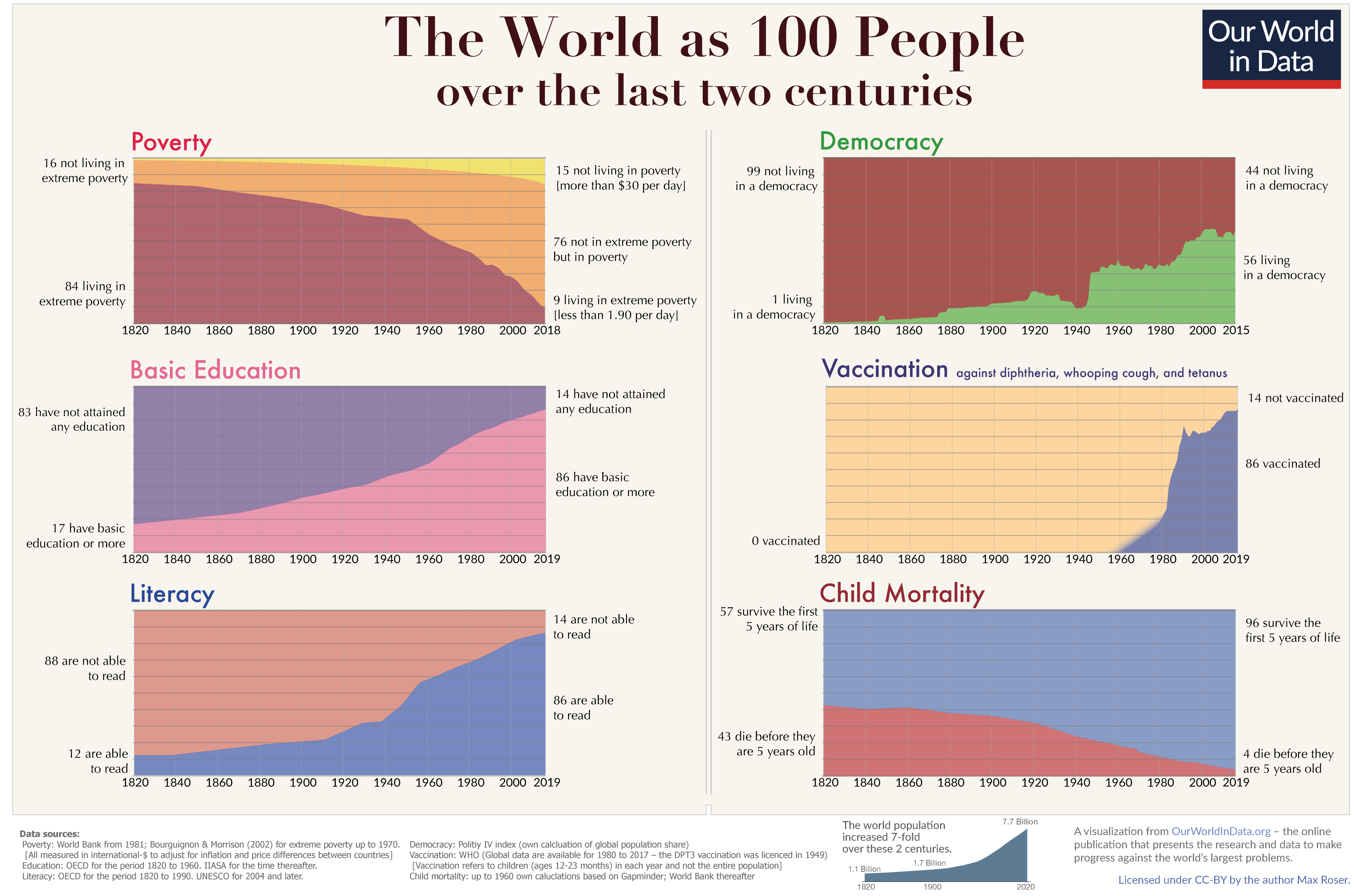
On Max Roser's A history of global living conditions in 5 charts and the future


Some days ago, I saw shared on Facebook an essay, Max Roser's "A history of global living conditions in 5 charts" at the Our World in Data project. In this essay, Roser makes the argument--contrary to the zeigeist of 2016--that, in fact, in the longue durée things have been getting decidedly better for people. Extreme poverty and premature mortality have faded, rates of literacy and education have risen, and both living standards and levels of political freedom have increased hugely. (Fertility rates, Roser has noticed, have fallen markedly worldwide as a result of these trends' conjunction.) Towards the end of this, Roser created a chart exploring just how radically things have changed.


The shift has been marked. Back in December 2010, I wrote about the demographic dynamics of the Roman Empire and other pre-modern polities, noting after Vaclav Smil that there are no modern equivalents to the terrible suffering of the past anywhere on our world now. Even central Africa, probably the least developed area of the world, is better off. More, as Roser notes, the dynamics to date are positive: rates of premature mortality and undereducation are falling, for instance.

Why is there unfounded pessimism about the world's future prospects? Roser suggests that the answer can be found in our failure to adequately understand the significance of long-running trends.

One reason why the media focusses on things that go wrong is that the media focusses on single events and single events are often bad – look at the news: plane crashes, terrorism attacks, natural disasters, election outcomes that we are not happy with. Positive developments on the other hand often happen very slowly and never make the headlines in the event-obsessed media.

The result of a media – and education system – that fails to present quantitative information on long-run developments is that the huge majority of people is completely ignorant about global development. Even the decline of global extreme poverty – by any standard one of the most important developments in our lifetime – is only known by a small fraction of the population of the UK (10%) or the US (5%). In both country’s the majority of people think that the share living in extreme poverty has increased. Two thirds in the US even think the share in extreme poverty has ‘almost doubled’. When we are ignorant about global development it is not surprising that few think that the world is getting better.

The only way to tell a history of everyone is to use statistics, only then can we hope to get an overview over the lives of the 22 billion people that lived in the last 200 years. The developments that these statistics reveal transform our global living conditions – slowly but steadily. They are reported in this online publication – Our World in Data – that my team and I have been building over the last years. We see it as a resource to show these long-term developments and thereby complement the information in the news that focus on events.

The difficulty for telling the history of how everyone’s lives changed over the last 200 years is that you cannot pick single stories. Stories about individual people are much more engaging – our minds like these stories – but they cannot be representative for how the world has changed. To achieve a representation of how the world has changed at large you have to tell many, many stories all at once; and that is statistics.


Individual stories matter, but statistical trends like these also merited tracking. Let's try to do them both this coming year, here at Demography Matters and elsewhere.

Monday, December 19, 2016

Nature's Amy MaxMen on the achievements of Gapminder's Hans Rosling


In January 2011 and June 2013, I linked to two videos by Swedish statistician and popularizer Hans Rosling demonstrating different demographic trends. Today, via 3 Quarks Daily, I came across Amy Maxmen's excellent long-format article on Rosling and his accomplishments, "Three minutes with Hans Rosling will change your mind about the world". It does a great job of explaining just what Rosling, and his Gapminder Foundatin, are trying to achieve, and why.

Back in Sweden, Rosling continued to teach global health, moving to the Karolinska Institute in Stockholm in 1996. But he came to realize that neither his students nor his colleagues grasped extreme poverty. They pictured the poor as almost everyone in the ‘developing world’: an arbitrarily defined territory that includes nations as economically diverse as Sierra Leone, Argentina, China and Afghanistan. They thought it was all large family sizes and low life expectancies: only the poorest and most conflict-ridden countries served as their reference point. “They just make it about us and them; the West and the rest,” Rosling says. How could anyone hope to solve problems if they didn’t understand the different challenges faced, for example, by Congolese subsistence farmers far from paved roads and Brazilian street vendors in urban favelas? “Scientists want to do good, but the problem is that they don’t understand the world,” Rosling says.

Ola, his son, offered to help explain the world with graphics, and built his father software that animated data compiled by the UN and the World Bank. Visual aids in hand, the elder Rosling began to script the provocative presentations that have made him famous. In one, a graph shows the distribution of incomes in 1975 — a camel’s back, with rich countries and poor countries forming two humps. Then he presses ‘go’ and China, India, Latin America and the Middle East drift forward over time. Africa moves ahead too, but not nearly as much as the others. Rosling says, “The camel dies and we have a dromedary world with one hump only!” He adds, “The per cent in poverty has decreased — still it’s appalling that so many remain in extreme poverty.”

Rosling’s online presentations grew popular, and the investment bank Goldman Sachs invited him to speak at client events. His message seemed to support advice from the firm’s chief economist, Jim O’Neill. In 2001, O’Neill had coined the acronym BRIC for the emerging economies of Brazil, Russia, India and China, often considered part of the developing world. He warned that financial experts ignored these rising powers at their peril. “I used to tease my colleagues who thought in a traditional framework,” O’Neill says. “Why are we talking about China as the developing world? Based on the rate of economic growth, China creates another Greece every three months; another UK every two years.”

Rosling welcomed the new audience. “They request my lectures because they want to know the world as it is,” he says. The private sector needs to understand the economic and political conditions of current and potential markets. “To me it was horrific to realize that business leaders had a more fact-based world view than activists and university professors.”

[. . .]

Rosling’s charm appeals to those frustrated by the persistence of myths about the world. Looming large is an idea popularized by Paul Ehrlich, an entomologist at Stanford University in California, who warned in 1968 that the world was heading towards mass starvation owing to overpopulation. Melinda Gates says that after a drink or two, people often tell her that they think the Gates Foundation may be contributing to overpopulation and environmental collapse by saving children’s lives with interventions such as vaccines. She is thrilled when Rosling smoothly uses data to show how the reverse is true: as rates of child survival have increased over time, family size has shrunk. She has joined him as a speaker at several high-level events. “I’ve watched people have this ‘aha’ moment when Hans speaks,” she says. “He breaks these myths in such a gentle way. I adore him.”


Here's another clip, a video taken last year where Rosling explains the reality of a strong convergence of Mexico with the United States.