Friday, December 29, 2006

Nigeria Population Census Results

by Edward Hugh


Well I don't have a lot to say about the details of the findings at this point (since among other things Thomas may want to say something), but as he suggested in this post, the Nigerian census results are now complete and published:

Nigeria's population is growing at an annual rate of 3.2 percent and stands at just over 140 million, a 63 percent increase in 15 years, population commission chairman Samu'ila Mukama has said.

"The total number of the Nigerian population is 140,003,542," Mukama announced in presenting the provisional results of the March 2006 census to President Olusegun Obasanjo in the federal capital Abuja on Friday.


I think it is just worth pausing to reflect on this one second: the population has increased by 63% in 15 years, or by a little over 4% per annum. This is massive (even allowing for some undercount last time) and shows clearly what an important problem continuing high fertility is.It is far from clear what is going to happen to Nigeria during the next few years, but one thing is sure, it won't be serious economic growth and development, however good the policy mix that is deployed (and the political instability that is almost inevitable makes good policy hard to expect). The preponderance of children will ensure that.

To try and understand in simple laymens terms why this is, take a look at this graph for Indian savings since 1970, and observe the steady secular rise.
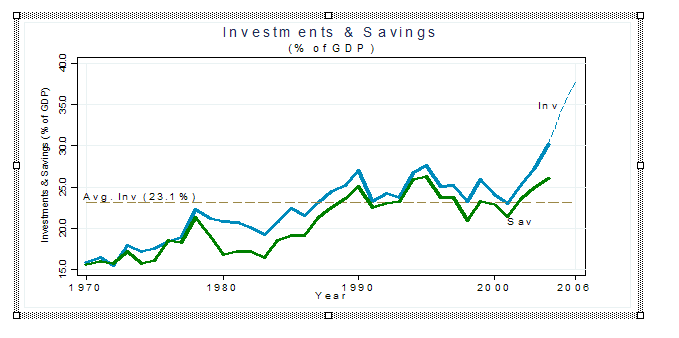


India's growth suddenly took off around 2,000, and India may well now be about to move over from a middle class consumption driven growth process, to an investment lead one thanks precisely to the important increase in internal saving, an increase which has been made possible by the reduced numbers of chidlren who have been being born in most Indian states.

At the end of the day, one big chunk of growth isn't such a mystery after all: it's the fertility silly.

So we have not one, but TWO population problems on the planet at the moment. The elderly population one in the developed world, and the excessively young population one in the yet-to-develop world (the developing world is, of course, in transition from being excessively young to being elderly, and it is precisely at this point that you get all that sizzling economic growth).

The think is both of these problems are simply crying out for policy solutions to seriously address them, but in neither case does the offer meet the need.

Thursday, December 28, 2006

Postponing and Accelerating Births

by Edward Hugh

Two vaguely related pieces of news attracted my attention today: German women it seems are busy postponing childbirth, whilst US ones are busy accelerating them, which, of course tells me that everything in the world is as I thought it was. The postponement and acceleration in question here, however, is entirely conjunctural. First the Germans:

"Enticed by a generous German government aid program for newborn children that takes effect on January 1, expectant mothers are doing what they can to prolong their pregnancies until Monday."

Behind the rush to delay there lies, as the article suggests, a new law which comes into effect on 1 January 2007, and which offers mothers of new born children significant benefits:

Worried about Germany's shrinking population and a birth rate that fell to a post-war low in 2005, the government introduced a law in September to encourage working couples to have children. They made January 1, 2007 the cut-off date.

Parents who take time off from work to care for newborns can receive two-thirds of their net monthly salary, or up to a maximum of 1,800 euros, for 12 months. If the other parent takes a further two months off, the benefit is extended to 14 months.


Now this move is obviously very welcome - although as a macro economist I would far rather that this was being paid for by a reduction in spending somewhere else and not by part of a 3% VAT tax hike, since the consequences of this on an already weak German consumption really are yet to be seen, and ageing populations involve difficult choices since resources are constrained, and growing debt is a problem which cannot simply be shrugged off, and at the end of the day governments have to take a stand in favour of the coming generations, even though this will never be easy.

Also of course it needs to be said that much as the present measure is to be welcomed, it is well short of what is actually needed. This post on Sweden gave some indication of the battery of measures that you need to actually have an impact on fertility, and of the degree of impact these can have on fertility (which is to say that such measures can nudge up fertility, but not dramatically, and they are very expensive when you add together the whole weight of the package up to the time of the labour market entry of the new child). Fertility in Germany is currently in the 1.3 range, so with a really effective pro-natalist package you might get up to 1.5/1.6 tfr, and remember none of this will impact the labour market for at least 20 years,and between now and then this is all on-cost for the society to assume, which is why such measures need to be paid for by savings elsewhere and not by increases in taxes.

Well, so much for Germany, but what about the US, well according to the New York Times:


In the last 15 years, there has been a huge increase in the number of births that are induced with drugs or come by Caesarean section. In either case, parents or doctors can often schedule a baby’s arrival on a day of their choosing.

Over this same period — since the early 1990s — the federal government has been steadily increasing the tax breaks for having a child. For parents to claim the full amount of any of these breaks in a given year, a child must simply be born by 11:59 p.m. on Dec. 31. If the baby arrives a few minutes later, the parents are often more than a thousand dollars poorer.

Unless you’re a cynic, or an economist, I realize you might have trouble believing that the intricacies of the nation’s tax code would impinge on something as sacred as the birth of a child. But it appears that you would be wrong.

In the last decade, September has lost its unchallenged status as the time for what we will call National Birth Day, the day with more births than any other. Instead, the big day fell between Christmas and New Year’s Day in four of the last seven years — 1997 through 2003 — for which the government has released birth statistics.


Now as Greg Mankiw (to whom I am indebted for this link) points out economists tend to call this process intertemporal substitution, and such processes can have large as well as small consequences, especially if they take place over years and involve a systematic upward displacement of maternal first birth ages. At the end of the day I might note that Greg Mankiw seems to be fascinated by the micro level components of fertility decisions (and even at times suggests that they well have no significant macro consequences), while I am convinced that such decisions play an important role in evolving macro phenomena and am mainly motivated by an attempt to understand what these are. In any event, here we are talking, not about storks, but about butterflies, and what happens when they flap their wings.

Tuesday, December 19, 2006

Demographic Dividend in India and the US?

by Edward Hugh


I would just like to draw readers attention to two recent blog posts which tackle very similar demographic ground, but in very different contexts. First off is The Indian Productivity Miracle, a post from Nanubhai on the Indian Economy blog. Then in second place there is Tim Duy's latest FedWatch on Mark Thoma's Economist's View (Claus has already discussed this post here).

Now the theme which holds these two - apparently unrelated - posts together is the fact that they both consider the impact of a changing demographic environment on economic performance. In the US case, it is clear that a period of very favourable demography is now about to come to an end (not exactly a demographic dividend, but damn near one). What follows comes from Tim Duy:

This - his expression of his inflation concerns - is not, however, the most interesting point in Bernanke’s speech. Nor was his view on the housing market. More interesting was his clear words on potential output:

With regard to the labor force, research by the Board's staff highlights the role of demographic factors in determining the number of people available to work in the years just ahead. Most notably, the impending retirement of the baby boomers and the fact that women are no longer increasing their participation in the labor force at the rate they were in the past will tend to restrain the future growth rate of the U.S. labor force….Even if productivity growth is sustained at a reasonably good rate, the slower expansion of the labor force will imply some moderation in the rate of growth of potential output over the next few years. In the very near term, that slower growth in the labor force needs to be taken into consideration when assessing the sustainability of given rates of expansion in economic activity.

I myself am not convinced on the outlook for baby boomers. But that shouldn’t distract from Bernanke’s point that the Fed is looking at a lower level of potential output than market participants – which translates into a lower acceptable rate of growth. Of course, this point has been made before, but I don’t think the Fed believes market participants were listening. Indeed, Fed officials apparently felt a need to reiterate the point further that week. The same day, Philadelphia Fed President Charles Plosser noted:

Of course you might ask, what is trend growth? … Up until July, most economists would have said that the rate was somewhere close to 3.5 percent, assuming labor force growth of about 1 percent and productivity growth of almost 2.5 percent. However, in July, the government issued a benchmark revision to its estimates of GDP for the last three years. The fallout from that revision was that wages and employment grew somewhat faster than was previously estimated and productivity growth was slightly lower than we thought. As a result, the commonsense estimate of trend growth has now been lowered slightly. My own view is that trend growth is closer to 3 percent than 3.5 percent. Some even claim that trend growth is as low as 2.8 percent. I don’t think it is useful to quibble over two-tenths of a percentage point, since our ability to measure productivity is so fraught with problems. Nevertheless, almost everyone agrees that estimates of trend growth are now lower. Thus, when I say that growth should return to trend in 2007, I am expecting that growth will be near 3 percent. Note that this means that it should not surprise or concern us to see growth slowing from its pace of the last few years.


(NB all of the last extract has been either Tim Duy, or Bernanke and Plosser in the indents, Edward).

Now for Nanubhai on India:

Ajay Shah, the Economist, and various investment banks (including Morgan Stanley and HSBC) have repeatedly said that India is overheated – evidenced most clearly by the run-up in inflation, and also by ‘bubble-like’ real estate and equity prices. Skittishness about the policy direction of the current governing coalition supports the prevaling belief that a crash (or, for the less brave, a “cooling down”) is imminent. According to them, economic growth and/or asset prices are both set to decrease in the near-medium term.

They may well be right. Nevertheless, it is worth taking a look at the numbers and seeing exactly what has been powering economic growth in India over the last couple of decades. If we want to figure out where the Indian economy is headed over the next 4-5 years (as opposed to say, the next 4-5 quarters), surely this is better than looking only at the short-term indicators.

Our potential workforce (defined as people aged 15-64) has been increasing at about 2% a year – and is projected to continue at that rate at least till 2020. However, labor force participation rates vary substantially from state to state, between the sexes, and between rural and urban areas – as do unemployment and underemployment. Given that labor force growth (potential workforce x overall participation rate) has been averaging about 2% over the past 10 years, in the absence of better statistics, it is a safe assumption that overall employment is growing in the range of 1-2% and gradually accelerating. (If the projections are to be believed, then the real demographic dividend is expected to come between 2009-2015 when labor force growth will accelerate to about 4% per year).

Now the real heart of the capacity debate centers around this question: what is India’s trend rate of growth now and what will it be for the next few years?.....If you add up the numbers, it seems to me that at a minimum, trend growth is at 8% (5% TFPG + 2% labor force growth + 1% capital deepening) with the capacity to reach 10% (4.5% + 3.5% + 2%) in the coming years. The 6.5% baseline level of growth that the Economist and others use to form their assessments of the Indian economy is fundamentally flawed.


Two final points from me (Edward). Firstly all of this is about trend growth, and how quickly (or slowly, Germany, Japan, Italy) an economy can grow depending on the underlying demography, and secondly: WHO THE HELL EVER HAD THE TEMERITY TO SUGGEST THAT DEMOGRAPHY DOESN'T MATTER TO ECONOMICS.