Showing posts with label immigration. Show all posts

Tuesday, February 05, 2019

Some news links: fertility, population aging, migration, demography is not destiny, Eurabia


Over the past week, I've come across some interesting news reports about different trends in different parts of the world.
  • The Independent noted that the length and severity of the Greek economic crisis means that, for many younger Greeks, the chance to have a family the size they wanted--or the chance to have a family at all--is passing. The Korea Herald, meanwhile, noted that the fertility rate in South Korea likely dipped below 1 child per woman, surely a record low for any nation-state (although some Chinese provinces, to be fair, have seen similar dips.)
  • The South China Morning Post argued that Hong Kong, facing rapid population aging, should try to keep its elderly employed. Similar arguments were made over at Bloomberg with regards to the United States, although the American demographic situation is rather less dramatic than Hong Kong's.
  • Canadian news source Global News noted that, thanks to international migration, the population of the Atlantic Canadian province of Nova Scotia actually experienced net growth. OBC Transeuropa, meanwhile, observed that despite growing emigration from Croatia to richer European Union member-states like Germany and Ireland, labour shortages are drawing substantial numbers of workers not only from the former Yugoslavia but from further afield.
  • At Open Democracy, Oliver Haynes speaking about Brexit argued strongly against assuming simple demographic change will lead to shifts of political opinion. People still need to be convinced.
  • Open Democracy's Carmen Aguilera, meanwhile, noted that far-right Spanish political party Vox is now making Eurabian arguments, suggesting that Muslim immigrants are but the vanguard of a broader Muslim invasion.

Saturday, February 10, 2018

On the unreality of imagining chain migration to be a bad thing


I have been paying attention to the world, as best as I can; I have been paying attention to demographics, though sadly not here. (Looking at the posts gathered together in the "Demographics" category at my blog, A Bit More Detail, should give you an idea as to what I've been watching.) I have not, for reasons including my mixed unhappiness and concern and confusion at ongoing trends in American politics and my ability to ignore these trends somewhat as a Canadian, have not been paying that close attention to the United States. Imagine my surprise, then, when the course of an exchange on my Facebook friend Andrew's page after Donald Trump's recent State of the Union address, I found out that the term "chain migration" had become a catch-phrase in the American far right, used to denote the sorts of immigrants and the sort of immigration that the United States should repel.

Over at VICE, Keegan Hamilton and Taylor Dolven in their article "How Trump made “chain migration” an anti-immigrant buzzword" did a good job of looking at how a perfectly useful academic phrase became an alt-right object of hate.

The current wave of nativism isn’t exactly new. In the early 20th century, U.S. immigration laws were highly discriminatory and favored white immigrants from Western Europe. The Immigration Act of 1965 ended racial quotas, but members of the far right, and occasionally the left, have sought to bring back restrictions that keep immigrants out. FAIR emerged in the late 1970s and was later followed by NumbersUSA and the Center for Immigration Studies in leading the charge to pull up the drawbridge and stop future generations of immigrants from coming.

The problem for this movement is that most American families — including many members of the White House — have benefitted from some version of chain migration somewhere along the line. Krikorian is aware that this paradox can make his position a difficult sell.

“There was a common cliche, ‘I’m not against immigration, I’m only against illegal immigration,’” Krikorian said. “For a lot of people, that was a way of talking about their concerns over immigration in a way that was either PC or that maintained their own cognitive balance because you know their grandma came through Ellis Island and they were conflicted against the issue, but at least they could be against illegal immigration.”

The increasing focus on “chain migration” tracks with the rising influence of far-right immigration groups. Historians have pointed out that social scientists and other scholars have been using the term for decades to describe the various waves of the Great Migration in the United States. It has appeared in official government records, including a 1988 report by the General Accounting Office that described how backlogs in the visa system were making it take decades for links in the chain to form. Since then, the clogs have only gotten worse. It can take anywhere from five to 25 years or more, depending on the country and the type of family member, for the government to process visa requests and families to be reunited.

Krikorian notes that as recently as 2010, Sen. Dick Durbin, a leading proponent of immigration reform, mentioned chain migration on the Senate floor, and he insists it’s not a loaded phrase. But it has taken on undeniable baggage in the current political climate, in which some on the far-right consider ending chain migration is an even higher priority than delivering Trump’s border wall.


Detailed criticisms of Trump's use of the term "chain migration" abound, done by Miriam Valverde at Politifact and done by Philip Bump at the Washington Post and done by Raquel Aldana at The Conversation. Trump's representation of chain migration, in the American context, as something that allows the rapid and nigh-unlimited resettlement of large numbers of relatives of even recent immigrants in large numbers is simply false. Trump is using a term that has one established meaning and, without even bothering to indicate that he is trying to change the meaning, do so. People less generous than me might call him a liar, or a fool. (Should I join them?)

Chain migration is normal. Chain migration is usually the way immigrants come to the United States, or come to any country. This was noted this week by Jonathan Blitzer in The New Yorker, in his examination of the work of a freelance genealogist.

Jennifer Mendelsohn, a freelance writer based in Baltimore, has a low tolerance for bad faith. Last summer, after Stephen Miller, the White House senior policy adviser, went on television to support a bill that would penalize immigrants who didn’t speak English, Mendelsohn took to Twitter. “Miller favors immigrants who speak English,” she began. “But the 1910 census shows his own great-grandmother couldn’t.” Her tweet, which included a photograph of a census document indicating that Miller’s ancestor spoke only Yiddish, went viral. “It’s hilarious how easy it is to find hypocrisy,” Mendelsohn said. “And I’m a scary-good sleuth.”

Miller wasn’t the only person she skewered after scouring the Internet for clues. She searched articles in local papers for the names of anti-immigrant activists’ family members, then plugged the information into search engines (familysearch.org, ancestry.com), which gave her birth and death records and marriage notices. “Someone called it ‘ancestor doxing,’ ” she said. “Please—it’s called journalism.” The grandmother of the Iowa Republican congressman Steve King—who has said that “we can’t restore our civilization with somebody else’s babies”—arrived at Ellis Island as a child, in 1894. Mendelsohn discovered that the great-great-grandfather of the Fox News commentator Tomi Lahren—“Respect our laws and we welcome you. If not, bye”—had been indicted for forging citizenship papers, in 1917. A Swiss ancestor of Lahren’s colleague Tucker Carlson—“Why does America benefit from having tons of people from failing countries come here?”—came to America looking for work, in 1860. Mendelsohn started publishing entries from census ledgers, turn-of-the-century news clippings, and memoirs shared among relatives. “The historical record doesn’t lie,” she said.

[. . .]

Then Donald Trump came along. His Administration prefers to call family-based immigration by a more sinister-sounding name, “chain migration.” Mendelsohn isn’t having it: “They’re telling the American people that chain migration is some new thing to be afraid of. I’m saying, ‘Not on my turf.’ ”

Last month, a White House official named Dan Scavino said that chain migration was “choking” America. “He’s lucky, or unlucky, that he’s Italian,” Mendelsohn said. After researching a Sicilian adoption, she’d recently learned how to search Italian records. Several days after his pronouncement, she had a message for Scavino. “So Dan,” she wrote on Twitter. “Let’s say Victor Scavino arrives from Canelli, Italy in 1904, then brother Hector in 1905, brother Gildo in 1912, sister Esther in 1913, & sister Clotilde and their father Giuseppe in 1916, and they live together in NY. Do you think that would count as chain migration?”


It isn't even about family migration. "Family reunification" is but one element of chain migration. Chain migration is a sort of migration that not only families but entire communities participate in. This, frankly, is something anyone should have expected. How often is it that close friends and intimates, the sorts of people one would expect to report truthfully about their experiences in the places where they went in pursuit of their destinations, would only consist of biological relatives? Wikipedia's article on chain migration provides plenty of examples of this sort of migration. I don't think I myself can be said to have partaken in this--I did know plenty of people in Toronto by the time I moved here from Prince Edward Island, but I did not follow other Islanders I knew to this metropolis--but there is a long tradition of a coherent pattern of Atlantic Canadian migration to this city, one described in Greg Marquis' 2010 article for Atlantic Canadian journal Acadiensis, "Confederation’s Casualties: The “Maritimer” as a Problem in 1960s Toronto". (Apparently my co-regionals tended to initially concentrate in the poor neighbourhood of Parkdale, abused alcohol, and were prone to knife fights.) Turning to the example of the United States, the exceptional granularity of immigration to the United States becomes clear. "Welcome to Oaxacalifornia" and more recently in a scholarly format in his 2015 Social Justice article "From Hometown Clubs to Transnational Social Movement: The Evolution of Oaxacan Migrant Associations in California". (Far Outliers, meanwhile, has a nice 2007 post outlining the origins of this diaspora and its often evangelically Protestant nature.)

Chain migration is normal. Chain migration, in that it lets prospective migrants save precious social and economic capital by helping them plug into communities in their destination regions, is a good thing. I really fail to see how trying to discourage chain migration could possibly lead to better outcomes, for migrants or their destination countries. Do we really want to transform population movements, across internal and international borders, from coherent patterns to an atomized collection of individuals? Noah Smith recently made the point over at Bloomberg View that opposing chain migration--in his narrow argument, migration connected to family not to wider communities--would badly hurt Asian Americans.

In 1960, before the immigration reform, there were fewer than 1 million people of Asian descent in the U.S. -- less than half a percent of the population. As of 2016, there were more than 21 million, representing almost 7 percent of the population. That’s about three times the number of Jewish Americans, and about half the number of black Americans. In states such as California and Hawaii, the Asian percentage is even larger.

Unlike Mexico, Asian countries don’t share a land border with the U.S. This means that there are two main ways for Asians to move to the country -- employer-sponsored visas like the H-1B, or family reunification. In 2016, Asians were the biggest users of family preference immigration -- one kind of legal immigration that Trump would mostly do away with[.]

Without family-reunification immigration, there would still be many Hispanic Americans and black Americans, but there wouldn’t be nearly so many Asian Americans. Combined, family preference and immediate family immigration (which includes spouses, minor children, and parents) accounts for a very large percent of the growth of Asian minorities[.]

If adult children, parents and siblings of U.S. citizens were barred from immigrating, as under Trump’s plan, the growth of Asian America would slow dramatically. The slowdown would be even worse than these graphs show, because some highly skilled employer-sponsored immigrants would refuse to come work in the country if they couldn’t bring their elderly parents with them.

That would certainly be a slap in the face to Asian Americans, since many would take the restriction as a declaration that they are undesirable as a group. What’s more, to repudiate family-based immigration is tantamount to wishing that Asian America as we now know it had never come into existence.

Though high-skilled immigrants come from all regions of the globe, and all have been successful in the U.S., the achievements of Asian Americans are particularly well-known. Despite language barriers and lack of local ties, Asian Americans tend to be economically successful, comparing favorably to the Norwegian immigrants Trump declared he wanted[.]

Asian Americans also have persistently lower unemployment rates than white Americans, and their average wealth has been increasing rapidly. Beyond these blunt economic statistics, Asian Americans have contributed to the fabric of American society in countless key ways -- starting companies such as YouTube, Yahoo and NVIDIA; inventing the birth control pill and AIDS treatment; directing Hollywood movies; serving in the U.S. Senate; and helping defeat the country’s enemies on the battlefield. And those are only a few famous individuals -- there are many more, in addition to the countless less famous Asian Americans who have added in a million small positive ways to the fabric of the country. Meanwhile, this new group of people been integrating rapidly and deeply into American society -- 46 percent of U.S.-born Asian Americans intermarry with Americans of other backgrounds.

The point here is not to glorify Asian Americans over other immigrant groups, or to imply that only famous or high-earning individuals contribute to America. The point here is merely to illustrate one clear example of a case where “chain migration” added something special to the U.S. that wouldn’t even exist otherwise.


I am still, at the end of this post, still taken aback that chain migration is supposed to be a bad thing. How are migrants supposed to learn local conditions and build communities in new homes without knowing people they trust who have done this? Why is this sort of informed migration bad?

Of course, the people who are making these arguments are lying about their opposition to chain migration being economically rational. Would they be talking about chain migration in this pejorative way if it was the immigration of Norwegians instead of Mexicans they were paying attention to? And why, I ask, would their language differ, change, as they moved from talking about the first movement to talking bout the second? Frankly, opposing chain migration strikes me as proof of the idea that cruelty is rarely rational. Not letting migrants make and sustain networks hurts everyone.

Tuesday, June 09, 2015

Some migration-related news links

  • Al Jazeera has hosted a few interesting articles exploring different kinds of migration. Alia Malek's "Daughters of Diaspora: two Algerian sisters, one in Texas, one in Paris" looks at the experiences of two Algerian sisters, one immigrating to France and the other to the United States, in the very different enviroments of their two adopted countries. Alia Malek's "Shaped by the decisions their mothers made, two cousins grapple with assimilation in both the U.S. and France" notes the substantial flight of ethnic Armenians from Syria to their ethnic homeland, quite possibly the largest post-Soviet migration to Armenia since the end of the Soviet Union. Anna Nigmatulina's "Brazil’s urban Indians confront city life head on, with headdress off" examines how Brazilian indigenous peoples fare in the cities of Brazil, while "Charity offers hope to Mexico's Mixtec elderly" by John Holman looks at how elderly Mixtec left to themselves by younger generations of migrants cope.
  • Portugal, meanwhile, remains a country of migrations. Bloomberg's Henrique Almeida and Joao Lima "Portuguese With No Pay From Oil Bust in Africa Go Home to No Job" describe how many Portguese emigrants to Angola have been forced to return in the aftermath of the end of the Angolan oil boom, while Raphael Minder's "Azorean Diaspora Can’t Resist the Powerful Pull of Home" in The New York Times looks at how Azorean migrants and their descendants in North America relate to their ancestral archipelago.
  • Vice's Maurice Chammah described in " Why Are Nigerians Flocking to Work in Texas Prisons?"
  • a remarkable story of chain migration, from West Africa to Texas, driven by employment opportunities in Texan prisons.

    Thursday, April 02, 2015

    On the transformation of Canada's temporary foreign worker program


    Today in Canada is a notable day in Canada's immigration history, for today is the day that changes in the Temporary Foreign Worker program are going to have a significant but as yet uncertain effect on the lives of people in the Canadian labour market. David P. Ball's article in British Columbian newsmagazine The Tyee, "Foreign Worker Exodus Expected as New Rules Kick in" outlines the situation.

    Changes to the Temporary Foreign Worker Program will force the removal of tens of thousands of workers from the country starting today.
    This will have an immediate impact not only on workers who have been in the country for more than four years, but also on industries that use foreign workers such as restaurants, construction and the agricultural sector.

    The new rules will apply to an estimated 70,000 temporary workers, migrant advocates claim, but the exact number is not known and has not been revealed by Citizenship and Immigration Canada. Under the rules, workers who have been in the country longer than four years must leave. Once out of the country, they can't re-apply for another work permit to enter Canada for another four years, hence the "four-in, four-out" description.

    There are more than 300,000 temporary foreign workers in Canada.

    The "four-in-four-out" policy was announced in 2011 amid public debate over whether the program was replacing Canadians' jobs and exploiting non-Canadian labourers at the same time.


    Last year, as a consequence of media reports that a significant number Canadian employers were bringing in temporary foreign workers in circumstances where there was no need--not only bringing in skilled labour, but bringing in unskilled labourers at a time of high domestic unemployment, the federal government clamped down significantly on the program. This extended analysis by the CBC's Tracy Johnson makes the point that, even now, basic information about the numbers of workers who will be affected remains vague. Betting on tens of thousands of people, perhaps--I speculate--as many as a hundred thousand--seems safe..

    Here's what we don't know — how many are set to leave April 1. Temporary workers who have been working in Canada since April 1, 2011, will see their visas expire, unless they were given the one-year reprieve.

    Migrante Canada says that based on the number of people asking for help in Alberta, 16,000 are vulnerable. But that doesn't mean they all have to leave April 1.

    "Well it's a rolling number," says Gil McGowan, president of the Alberta Federation of Labour. "Because it depends on when their employers got their approval and the workers got their visa."

    In June, the federal government made changes to the temporary foreign worker program after numerous abuses were reported by CBC
    News.
    The changes included a ban on low-wage temporary foreign workers in regions where the unemployment rate is higher than six per cent and ultimately a 10 per cent cap in areas where unemployment is lower. Low-wage temporary foreign workers are defined as workers who earn less than the median income of approximately $20 per hour, depending on your province.

    The consequences for the workers themselves will be severe: Without any chance to return to Canada for four years, these workers and their dependents will face significant issues. As reported by Torontoist' Desmond Cole, this could well lead to many of the former temporary foreign workers overstaying their visas, perhaps giving Canada a significant problem with overstaying--illegal--migrants. At the same time, the impact on the Canadian labour market could be significant. Will Canadians take up the newly-available jobs in substantial numbers? Do the demographics of the Canadian labour force, with a diminishing number of young people able and willing to fill these "starter" jobs, support this? Will employers improve the working conditions they offer so as to be more competitive?

    More will come later. I'm still thinking through the consequences of this. I would be interested to hear from our readers about what they think of all this. Is this a good strategy to increase levels of unemployment? Is this a fair strategy, for Canadians and for foreign workers alike? Will it work?

    Thursday, March 26, 2015

    On Jollibee, the Philippines, and diaspora economics

    Over on my blog this evening, I noted that Philippines I based fast food chain Jollibee was set to open its first Canadian location later this year in Toronto. Apparently part of the chain's plans for global exchange expansion, with more locations slated to open up in the United States, Europe, Japan, and the Middle East, the Toronto restaurant is being created as part of a diaspora events red strategy. instead of competing head-on with established chains, for the foreseeable future Jollibee in Canada--and elsewhere?--will be targeting communities with larger Filipino populations. Already familiar with the chain, the thinking seems to be that these communities will hopefully serve as the base for future growth.

    This strategy makes sense to me. Is Jollibee's expansion globally based on a similar strategy? If so, I wonder if a South Korea with its own rapidly growing ties with the Philippines might also be targeted. One strategy common to many immigrant groups around the world, as they grow in number and start to become business owners s, is to specialize in food. To the best of my knowledge, Jollibee is unique in being a fast food chain. Are there comparable cases elsewhere in the world that I am missing? I am quite curious. I also wonder if, given likely future growth in Filipino-originating communities around the world, Jollibee might be a good investment.

    Saturday, February 21, 2015

    Three links on African immigration to China


    1. I'd like to point people towards Africans in China, a blog maintained by researcher Roberto Castillo. This blog concentrates on the African immigrant community in Guangzhou, its development and its issues.

    2. Yucheng Liang's study "The causal mechanism of migration behaviors of African immigrants in Guangzhou: from the perspective of cumulative causation theory", published in 2014 in The Journal of Chinese Sociology, draws on ethnographic interviews and statistical analyses to argue that African immigraiton to China can be expected to continue and that China should innovate accordingly to try to minimize potential problems.

    This study tests international migration theory, especially cumulative causation theory, by looking into the causal mechanisms of international migration behavior among African immigrants in China by using the respondent-driven sampling method since African immigrants in China belong to a small hidden population. This method collected a representative sample (N = 648) from two locations in 2011. The paper reveals that the immigration behaviors of African immigrants in China from 2005 to 2011 have characteristics similar to international immigrants in initial stages - the cumulative causal effects of immigrants' social capital was continually strengthened during the reproduction of migration behavior in the sending countries. Consequently, given the sustainable economic growth and maintenance of a stable society in China, the scale of future transnational immigration (including illegal migration) will continue to expand. The paper proposes that at the present stage, existing policies should raise the entry threshold of African immigrants into China in order to mitigate the speed and scale of migrants' social class decline.

    It's also quite interesting to note that, far from Guangzhou and the south of China, in the Zhejiang city of Yiwu in the lower Yangtze basin, another African immigrant community is starting to take form. I point readers specifically towards the 2010 article "From Guangzhou to Yiwu: Emerging facets of the African Diaspora in China" (PDF format), written by Adams B. Bodomo and Grace Ma and published in the International Journal of African Renaissance Studies - Multi-, Inter- and Transdisciplinarity. This article suggests that, owing to a variety of factors, Africans have better experiences here than in Guangzhou.

    Yiwu Africans also experience constraints in their Chinese sojourn but these are not different from what any foreigner living in China would experience: linguistic misunderstandings, cultural differences, and even having to put up with socially unacceptable practices like spitting profusely. But Yiwu Africans, in most cases, are treated respectfully by Zhejiang law enforcement officers. Civil liberties are well respected. For instance, freedom of worship among these Africans seems to be one of the highest in China. There may be a number of reasons why this difference is there. One, it may be that Africans who number less than 30,000 in Yiwu can be contained easily. Two, most of the Africans in Yiwu are from the Magbreb region of Africa, while most Africans in Guangzhou are from Sub-Saharan Africa. My fellow West Africans in Guangzhou report that even the brutal Guangzhou police treat Arab Africans more respectfully than Black Africans. But, third, and more importantly, the difference, we propose here, is due to the differences in efficiency and fairness on the part of Yiwu law enforcement officers such as the police and immigration officials. We propose here that, partly as a result of these differences in treatment, and also if Yiwu gets more developed into an international trade centre, it may overtake Guangzhou as a model residential city for Africans and many foreign businessmen from developing parts of the world, such as West Asia and Latin America. In that sense then, Guangzhou is missing an early opportunity as a model multi-racial business city in China.

    If in fact the majority of African migrants in Yiwu are from the Maghreb, this does suggest at least the potential for Yiwu to start attracting migrants from the wider Arab world. The role of Islam in binding together Chinese and non-Chinese Muslims, meanwhile, is also noteworthy.

    Friday, June 14, 2013

    On the problems of David Goodhart on immigration in the United Kingdom


    I was alerted by a post by Yorkshire Ranter Alex Harrowell about Jonathan Portes' review of David Goodhart's new book about immigration in the United Kingdom, The British Dream. The title? "An Exercise in Scapegoating".

    The problem with Goodhart's book, simply put, is that it doesn't appear to deal with facts.

    There are two major problems with contemporary British society, according to David Goodhart in The British Dream, and both are primarily caused by immigration. The first problem is economic: the plight of the white working class, especially the young, and the decline of social mobility. Goodhart argues that low-skilled immigrants have taken jobs from unskilled natives, leaving them languishing on benefits, while high-skilled immigration reduces both the incentives and opportunities for ambitious and talented natives to move up the ladder. Many find this thesis convincing, and it has been accepted as fact by much of the political elite. There is, however, almost no evidence to support it. The second problem is social: the decline of a shared sense of community, local and national, which Goodhart relates to the failure of at least some immigrants to integrate, either ‘physically’ (where they live, who their kids go to school with, what language they speak and so on) or ‘mentally’ (in terms of the degree to which they identify with Britain, or share a common set of values). Some may think this argument has more force, but again, his conclusions far outrun the facts.

    I’ll start with the economics. Goodhart gives a fair summary of the current consensus about the effects of immigration on the labour market. It comes in two parts. First, in the medium to long term the ‘lump of labour’ fallacy is just that: it isn’t true that the number of jobs in the economy is fixed, and more jobs for immigrants doesn’t mean fewer for natives. Second, the evidence suggests that in the UK immigration has little or no impact on employment even in the short term; it may drive down wages for the low-skilled, but the effect is small compared to that of other factors (technological change, the national minimum wage and so on). These things are now well established, and Goodhart appears to accept them. So it comes as something of a surprise that he should cite with approval Fraser Nelson’s observation that mass immigration ‘broke the link between more jobs and less dole’[.]

    [. . .]

    Goodhart cannot escape from his instinctive view that the political economy of immigration is a zero-sum game, even as he accepts that both economic theory and the evidence say no such thing. ‘A disproportionate number of new jobs,’ he writes, ‘seem to have been going to recent immigrants.’ But this is an expression of the ‘lump of labour’ fallacy he elsewhere dismisses. The belief that if immigrants get ‘more’ of something (jobs, education, opportunities, political power), natives (or whites) must get less. This guides his discussion of the local economic impact of immigration in Merton, South-West London: ‘Poor whites [are] doing the worst of the lot.’ Such people have ‘mainly opted out: they seldom vote, and a lot of the younger people are “Neets” – not in employment, education or training.’ It isn’t entirely obvious from Goodhart’s description of Merton why immigration is responsible for this. Do the immigrants displace natives from jobs, schools and polling booths, or do they somehow drag them down? Either way, such facts as there are in this sentence appear to be wrong. Do fewer working-class whites vote in Merton than elsewhere? I’m not aware of the existence of any statistics on local voting by ethnicity or class, but both the Merton constituencies (Mitcham and Morden, and Wimbledon) had a higher than average turnout at the last election, and more than two-thirds of Merton voters are white. As for Neets, the Merton Council report cited by Goodhart found 87 white Neets aged 16-18. Is that a lot? Not really: there are about 2300 whites in the relevant age group. Whether the council’s data are directly comparable with official statistics isn’t certain, but if they are then the chances of a white teenager being Neet are considerably lower in Merton than they are nationally. (The official statistics suggest that Merton’s Neet rates are pretty low.)


    More, Goodhart's problems with facts seem to have unsettling inclinations.

    Goodhart is of course right that young Brits, especially those not from middle-class backgrounds, are having a pretty hard time. But the question is why. Think about it this way. Suppose you’re poor, young and white: where in the UK don’t you want to be? That’s a subjective question. But from an economic point of view, one might want to consider such criteria as the proportion of young people who don’t get decent GCSEs and the number who are out of work. By those yardsticks, the answers are reasonably clear. Nationally, just under 60 per cent of kids whose first language is English get five good GCSEs including maths and English. There are eight local government districts where that figure dips below 50 per cent: Hartlepool, Middlesbrough, Knowsley, Blackpool, Barnsley, Hull, Nottingham and the Isle of Wight. Job prospects for young white school-leavers in these areas are, not surprisingly, poor: the proportion on the dole ranges from 12 to 18 per cent, compared to the national average of about 8 per cent. Yet of these areas, only Nottingham has a substantial non-white or immigrant population. In London, children whose first language is English are somewhat more likely (about 62 per cent) than the national average to get five good GCSEs, despite considerably higher poverty rates. Young whites in London don’t often end up on the dole: only about 5.5 per cent, close to the lowest rates in the country. Things are a little worse in Merton, where GCSE results are about average, and the proportion of young whites claiming benefits is about 6.5 per cent, but that’s still well under the national average.

    So, to put it bluntly, if you’re going to be white, British and poor, all the statistical evidence suggests you’d be better off being born in Merton – or anywhere else in London, surrounded by immigrants – than in the mostly white areas where educational outcomes, in particular, are worse. We need to be careful here. Correlation doesn’t imply causation. There are lots of possible explanations for the figures I have given; in particular, the remarkable improvement in London’s schools, especially for more disadvantaged children, over the last decade. And there’s little doubt that the depression of local economies in some Northern cities is responsible for both the high unemployment and relatively low immigration in those places. Econometric analysis suggests that there’s little or no association between high immigration and employment or unemployment rates.


    And:

    Goodhart [makes] an absurd, some would say offensive, analogy with the US. Talking about Waltham Forest in North-East London, he writes: ‘In America, this is called Sundown Segregation; people mixing during the day but going home to quite separate neighbourhoods.’ ‘Sundown towns’, as the sociologist James Loewen has documented, were places in the US where, before the enactment of civil rights legislation, black people (sometimes in earlier years also Chinese, or Mexicans) were not permitted to remain after dark. I’m not sure which is worse: the irrelevance of this concept to modern Britain; the failure to do the elementary research required to establish the origin of the term; or the ugliness of comparing Waltham Forest to American towns that once displayed signs reading ‘Don’t let the sun set on you, nigger.’

    Even worse is Goodhart’s discussion of specific communities where there are very real economic and social problems. I know little about Bradford, so have no firm basis on which to judge his plausible-sounding claims about the Pakistani immigrant experience there: much higher segregation than in London, the dominance of clan politics, the impacts of chain marriage migration etc. A friend in Bradford – a professional, leftish woman of Pakistani origin, working in education – told me that what he has to say is ‘unscientific’, based on ‘cheap anecdotes and quite frankly baloney’. No reason you should take her word for it, so let’s provisionally accept Goodhart’s suggestion that there is a prima facie case that first-cousin marriage is responsible for a higher than average proportion of birth defects among Bradford Pakistanis. He cites some relevant research, but follows it up with assertions which are unsubstantiated, inaccurate and alarmist: ‘Bradford has just opened two more schools for children with Special Educational Needs,’ he writes. ‘On some measures nearly half of all children in the area qualify for special help.’ No source. However, the Department for Education publishes the statistics, and it turns out that in Bradford, the proportion of children who ‘qualify for special help’ is about 21 per cent. Well, 21 per cent is not ‘nearly half’. It is, in fact, only slightly higher than the national average of 20 per cent. And it is significantly lower than in some other, mostly white places. Nationally, the highest figure is 27 per cent, in north-east Lincolnshire. What’s going on? Maybe the locals marry their cousins there too. But I think I’ll restrict myself to saying that this is a complex phenomenon on which I’m no expert. It’s a pity Goodhart didn’t do the same.


    David Edgar's Guardian review touches on this.

    Many elements of this narrative are questionable. Set against comparable countries, Britain's current immigration level is average: both Germany and France have higher numerical foreign-born populations, and 11 EU countries have immigrant populations which are proportionately higher than ours. It's true that less than half of current immigration comes from the EU, but emigration by non-EU citizens is higher too. As Goodhart acknowledges, more than 70% of current immigrants stay less than five years, because so many of them are students (only half of the headline four million have settled here). Studies of the 2011 census indicate that large cities such as Birmingham and Bradford have seen a decrease in segregation for most ethnic groups; in London, the decrease is particularly notable among Bangladeshis.

    The argument that racism is greatly exaggerated doesn't really stand up either. The five-fold increase in the number of racist attacks since the early 90s may be partly due to changing definitions, but the absolute 2011-2012 figure of 47,678 racist incidents in England and Wales, of which 35,816 were recorded by the police as race-hate crimes, is a dramatic figure in itself. Goodhart's argument that press demonisation of immigrants contributes positively to race relations by providing "a psychological safety valve" is clearly self-serving. On pay, a 2008 report to the Equality and Human Rights Commission found that the earnings of Pakistani and Bangladeshi men at the low and middle levels of education were only two thirds of those of similarly qualified white men. On employment, male Chinese graduates are over three-quarters less likely to be employed than their white peers. And while Goodhart acknowledges the results of the so-called "CV tests", revealing that employers are still less likely to employ applicants with ethnic minority names, he justifies the discrepancy on the grounds that such people might prove "a source of tension and embarrassment" in the workplace, as, after all, "people will generally give preference to, and feel more comfortable being around, people they are familiar with". Acting on such attitudes as an employer has, of course, been illegal since the passage of the 1968 Race Relations Act.

    [. . .]

    Of course Goodhart acknowledges the cultural and (in a selective kind of way) the intellectual contribution of Britain's postwar immigrant communities. But recognising the changes that were brought about not in restaurants or at concerts or universities, but in workplaces and on the streets, through campaigns that were initially resisted by large sections of the host community, challenges the notion of a unified, linear national story. Goodhart's insistence that integration cannot be a "two-way street" and that immigrants "must carry the burden of any adaptation that is necessary" raises the question of what is being adapted to.


    Harrowell has written at length about Goodhart's radicalization, here, noting (after a blog post by Portes) Goodhart's own claims that the United Kingdom is being run by people who care more for the benefits of people in Burundi than of people in Birmingham.

    Well, we've been warned.

    Thursday, June 06, 2013

    Some demographics-related news links


    * I was quite surprised by the news, reported by the BBC among others, that the most recent German census revealed that the country's overall population was overestimated by 1.5 million. The whole set of discrepancies between updated estimates for West and East Germany and the 2011 census is described in detail at the website of the Federal Statistical Office of Germany, here, here, and here. It's noteworthy that the biggest overestimate by far occurred among foreigners, whose numbers were overestimated by 1.1 million.

    * News from Europe's periphery is generally dire. The Inter Press Service's Zoltán Dujisin argues that Hungary is starting to experience a brain drain of professionals to western Europe, a consequence of deteriorating economic and political conditions. The Portugal News observes the continuing fall in Portuguese birth rates, noting that poverty--not just a lack of funding for families, but absolute shortages of necessities like money and even food--is preventing any possibility of a quick recovery. Reporting from Skopje, Balkan Insight notes that more than a tenth of the population of Macedonia is recorded to have emigrated between 1998 and 2011, Eurostat additionally noting that this does not capture irregular migration. Also from the Balkans, the BBC has a depressing profile of the employment situation for young people in Greece. Where emigration is not a realistic option, volunteering is often the only possibility for young Greeks to do something in the hope that, one day, they might enjoy a salary.

    * At New Eastern Europe, Filip Mazurczak writes about demographic policies in the former Communist world, arguing that the discontinuation of perfectly helpful policies like workplace childcare after the end of Communism may have contributed to the collapse of birth rates. Estonia is singled out as one country that has made noteworthy progress, as is Russia. The Baltic Course takes a look at the balance of migration in Estonia. Emigration and immigration have both surged in recent years, with just under eleven thousand people leaving in 2012 and a bit over four thousand immigrating. Finland and United Kingdom are the major destinations for Estonian emigrants, while Finland and Russia are the major sources of immigrants. Estonia is uniquely favoured among the Baltic States in having a migration partner so close at hand in Finland.

    * The Daily Mail notes that rural and even exurban areas of the United States are facing population decline and aging, as dismal economies and shrinking opportunities encourage migration to cities.

    * The Economist observes the rapid and thorough demographic transformations of Latin America, with sharply falling fertility rates, radically changed gender roles, and the rise of new family forms including cohabitation. The article's conclusion that Latin America risks wasting its demographic dividend if it doesn't transform its educational and pension systems in time to, respectively, maximize the coming generation's human capital and prepare to finance its retirement.

    * Also at the Economist, the Buttonwood blog examines Spanish youth unemployment, placing the relative reluctance of young Spanish workers to migrate to Germany (compared to their Greek, Romanian, and Polish counterparts) to the relatively better conditions they experience and argues that youth unemployment estimates wrongly include students and mothers of young children.

    * The South China Morning Post notes that in Hong Kong, the ongoing fall in fertility rates now means that one-child families outnumber their two-child counterparts for the first time in the city-state's history. In adjacent Macau, meanwhile, population growth is dominated by immigration, 60% of immigrants coming from China but a quarter from the Philippines and Vietnam.

    * Australia's ABC News argues that Australia's much-hyped baby bonus didn't contribute to the uptick in fertility rates in that country, that the recuperation of postponed fertility is a more likely explanation.

    * Finally, on the lighter end, the Czech capital of Prague has assigned subway cars to singles and the Hungarian government is setting up dance parties, all in efforts to boost birth rates. The Atlantic's Jordan Weissman wonders, meanwhile, if spending on pets and pet ownership is growing as people of parent age respond to the growing costs of children by switching to less expensive substitutes.

    Tuesday, January 15, 2013

    More on France versus Germany


    My post last Monday compared French and German fertility patterns, as key elements in French and German demographic patterns. It's been noted for some time that the populations of Germany and France, the first and second-largest countries in the Eurozone and European Union by population and the anchors of the European Union, are evolving in very different directions. In my 2008 post on Eurostat's demographic projections for 2060, for instance, I noted that the projections assume that the French population will grow to surpass a shrinking German population.

    These differences have continued. Gérard Cornilleau's blog post at the French Economic Observatory, "France-Germany: The big demographic gap", outlines the extent to which fertility in France and Germany has been different for the past half-century.

    The demographic trajectories of France and Germany are the product of Europe’s history, and in particular its wars. The superposition of the age pyramids is instructive in this regard: in Germany the most numerous generations are those born during the Nazi period, up to 1946; then come the cohorts born in the mid-1960s (the children of the generations born under the Nazis). In contrast, in France the 1930s generation is not very numerous. As a consequence, the baby-boomer generation which, as can be easily understood, kicked off earlier than in Germany (starting in 1945, at a time of a baby crash in Germany that ended only in the early 1950s, with the German baby boom peaking somewhat late, in the 1960s), was limited in scale, as people of childbearing age were not numerous. On the other hand, the birth rate in France slowed much less in the wake of the 1970s crisis, and most of all it has risen again since the early 1990s. This has resulted in the fertility rate remaining close to 2 children per woman of childbearing age, so that the size of the generations from 1947 to the present has remained virtually constant. German reunification led to a collapse in the birth rate in former East Germany, which converged with the rate in ex-West Germany in the mid-2000s. Overall, French fertility has generally been higher than German fertility in the post-war period, with the gap widening since the early 2000s. As a result, the number of births in France is now substantially higher than the number in Germany: in 2011, 828,000 compared with 678,000, i.e. 22% more births in France.

    A recent German study goes into more detail. France is going to be enjoy a relative advantage over Germany in that its working-age population will not shrink.

    During the post-war baby boom, women in both France and Germany gave birth to more children than today. However, while fertility rates in Germany declined significantly in the mid-1970s and have been fluctuating around the number of 1.4 children per woman ever since, French rates have never dropped below 1.7 and have even climbed back to about 2.0 children recently. Since the decimated generations of German women, who were born in the 1970s and after, are in the midst of their childbearing careers today, the downward trend is gathering pace: Since the 1960s, the number of newborns has halved - from 1.35 million to less than 700,000 per year. Furthermore, due to the constantly shrinking cohorts of potential mothers, this figure is likely to decrease even further. The picture looks different in France: Here, around 750,000 children are being born every year for quite some time already.

    The neighbouring countries also differ when it comes to migration: France has been recording net immigration of maximum 200,000 people for the last 40 years. Germany's migration figures, on the contrary, exhibit considerable upward deflections: in times of the guest worker immigration, but also after the end of the Cold War, when around three million ethnic Germans from the former Soviet Union, and in consequence of the Yugoslavia War, numerous refugees entered the country. Meanwhile, however, the attractiveness of Germany as an immigration country has declined considerably. In 2008, statisticians observed net immigration of a mere 4,800 people. That same year, France welcomed 67,000 immigrants, mostly North Africans, who reunited with their families in Europe. In France, both nationals and foreigners have more children than their respective counterparts in Germany.

    However, even France is not spared from the trend of demographic ageing. Not only because life expectancy is increasing steadily in both countries - the French figures of 84.4 years for women and 77.5 years for men are even significantly higher than in Germany, where women average 82.3 years, while men can expect 76.9 life years -, but also because the French have less children than in the past. Here too, a generation of families with many children is replaced by one with comparatively few, although at a different level than in Germany. While in Germany the share of under 20-year-olds in society will decrease from 19.5 per cent in 2007 to 15.1 per cent in 2050, in France it will drop from 24.7 to 21.9 per cent. Analogously, over the same time period the share of over 64-year-olds will rise from 19.9 to 33.2 per cent in Germany, while, in France, it will only reach 26.2 per cent in 2050 - up from 16.5 in 2007.

    At a rate of two children per woman, the number of people of working age - defined here as 20 to 64 years - will remain constant in France until 2050. In Germany, however, the potential labour force will shrink by almost 15 million. This development is expected to have impact on both countries' economies. While Germany outscores its neighbouring country by far in terms of absolute GDP, GDP per capita is nearly the same in both countries. In view of Germany's rapidly ageing society, France could not only overtake its Eastern neighbour population-wise, but also economically. Germany will need to massively invest in education and be able to trigger innovations as well as to raise productivity levels in order to compensate for its labour shortages.

    Due to the proceeding demographic ageing, the two countries will find it increasingly difficult to finance their health care and pension systems. Particularly in France, the low employment rate of the 55- to 64-year-olds is an increasing matter of concern for policy-makers. While a retirement age of 67 is a settled matter in Germany, the French public is still debating - despite a higher life expectancy - if it is reasonable to continue working after having celebrated one’s 60th birthday.

    (This, is goes without saying, is a significant change as Euractiv noted in commenting on an INED comparative study of French and German patterns.)

    In 1800, France had a population of 30 million, twice that of Germany when calculating those who then lived within what are its current borders. However, over the following 150 years, the situation was reversed. "In the mid-18th century, women in both countries had 5 or 6 children on average," noted Pison in the study.

    "But by the end of the century, the practice of birth control was spreading in France, and fertility fell from 5.4 children per women in the 1750s to 4.4 in the 1800s and 3.4 in the 1850s. In Germany, on the other hand, it was not until the late 19th century that German women, in turn, started to limit their family size. This timing differential is often attributed to the early spread of Enlightenment ideas across France, or to the lifting of religious constraints."

    "One consequence of the early fertility decline was slower French population growth in the 19th century compared with its European neighbours, and early population ageing ... The crushing defeat in the Franco-Prussian War of 1870-71 was attributed to the superiority of the Prussian education system, but also to the demographic decline of France which was believed to have lost its triumphant vigour of the Napoleonic First Empire. Similar reasons were given to explain France's vulnerability in the face of its German enemy at the start of the First World War. These ideas served to justify the introduction of pronatalist policies at the end of the 19th century." By 1939, Germany’s population had reached 60 million, compared to 41 million in France. “German growth was due to a surplus of births over deaths, with a birth rate that remained consistently above the death rate throughout the nineteenth and early 20th centuries (discounting war years),” observed Pison. “By contrast, the curves of births and deaths in France remained very close over this same period, and the resulting low level of natural growth was even cancelled out by the losses of the 1914-1918 war. It was only thanks to immigration that the population did not totally stagnate between 1900 and 1939." Beginning at the end of the 19th century, France saw a strong influx of immigrants, rising notably in the years immediately after World War I. "Germany, on the other hand, far from being a country of immigration, saw an exodus of it inhabitants towards the New World," Pison underlined. "Without this emigration, its population would have increased even further.


    This French demographic advantage, however, does not necessarily have to translate into a French economic advantage relative to Germany. It's perfectly possible to imagine a France that does have a larger working-age population than Germany while still having a less efficient economy. One recent article contrasts in its very title "Germany's business boom vs. France's baby boom". Cornilleau in his analysis notes that France has breathing room that Germany lacks--France's relatively slower aging makes French pensions more affordable despite being more generous than Germany's, for instance, while France can boost employment rates in a way that Germany cannot, and French potential rates of GDP growth are consequently higher. Will the potential necessarily be realized, though? Demographics are very important, but other factors can intervene to prevent the realization of these demographics' potential.

    Jacques Attali warns that this profound difference between the two largest economies of the Eurozone could tear the currency apart.

    This explains much of what we live today: Germany has absolutely nothing to gain from inflation, which will impact savings, therefore the elderly, to the benefit of borrowers, who are the youngest. And of course, without young people with a job, the German pensions will not be fundable. Germany must therefore keep most of its resources to try to fund at least part of its pensions, while France has less to fear from inflation and should have an interest in maintaining important social spending (in terms of family, childcare facility, female employment, housing, taxation) that accompanies in a very substantial way its demographic structure.

    These differences in demographic trends in the same currency zone will eventually be as unbearable as differences in public debt and competitiveness. For, if we continue like this, the Germans will have to borrow money from the French to pay for their own pensions.

    ("Will the French necessarily have the money to lend?", Attali might have gone on to ask.) He himself recommends that Germany try to adopt French policies and attitudes, with a more open attitude towards immigration also being key. Will Germany necessarily do this, though? Or will France and Germany continue to diverge?

    Wednesday, August 17, 2011

    Some notes on new immigration trends in Canada

    In the right-leaning Canadian daily newspaper the National Post, policy analyst and writer Steve Lafleur recently had an article titled "Only more immigrants can save Canada’s economy" published. How many more immigrants, and why so many more?

    In his immigration policy remarks on July 19, Minister Jason Kenney acknowledged that Canada would need roughly one million immigrants per year in order to maintain the ratio of working age citizens to retirees. Citing a lack of resources for integrating new Canadians, and a concern that accelerating immigration levels too rapidly could lead to a nativist backlash, he said that it won’t happen.

    While the Minister’s expressed concerns are valid, they pale in comparison to the demographic reality. The proportion of Canadians aged 60 and over is projected to increase from roughly one-fifth to nearly one-third by 2020. Our national debt stands at over $582-billion, and is increasing at a rate of more than $1,400 per second. This burden doesn’t include provincial government debts, or unfunded pension liabilities such as the $748-billion shortfall for the CPP. For those Canadians hoping to start collecting CPP in the next decade, the question shouldn’t be if we can integrate one-million immigrants per year, but how.

    While taking in four times more immigrants than we do now would present some logistical challenges, they are not insurmountable. One criticism against more immigrants is that more immigrants will put greater stress on the housing market. This assumes that the housing stock is fixed, and that all immigrants will go to the hottest real estate markets. Canada’s three biggest cities have admittedly been hostile to new development, which is pricing many out of the market. A healthier attitude toward development will be crucial if those cities are to remain affordable.

    However, the immigration question presents a great opportunity not just for smaller metropolitan areas, but for rural areas as well. Rural areas in Canada are often resource rich, but population poor. It is most evident in Saskatchewan, where there are typically 10,000 vacancies in any skilled trade in the province. There are plenty of resources, but not many people. Saskatchewan is twice the size of Germany, with 1/80th the population. There is no shortage of room or resources.

    Smaller centres also offer the advantage of lower cost housing, and would require less expensive infrastructure upgrades. Manitoba is leading the country in terms of targeted immigration to smaller centres. Rural Manitoba received nearly 3,200 immigrants in 2008 alone, and the province is clamouring for more. For too long, our immigration policy has been fixated on Toronto, Montreal and Vancouver. High levels of rural immigration can revitalize communities, and Manitoba has shown the way.


    I see any number of problems with this. Leaving aside the question of whether such vastly increased immigration would be acceptable to the Canadian electorate, I wonder if Canada should enact this policy given the continuing lags in income and employment relative to the Canadian average experienced not only by first-generation immigeants but apparently many of their Canadian-born children. Is it ethical for a country to sharply increase levels of immigration if it can't guarantee the integration of these immigrants and their children into the community on equal terms with native-born? Canadians have a myth of their country as a country open to all. The ongoing growth of class and income disparities in the city of Toronto right now defined substantially by ethnicity and immigration status could disprove this thesis quite badly.

    Lafleur does bring up the interesting success of the province of Manitoba. Manitoba Labour and Immigration's 2009 report does suggest that the province, twice as many immigrants as the neighbouring province of Saskatchewan that also has a population of roughly one million (13 520 in Manitoba in 2009 versus 6 890 in Saskatchewan). This may have something to do with the distribution of the Manitoban population. Winnipeg is the province's capital and largest city, and with its hinterland, accounts for seven-tenths of the province's population. Opportunities offered by economies of scale may exist in Manitoba thanks to Winnipeg that don't exist in Saskatchewan, where less than a quarter live in the largest city of Saskatoon and a fifth in the provincial capital of Regina a substantial distance away. The previous mentioned report does suggest that a percentage of immigrants roughly proportional to Winnipeg's share of Manitoba's population does settle in Winnipeg, however, suggesting that the rest of province is also attractive. Rates of unemployment in Manitoba are consistently 2% or more below the Canadian average, with Saskatchewan in a similar position. Presumably Manitoba is doing something right insofar as attracting immigration goes. Is it doing right by its immigrants? Research is called for.

    For that matter, my native Prince Edward Island is also apparently doing something right. Taking in absolutely as many immigrants (some two thousand per year) as the much larger adjacent provinces of Nova Scotia and New Brunswick, the province is really surprising me.

    When a Chinese immigrant visits Brown’s Volkswagen in Charlottetown, general manager Skip Rudderham is prepared: He has interpreters on speed-dial and bilingual business cards. Prince Edward Island, with its reputation of homogeneity and conservatism, may not seem the likeliest province to require such measures, but require them it does: Chinese immigration is transforming the island both culturally and economically.

    “We would quite literally hire every qualified [Chinese] person we could get our hands on,” said Mr. Rudderham. “Our Chinese clientele is large enough that we could keep this person busy basically dealing with that clientele alone.”

    [. . .]

    Since the province started recruiting skilled and affluent immigrants through its Provincial Nominee Program in 2001, upward of 10,000 newcomers have called P.E.I. home. But while the province of just 143,200 is undergoing a metamorphosis at the behest of immigration generally, it is immigration from a land of nearly 1,337,000,000 in particular that is driving the novel shift.

    China has been the chief source of immigration to P.E.I. for the past five years, with nearly 2,400 newcomers arriving between 2006 and 2009 alone, according to the province’s Population Secretariat. Most of those newcomers at least initially settled in Charlottetown, where the population was just 32,000 at the time of the census in 2006.

    [. . .]

    That fact has not been lost on the government, which is looking to counter a natural-population-growth rate that has shrunk to almost zero. Provincial spending on resettlement programs doubled to more than $4.2-million between 2008 and 2009, and it has paid off: P.E.I’s population rose by nearly 400 in the first quarter of this year, making it the only Atlantic Canada province to see an increase.

    [. . .]

    Hamish Redpath, a realtor who recently launched a monthly bilingual publication called Ni Hao PEI (Mandarin for “Hello P.E.I.”), said he regularly shows homes to Chinese newcomers at prices ranging between $400,000 to $1.5-million. He said the Chinese community is peppered throughout Charlottetown and across the bridges in communities such as Stratford and Cornwall.

    “They’re interested in beautiful homes, with water views or right on the waterfront,” Mr. Redpath said, adding that he serves Chinese families looking for more modest abodes, too. “I have also shown Chinese families some rural homesteads outside of Charlottetown. They have lived in Beijing all their lives and they talked to me about the pollution and the crazy traffic, so to come here and have five acres and a little farmhouse for a couple hundred thousand bucks is a dream come true.”


    A fourfold increase in immigration is probably impossible. If Manitoba and Prince Edward Island, two provinces not known as receivers of immigrants, are encountering success, then there may well be a diffusion of immigrants beyond the country's traditional gateway cities--Toronto, Montréal, Vancouver--that could bode well for immigrant integration into the country's labour markets and national life as a whole.

    Sunday, May 08, 2011

    How demographics shaped the 2011 Canadian federal election

    My previous post here touched upon the remarkable consequences of the Canadian federal election held last Monday. The New Democratic Party made massive breakthroughs, especially in Québec, to become the official opposition, while the separatist Bloc Québécois was devastated (from 47 to 4 seats) and the Liberal Party was more than halved. Maps do a good job of illustrating this transformation. Copied from here, this map shows the distribution of seats following the 2008 federal election in Canada. Blue is for the Conservatives, red for the Liberals, orange for the New Democratic Party, and teal for the Bloc Québécois.
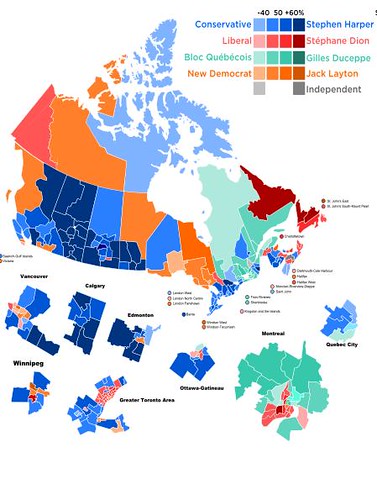
    Results of 2008 federal election, Canada

    Here is a map showing the results of the 2011 election.
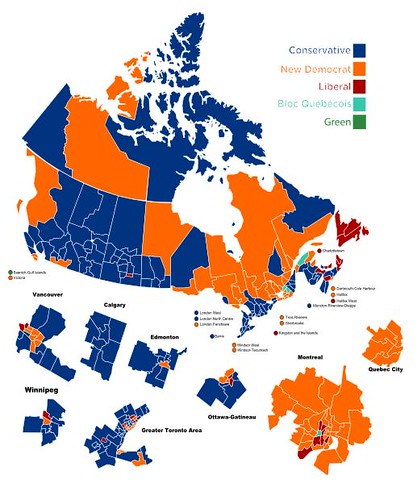
    Results of 2011 federal election, Canada

    Population changes played a major role in this outcome. Take voter turnout, which rose 2.3% from 59.1% in 2008 to 61.4% this time. The low voter turnout is a major concern for Canadians, but so far no one has come up with a solution. Disenchantment with politics is pervasive.

    The NDP made massive gains, going from 36 to 108 seats (by comparison, the previous peak was 43 seats in 1988). Many established parties were displaced. My own downtown Toronto riding of Davenport, represented by Liberal parliamentarians since 1962, switched massively over to the New Democratic Party, the NDP candidate outpolling the Liberal incumbent by 2:1. Davenport, with a large Portuguese-Canadian community, has traditionally voted Liberal. Why the change?

    The Davenport riding is in transition. As Portuguese-Canadians become prosperous and move to the suburbs, the gentrification that has taken over The Annex neighbourhood is spreading west into Davenport. Since I've moved here, a townhouse complex has been built on the other side of the street, while an artists' community centre is by the laundry and any number of old storefronts about being converted into residential units.

    Store made house (3)

    It may not be that whereas Liberal Mario Silva made his name partly through his aid to immigrants, the NDP's Andrew Cash first came to attention as a punk rocker, then as a journalist for the alternative press. And yes, you probably won't be surprised to hear that I voted NDP myself. I was frustrated with the Liberal Party and wanted a change. Clearly, I was not alone.

    One very notable instance of demographics on the election--here, the tendency of Québec to vote as a bloc and to swing massively from one party to another was the massive success enjoyed by the NDP, which crushed the Bloc Québécois and won 58 of the province's 75 seats. By way of comparison, before the election the NDP had only one seat in Québec, in Montréal. Québécois seem to have tired of the Bloc, and voted for the only other party in massive numbers. The NDP didn't have to try: one candidate, a unilingual Anglophone who spent a good part of the campaign in Las Vegas on vacation and hasn't even visited her rising beat a 13 years' incumbent.

    What's very interesting about this is that the NDP is now the dominant party of French Canada, not just Québec. I wrote earlier here about the substantial assimilation facing most Francophone populations outside of Québec, but for the time being there are close to a million Francophones in adjacent Ontario and New Brunswick. These populations also voted substantially for the NDP. Taken from Wikimedia here, the below is an edited map showing electoral outcomes in central and eastern Canada, with maps of outcomes in the three Canadian cities with the largest Francophone populations (in descending order, Montréal, Québec City, and Ottawa-Gatineau) added.
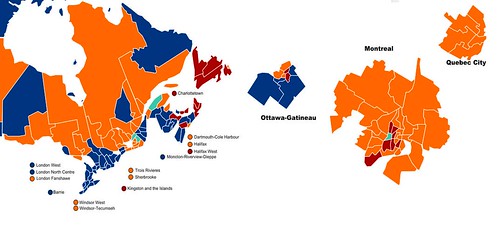
    2011 election results, eastern Canada

    Even Francophone neighbourhoods in Ottawa voted for the NDP.

    What this means, given the weakness of the governing Conservatives in the province, is that the NDP is the only political party to have large numbers of members in both French Canada and English Canada. If the party can assimilate its new huge cohort, this straddling the language frontier could well make it an inevitable party of government.

    Finally, here in Toronto the Conservatives pierced what was once a Liberal stronghold and split the city with the NDP. The first map below shows the situation before the election; the second shows the situation after the election.

    20081014_GTA_results[1]

    201152-2011-GTA-ridings[1]

    This division corresponds substantially to the geographical divisions manifested in Toronto's recent mayoral election, where the left-wing George Smitherman held the downtown but the right-wing Rob Ford carried the day with the outer peripheries of the city: as described by the "Three Torontos" paradigm, poorer, more multiethnic, and with more problems about a left-leaning city government that didn't seem to do much for them. These areas traditionally voted Liberal federally--for instance, the Portuguese Canadians--because the Liberal Party is the one responsible for the lifting of discriminatory immigration legislation and the introduction of multicultural policies in the 1970s. As immigrant communities have become larger and more stable, and the Conservative Party has made efforts to appeal through social and economic conservatism, many of their members have switched allegiances to the Conservative Party. While a good marker of assimilation, this is not good for the Liberals.

    What does all this mean? Considering the Conservative Party's gains in Ontario, and the NDP's massive success in Québec and substantial improvement in the rest of Canada, the future of the Liberal Party as a potential party of government is in doubt. Without any particularly coherent geographic or communal base and no longer the party of central Canada's cities (and patches elsewhere), how can it succeed? As for Québec, the effective destruction of the Bloc Québécois and the defection of Québécois voters en masse to the federalist NDP may signal significant reverses for the local separatist movement.

    It is exciting times for Canadian politics. Demographics both established and changing can be thanked for a good chunk of it.

    Thursday, February 24, 2011

    On the Maltese immigrants in North Africa

    The country of Malta has had many representations. Most recently, after its accession to the European Union in 2004 and to the Eurozone in 2008 while it became a major transit point and inadvertant destination for migrants, it has been imagined as a destination for migrants, perhaps peculiarly vulnerable owing to its small size and relatively tenuous economic state and national identity. Malta, as represented in the press, might be a beseiged battlement of Fortress Europe, located perilously close to the North African coast.

    That's not the only way it's been seen. In fact, this time last century the situation was precisely the reverse. As small islands sometimes overpopulated relative to the productive capacity of their once-agricultural/military-driven economy part of the British global empire, from the mid-19th century on Malta experienced massive emigration, tens after tens of thousands of Maltese emigrants making their way throughout the British Empire and later Commonwealth and beyond. Some settled in Canada, for instance, the nucleus of the Maltese-Canadian community (as described by Shawn Micallef) lying here in Toronto just a couple of subway stops to the west of my home beyond its eventual dispersal. Many Maltese chose not to leave home so far behind and instead immigrated to French North Africa, to the Algeria colonized since 1830 and the Tunisia made a protectorate from 1881. There, Maltese immigrants came to play critical roles in the colonization of North African territories at a time when population pressures in Europe made the organized settlement of the southern rim of the Mediterranean Sea by Europeans seem a sensible idea.

    Algeria was for many years the most important country for Maltese migration within the zone of the Mediterranean. Under various aspects it was also the most successful and statistics show that by the middle of the nineteenth century more than half of Malta's emigrants had chosen Algeria as their country of residence. Although the French conquest had began in 1830, some Maltese had found their way to the area around the city of Constantine before the French connection had began. In 1834 a French governor for North Africa had been appointed, and as the French consolidated their foothold on Algerian territory, Europeans followed the French tricolor. Among the Europeans the Maltese were one of the largest groups, being outnumbered only by Spaniards and Sicilians.

    Like all newcomers, the Maltese in Algeria did at first encounter hostility from the French. Continental Europeans looked down on other Europeans who came from the islands such as the Sicilians and the Maltese. It is true to admit that most insular Europeans were poor and illiterate. Some did have a criminal record and were only too ready to carry on with their way of life in other parts of the Mediterranean where their names were not publicly known.

    French official policy was dictated by sheer necessity. France was a large and prosperous country. Its population was not enormous and many French peasants were quite happy with their lot. If the French needed colonists to make their presence permanent they had to turn to other sources to obtain their manpower. The French Consul in Malta was in favour of encouraging Maltese emigrants to settle in Algeria. He believed that the Maltese showed a distinct liking for France and the French. Although the Maltese under the British, they were not politically active and the French could accept them without any fear.

    Another important man who favoured Maltese emigration to North Africa in general and to Algeria in particular was the prominent French churchman, Cardinal Charles Lavigeric who had dreams of converting the Maghreb back to Christianity. Lavigerie saw North Africa in historical terms as he was professor of Church history. He founded a religious order which was . commonly called "The White Fathers" with scope of spreading Christianity among the .Berbers and the Arabs. Cardinal Lavigerie was archbishop of Carthage and Algiers. In 1882 Cardinal Lavigerie visited Malta. He immediately appreciated the Catholic fervour of the islanders. During his stay he talked of the Maltese as providential instruments meant to augment the Christian population of French North Africa. He saw the Maltese as loyal to France and to the Catholic Church and at the same time as being eminently useful in building some form of communication with the Arab masses.

    [. . .]

    By 1847 the number of Maltese living in Algeria was calculated at 4,610. The Maltese colony in Algeria had been realised as being of some importance by that date, so much so that Maltese church leaders decided to send two priests during Lent to deliver sermons in Maltese.

    In a letter written by the Governor General of ,Algeria on June 17, 1903, it was stated that by then there were 15,000 inhabitants who claimed Maltese origin. Most of these were small farmers, fishermen and traders. As in other parts of North Africa, the Maltese ability to speak in three or four languages helped them to get on well with the French, Spaniards, Italians and Arabs.

    In 1926 the number of ethnic Maltese living in Algeria and Tunisia was tentatively calculated at about 30,000. The exact number of Maltese in was impossible to arrive at because many Maltese had opted for French nationality. By 1927 the Maltese were considered as excellent settlers who worked very hard and were honest in their dealings with others. This was the judgement given by Monsieur Emile Morinaud, a Deputy for Algiers in Paris. In a speech delivered by Morinaud on November 30, 1927, the French politician declared the Maltese as being "French at heart".


    Settlement in Tunisia began later.

    When Napoleon Bonaparte captured Malta from the Knights of St. John in 1798 he ordered the Bay of Tunis to free all the Maltese slaves who languished in jail. At least fifty such slaves returned to Malta. For centuries the Maltese who found themselves in Tunis probably did so against their will. With the advent of the Napoleonic Era and the re-structuring of political power in Europe and along the shores of the Mediterranean, the pirates of Tunis lost their trade. The foothold gained by the French in North Africa changed the political framework of the Maghreb and some Europeans thought, somewhat prematurely, that the Mediterranean was to enter into another Roman Epoch. with peace reigning all along its coasts.

    The Maltese were among the first to venture in their speronaras into Tunisian waters. They traded with coastal towns and with the island of Jerba. Eventually they established settlements not only in Tunis and on jerba but also in Susa, Monastir, Mehdia and Sfax. By 1842 there were about 3,000 Maltese in the Regency. In less than twenty years their numbers increased to 7,000.

    [. . .]

    The French had one serious preoccupation in Tunisia. Italian immigrants had settled there in their thousands and Italy had coveted Tunisia for a very long time. The French occupation of Tunisia had gone down very badly with the Italians. The French wanted the Maltese to act as a counter-balance to the Italians. British consular statistics show that by the beginning of the twentieth century there were 15,326 Maltese living in Tunisia.

    The Maltese in Tunisia worked on farms, on the railways, in the ports and in small industries. They introduced different types of fruit trees which they had brought with them from Malta. Moreover contact between Malta and Tunisia was constant because the small boats owned by the Maltese, popularly known as speronaras, constantly plied the narrow waters between Tunisia and the Maltese Islands.

    Paul Cambon referred to the Maltese living in Tunisia as the "Anglo-Maltese Element". He was grateful that such an element proved to be either loyal to France or at least was politically neutral. In spite of rampant anti-clericalism in France, the French allowed the Maltese complete freedom of their religion. Cardinal Lavigerie was respected. The fiery leader of French anti-clericalism, Leon Gambetta, did not hesitate to state that when French priests spread not only religion but French culture, then they were to be allowed to carry on with their work without any restraint.

    After 1900 it became legally possible for foreigners to buy land in Tunisia. After that year there was a number of Maltese landowners in that country. In 1912 trade between Tunisia and Malta had risen to more than two million francs. Cultural ties were kept alive by the frequent visits brass bands from Malta which were often invited to cross the water to help create a festive -mood when the Maltese in Tunisia celebrated the feast of their parish. On April 10, 1926, a Maltese newspaper commented on a visit made by the French President to Tunisia. The newspaper claimed that the President, Emile Loubet, had eulogised the Maltese as "a model colony".


    Go, read, and reflect on the interesting ways in which history can more than reverse itself in short periods of time. Malta wasn't the territory experiencing pressure from ill-regulated immigration; Maltese, rather, were settlers making new homes in the conquered territories just beyond the horizon.

    Tuesday, February 22, 2011

    Some Libya notes

  • It may not be well-known that plans were made, during the brief three decades of Italian rule, to engage in the extensive colonization of Libya, in many respects as thorough and disruptive as French colonization as neighbouring Algeria.


  • Once pacification had been accomplished, fascist Italy endeavored to convert Libya into an Italian province to be referred to popularly as Italy's Fourth Shore. In 1934 Tripolitania and Cyrenaica were divided into four provinces--Tripoli, Misratah, Benghazi, and Darnah--which were formally linked as a single colony known as Libya, thus officially resurrecting the name that Diocletian had applied nearly 1,500 years earlier. Fezzan, designated as South Tripolitania, remained a military territory. A governor general, called the first consul after 1937, was in overall direction of the colony, assisted by the General Consultative Council, on which Arabs were represented. Traditional tribal councils, formerly sanctioned by the Italian administration, were abolished, and all local officials were thereafter appointed by the governor general. Administrative posts at all levels were held by Italians.

    [. . .]

    During the 1930s, impressive strides were made in improving the country's economic and transportation infrastructure. Italy invested capital and technology in public works projects, extension and modernization of cities, highway and railroad construction, expanded port facilities, and irrigation, but these measures were introduced to benefit the Italian-controlled modern sector of the economy. Italian development policy after World War I had called for capital-intensive "economic colonization" intended to promote the maximum exploitation of the resources available. One of the initial Italian objectives in Libya, however, had been the relief of overpopulation and unemployment in Italy through emigration to the undeveloped colony. With security established, systematic "demographic colonization" was encouraged by Mussolini's government. A project initiated by Libya's governor, Italo Balbo, brought the first 20,000 settlers--the ventimilli--to Libya in a single convoy in October 1938. More settlers followed in 1939, and by 1940 there were approximately 110,000 Italians in Libya, constituting about 12 percent of the total population. Plans envisioned an Italian colony of 500,000 settlers by the 1960s. Libya's best land was allocated to the settlers to be brought under productive cultivation, primarily in olive groves. Settlement was directed by a state corporation, the Libyan Colonization Society, which undertook land reclamation and the building of model villages and offered a grubstake and credit facilities to the settlers it had sponsored.

    The Italians made modern medical care available for the first time in Libya, improved sanitary conditions in the towns, and undertook to replenish the herds and flocks that had been depleted during the war. But, although Mussolini liked to refer to the Libyans as "Muslim Italians," little more was accomplished that directly improved the living standards of the Arab population. Beduin life was disrupted as tribal grazing lands--considered underutilized by European standards but potentially fertile if reclaimed--were purchased or confiscated for distribution to Italian settlers. Complete neglect of education for Arabs prevented the development of professional and technical training, creating a shortage of skilled workers, technicians, and administrators that had not been alleviated in the late 1980s. Sanusi leaders were harried out of the country, lodges broken up, and the order suppressed, although not extinguished.


    This photo post examining the hybridity of the homes built in Cyrenaica, in the east, to house the new Italian residents of confiscated Arab land is worth looking at. Gary Fowler's study of colonization in Tripolitania, the western Libyan region at the heart of modern Libya and the Italian colonial enterprise, is likewise worthwhile.

  • Meanwhile, over at my own blog I've a brief post up pointing out that the Libyan state is a very recent creation; unlike the other polities of North Africa, modern Libya as a single state as opposed to a broad region dates back securely only to the 1930s, with identities overlapping state boundaries.


  • Ottoman_Provinces_Of_Present_day_Libyapng


  • Back here, in November 2009 I speculated that Italian-era links with Eritrea and Somalia might explain a predominance of Eritreans and Somalis trying to make it to Italy. That doesn't seem to be the case, but Libya retains the potential--suppressed only under Gadaffi at Italy's behest--of becoming a destination of transit migrants from Africa as a whole, as well as a destination for migrants in itself.


  • The Yorkshire Ranter took a look at one interesting form of migration to Libya that's come into prominence recently, that of the mercenary from Africa or elsewhere hired to repress Libyans.


  • In Libya this week, it is said that the government is using mercenaries recruited from its various allies’ wars in sub-Saharan Africa as arseholes, and that it’s paying $500 a day for their services. Libyan per capita GDP is $14,884 at purchasing-power parity, so the price of privatised violence is running at a premium of over one hundred times typical earnings. Clearly, either the regime has so much less real legitimacy, or the degree of brutality required and risk involved is that much higher. In fact, those options are both consistent, as a regime with less legitimacy would need to use more force and it does seem to be doing just that.

    I made the point last time out that it’s typical for mercenaries to be very highly paid relative to the countries in which they operate. This is clearly an important point here. It’s also true that Gadhafi’s Libya has often got other people to fight its battles for it – they exported Palestinians into a variety of different wars in the 1970s and 80s, notably sending PLO volunteers to prop up Idi Amin (you bet they didn’t sign on for that). Later, in the 1990s, they trained and equipped fighters in the various West African civil wars (notably Charles Taylor – there’s an arsehole for you). Now they’re doing the opposite.

    Of course, being an oil state, they can probably afford to keep hiring the arseholes.


  • This poster is skeptical about the idea of African mercenaries, suggesting that the idea fits into an established tradition of Libyan anti-black racism and making the point that the vast majority of sub-Saharan Africans living in Libya are work migrants.
  •