Showing posts with label eurabia. Show all posts

Tuesday, February 05, 2019

Some news links: fertility, population aging, migration, demography is not destiny, Eurabia


Over the past week, I've come across some interesting news reports about different trends in different parts of the world.
  • The Independent noted that the length and severity of the Greek economic crisis means that, for many younger Greeks, the chance to have a family the size they wanted--or the chance to have a family at all--is passing. The Korea Herald, meanwhile, noted that the fertility rate in South Korea likely dipped below 1 child per woman, surely a record low for any nation-state (although some Chinese provinces, to be fair, have seen similar dips.)
  • The South China Morning Post argued that Hong Kong, facing rapid population aging, should try to keep its elderly employed. Similar arguments were made over at Bloomberg with regards to the United States, although the American demographic situation is rather less dramatic than Hong Kong's.
  • Canadian news source Global News noted that, thanks to international migration, the population of the Atlantic Canadian province of Nova Scotia actually experienced net growth. OBC Transeuropa, meanwhile, observed that despite growing emigration from Croatia to richer European Union member-states like Germany and Ireland, labour shortages are drawing substantial numbers of workers not only from the former Yugoslavia but from further afield.
  • At Open Democracy, Oliver Haynes speaking about Brexit argued strongly against assuming simple demographic change will lead to shifts of political opinion. People still need to be convinced.
  • Open Democracy's Carmen Aguilera, meanwhile, noted that far-right Spanish political party Vox is now making Eurabian arguments, suggesting that Muslim immigrants are but the vanguard of a broader Muslim invasion.

Thursday, September 24, 2015

On Joe Daniel, Syrian refugees, Eurabia, and the Canadian elections


Joe Daniel, Conservative MP for the Toronto riding of Don Valley East, has today caused something of a stir. As reported by the Toronto Star's Tim Harper, in talking to his constituents Daniel ended up talking about Eurabia. Yay.

On the same weekend Conservatives expedited a refugee processing system in a nod to what they called “Canadian generosity,” one of their candidates seeking re-election was telling voters about an “agenda” to move Muslims into European countries.

And that is something Joe Daniel doesn’t want to see in Canada.

In a video obtained by the Star, Daniel offered this warning to voters in Don Valley North: “So I think there is a different agenda going on in terms of these refugees.

“Whereas at the same time Saudi Arabia is putting up money for 200 mosques in Germany I think the agenda is to move as many Muslims into some of these European countries to change these countries in a major way.

“That is something that I certainly don’t want to see happening in Canada. I think Canada is the greatest country in the world.”

A later CBC report quotes his manager as saying these reports are taken out of context.

Daniel's comments were circulated online days after the Conservatives announced an expedited process to resettle 10,000 Syrian refugees by September 2016, in an effort to move past criticism the government wasn't doing enough to help ease the crisis.

In a phone interview with CBC News, campaign manager Didar Khokhar said it was ultimately up to Daniel to explain his comments, but immediately went on to say they were "taken out of context."

"He was touching upon the controversy that has seized Europe," Khokhar said Wednesday afternoon.

Khokhar said Daniel gave a brief speech during a barbecue with some 30 people in attendance, where he touted the government's record on the resettlement of Syrian and Iraqi refugees.

"He made the comments in passing," Khokhar said.

Both news agencies feature the video in question. The CBC"s version is below.


Readers should make their own judgement.

I rather dislike the introduction of unfounded Eurabian conspiracy theories into the Canadian elections. That such potentially dangerous falsehoods are apparently being passed off casually by candidates at meet-and-greets is appalling. I will note that Daniel at least apparently chooses not to own up to this. I'll also note that Daniel himself is of immigrant background, both to parents of Malayali background in Tanzania, product of the Conservative Party's effective outreach to "new" immigrant communities. Might, I say only partly jokingly, the propagation of nativist and xenophobic myths by these people at least show that integration is working in some skewed way?

More, about Syrians and Canada's elections, later this week.

Wednesday, January 21, 2015

On "Why the Muslim 'No-Go-Zone' Myth Won't Die"

The Atlantic's David A. Graham has an article up taking an in-depth look at the concept of ubiquitous "no-go zones" run by Muslims in western Europe. First introduced to the mainstream by Fox News television coverage, Graham notes that this pre-Eurabian concept comes from the conflation of three separate, misunderstood, phenomena.

It seems to stem from two or maybe three real phenomena. The first is the presence of sharia courts in some places in Europe. In the United Kingdom, for example, "Muslim Arbitration Tribunals" are officially mandated but set up outside the court system and can resolve civil and family issues through Islamic law; there are also reports of informal religious courts. There are similar Jewish courts in Britain, and the Muslim tribunals have received encouragement from figures including then-Archbishop of Canterbury Rowan Williams. On the other hand, there are convincing arguments that the courts can sometimes be bad for women. (There's a fascinating echo of the Ottoman empire's "millet" system, in which non-Muslims were allowed to set up their own courts to deal with matters of personal law.)

The second real phenomena is the rise of vigilante sharia squads in some places. For example, in Whitechapel, East London, CNN reported on bands of Muslim men who try to keep alcohol out of the area and harangue passers-by about morality. RedState's Erick Erickson thinks he's caught CNN red-handed: While the network criticizes Jindal for not knowing of any real no-go zones, CNN itself reported on one! But the analogy doesn't quite hold. What's happening here is disturbing, but well-short of extremist-run enclaves. These are just ad-hoc groups, and area Muslims by and large condemn it in CNN's reporting. There's no evidence that these squads are powerful or widespread.

The third factor is what are known as "Zones Urbaines Sensibles," or "sensitive urban zones," in France. These areas are defined by their socioeconomic status—they're characterized by high unemployment, high rates of public housing, and low educational attainment. As it happens, many of these areas are populated largely by poor immigrants from the Muslim world, creating a neat but misleading correlation. Some of the "no-go" coverage has suggested that police and other emergency services dare not go into these areas. The United States is sadly not immune to dangerous city areas where emergency-service providers feel unsafe, so in that way this is a universal phenomenon. But as BusinessWeek notes, it's not the case that the government has written these zones off; in fact, they've been designated for further attention and work on urban renewal.


Tracing the meme to the writings of Daniel Pipes early last decade, Graham notes that the idea has since been spreading online, through people participating in social networks ideologically predisposed to this belief.

If you dig through the fever swamps of the Internet, you can see the idea spreading since then. For example, the blog "Violence Against Whites" chronicles the SUZs and other alleged no-go zones across Western Europe. (Other material on the site includes claims that Boers were ethnically cleansed in South Africa and a section on "white martyrs.") Catholic.org reports, "These areas are Muslim-dominated neighborhoods. Non-Muslims dare not set foot into the areas."

I noted earlier that there are popular misestimates of population, based on non-random and inaccurate samplings. Graham notes, depressingly, that phenomena like these are often resistant to correction.

Erroneous beliefs such as these tend to concentrate along people's partisan or ideological axes. (The same is true of liberal media, though not in this particular case.) And once an idea has taken seed, it's extremely difficult to root out. As political scientists Brendan Nyhan and Jason Reifler have shown, corrections can actually backfire, increasing holders' faith in their incorrect beliefs.


And yet, this needs to be done.

Wednesday, January 14, 2015

On Steve Emerson, #foxnewsfacts, and bad pop demography


Steven Emerson's gaffe about the British city of Birmingham, stating in a live television interview that "[I]n Britain, it’s not just no-go zones, there are actual cities like Birmingham that are totally Muslim where non-Muslims just simply don’t go in", has gotten global coverage. (For the record, in Birmingham, the United Kingdom's second-largest city by population, Muslims make up 14.3% of the city's population.)


Informed Consent's Juan Cole notes correctly that Emerson has consistently gotten things wrong, assigning responsibility for the 1995 Oklahoma City bombing to Muslims. One question still has to be asked: How could someone with his reputation get global media coverage? I'll suggest the trending Twitter hashtag #foxnewsfacts wasn't picked arbitrarily

Meanwhile, this would seem to fit with the pattern I mentioned last week of people badly misjudging the size of populations, overestimating them. Joe. My. God. has noted that the same sort of thing goes on with non-heterosexuals, too. The suggestions of the commenter here, that minorities tend to concentrate in cities and that cities are often taken to accurately represent their countries, do point in a plausible direction.

I think one of the primary reasons is the that Immigrants concentrate in the cities.

In my neck of the woods, the rural areas and the suburbs are almost completely white European in decent. But if you go to the local city (which is a small American city that you have never heard of) it is a regular United Nations full of Muslims, Hindus, Orthodox Christians (as exotic to the locals as the other faiths).

The end result is that were people live is more homogeneous then the country at large but where they go to socialize and shop is far more diverse then the country at large. And I think that people get their preconception of what the country as a whole is like not from where they live but from where they shop.

How often have conservatives and nationalists castigated cities, especially large ones, as unrepresentative of their community--too multiethnic, too "cosmoplitan", too secular, et cetera?

Thursday, January 08, 2015

Houellebecq is as wrong today as he was yesterday


When I wrote last night about Houellebecq and Submission, just like the rest of the world I had no idea what would happen today in Paris, with the massacre in the offices of Charlie Hebdo. I was as surprised anyone to find out the subject of the cover of the most recent issue of that satirical magazine, courtesy of the Los Angeles Times.


Houellebecq's novel is just as fundamentally incorrect about the world and French realities today as it was yesterday. As noted by Leonid Bershidskiy at Bloomberg View, Submission labours under a mass of prejudices and improbabilities. It just doesn't work in describing any kind of plausible scenario.

Meanwhile, I would also like to point people to Juan Cole's essay "Sharpening Contradictions: Why al-Qaeda attacked Satirists in Paris". Cole's observation that the people responsible likely want to start broader conflict where there need be none is quite probable.

The problem for a terrorist group like al-Qaeda is that its recruitment pool is Muslims, but most Muslims are not interested in terrorism. Most Muslims are not even interested in politics, much less political Islam. France is a country of 66 million, of which about 5 million is of Muslim heritage. But in polling, only a third, less than 2 million, say that they are interested in religion. French Muslims may be the most secular Muslim-heritage population in the world (ex-Soviet ethnic Muslims often also have low rates of belief and observance). Many Muslim immigrants in the post-war period to France came as laborers and were not literate people, and their grandchildren are rather distant from Middle Eastern fundamentalism, pursuing urban cosmopolitan culture such as rap and rai. In Paris, where Muslims tend to be better educated and more religious, the vast majority reject violence and say they are loyal to France.

Al-Qaeda wants to mentally colonize French Muslims, but faces a wall of disinterest. But if it can get non-Muslim French to be beastly to ethnic Muslims on the grounds that they are Muslims, it can start creating a common political identity around grievance against discrimination.

This tactic is similar to the one used by Stalinists in the early 20th century. Decades ago I read an account by the philosopher Karl Popper of how he flirted with Marxism for about 6 months in 1919 when he was auditing classes at the University of Vienna. He left the group in disgust when he discovered that they were attempting to use false flag operations to provoke militant confrontations. In one of them police killed 8 socialist youth at Hörlgasse on 15 June 1919. For the unscrupulous among Bolsheviks–who would later be Stalinists– the fact that most students and workers don’t want to overthrow the business class is inconvenient, and so it seemed desirable to some of them to “sharpen the contradictions” between labor and capital.

The operatives who carried out this attack exhibit signs of professional training. They spoke unaccented French, and so certainly know that they are playing into the hands of Marine LePen and the Islamophobic French Right wing. They may have been French, but they appear to have been battle hardened. This horrific murder was not a pious protest against the defamation of a religious icon. It was an attempt to provoke European society into pogroms against French Muslims, at which point al-Qaeda recruitment would suddenly exhibit some successes instead of faltering in the face of lively Beur youth culture (French Arabs playfully call themselves by this anagram). Ironically, there are reports that one of the two policemen they killed was a Muslim.


We can have a clash of civilizations if we want to. Let us not want this.

Wednesday, January 07, 2015

A few thoughts on the Eurabia of Houellebecq


I've a certain fondness for Michel Houellebecq. I read his The Elementary Particles, the North American translation of his 1998 Les Particules élementaires when I was younger and perhaps more impressionable. The stylish bleakness of his worldview appealed to me. This evening, a Bloomberg article appeared on my RSS feed noting the controversy over the author's newest book.

“Submission,” a book by Michel Houellebecq released today, is sparking controversy with a fictional France of the future led by an Islamic party and a Muslim president who bans women from the workplace.

In his sixth novel, the award-winning French author plays on fears that western societies are being inundated by the influence of Islam, a worry that this month drew thousands in anti-Islamist protests in Germany. In the novel, Houellebecq has the imaginary “Muslim Fraternity” party winning a presidential election in France against the nationalist, anti-immigration National Front.

“A pathetic and provocative farce,” is how Liberation characterized the book in a Jan. 4 review that scathingly said the novelist is “showing signs of waning writing skills.” Political analyst Franz-Olivier Giesbert in newspaper Le Parisien yesterday was kinder, calling it a “smart satire,” adding that “it’s a writers’ book, not a political one.”

National Front’s leader Marine Le Pen, who appears in the 320-page novel, said on France Info radio on Jan. 5 that “it’s fiction that could become reality one day.” On the same day, President Francois Hollande said on France Inter radio he would read the book “because it’s sparking a debate,” while warning that France has always had “century after century, this inclination toward decay, decline and compulsive pessimism.”

[. . .]

Houellebecq’s book is set in France in 2022. It has the fictional Muslim Fraternity’s chief, Mohammed Ben Abbes, beating Le Pen, with Socialists, centrists, and Nicolas Sarkozy’s UMP party rallying behind him to block the National Front.

Ben Abbes goes on to ban women in the workplace, advocates polygamy, pushes Islamic schools on the masses and imposes a conservative and religious vision of society. The French widely accept the new environment, hence the book’s title.

Submission has gotten quite a lot of reaction in France; Les Inrockuptibles has a broad selection. Libération's article on the book, referenced in the above Bloomberg article, is here. Anglophones might be interested in The Independent's article, perhaps still more in Houellebecq's English-language translated interview in The Paris Review with Sylvain Bourmeau

Where did you get the idea for a presidential election, in 2022, that came down to Marine Le Pen and the leader of a Muslim party?

Well, Marine Le Pen strikes me as a realistic candidate for 2022—even for 2017 … The Muslim party is more … That’s the heart of the matter, really. I tried to put myself in the place of a Muslim, and I realized that, in reality, they are in a totally schizophrenic situation. Because overall Muslims aren’t interested in economic issues, their big issues are what we nowadays call societal issues. On these issues, obviously, they are very far from the left and even further from the Green Party. Just think of gay marriage and you’ll see what I mean, but the same is true across the board. And one doesn’t really see why they’d vote for the right, much less for the extreme right, which utterly rejects them. So if a Muslim wants to vote, what’s he supposed to do? The truth is, he’s in an impossible situation. He has no representation whatsoever. It would be wrong to say that this religion has no political consequences—it does. So does Catholicism, for that matter, even if the Catholics have been more or less marginalized. For those reasons, it seems to me, a Muslim party makes a lot of sense.

But to imagine that such a party might find itself poised to win a presidential election seven years from now …

I agree, it’s not very realistic. For two reasons, actually. First—and this is the most difficult thing to imagine—the Muslims would have to succeed in getting along with each other. That would take someone extremely intelligent and with an extraordinary political talent, qualities that I give to my character Ben Abbes. But an extreme talent is, by definition, an unusual occurrence. But supposing he existed, the party could take off, but it would take longer than seven years. If we look at the way the Muslim Brotherhood has done it, we see regional networks, charities, cultural centers, prayer centers, vacation centers, health care, something not unlike what the Communist Party did. If you ask me, in a country where poverty will continue to spread, this party could attract a lot more than just “average” Muslims, if I can put it that way, because really there is no longer such a thing as an “average” Muslim since we now have people converting who are not at all of North African origin … But such a process would take several decades. The sensationalism of the media plays a negative role, really. For example, they loved the story of the guy living in a little village in Normandy, as French as he could be, not even from a broken home, who converted and went off to wage jihad in Syria. But we can reasonably assume that for every guy like that there are several dozen who convert and don’t go off to wage jihad in Syria, who don’t do anything of the kind. After all, one doesn’t wage jihad for the fun of it, that sort of thing only interests people who are strongly motivated by doing violence, which is to say, necessarily a minority.


I'm inclined to agree with Laurent Joffrin, a literary critic quoted in 20 Minutes who calls Submission the work that marks the return of the far right and its theses to literary prominence in France. The whole idea of a Muslim takeover is ridiculous. As I noted way back in 2004 when I took time from grad school to write my "France, its Muslims, and the Future", and as--for instance--the Pew Research Group noted in 2011 with its projection that Muslims of all background would amount to a tenth of the French population circa 2010, the numbers just aren't there. Presuming, as Houellebecq does in his scenario, that somehow this disparate and divided religious minority would become a unified bloc capable of taking over a much larger country, assumes a view of human behaviour that is simply not credible. This should be no surprsie: as an Economist article on Muslims in Marseille in May 2014 noted, Muslims in that French city at least are assimilating, moving beyond the left to vote for the parties they like, including the French right. Houellebecq would seem to know very little indeed about what is actually going on indeed, and in so doing is narrowing the forum for rational discussion of matters of immigration and cultural change and assimilation that much more. Submission does little good, save perhaps Houellebecq himself and his publisher with their succès de scandal.

I mentioned at the beginning of this blog post that I had found the bleakness of Houellebecq's worldwide appealing when I was younger. I wonder what I would find on re-reading. Would this turn out to be merely adolescent angst?

Thursday, June 13, 2013

"Hans Rosling: Religions and babies"


I'd like to thank Will Baird for pointing me towards this 2012 TED talk by the Gapminder Foundation's Hans Rosling, examining the question of the relationship between religion and fertility.


Saturday, September 17, 2011

Adomanis on Steyn: Eurabia as an oversimplified story

Writer Mark Adomanis has an extended review of Eurabia theorist Mark Steyn's latest book, the subtly-titled America Alone: Get Ready for Armageddon. Adomanis is critical of Steyn's thesis, since despite his undeniable skill as a raconteur with a good grasp for compelling narratives, it's fundamentally confused if not outright self-contradictory. The core of Adomanis' argument deserves to be quoted at length.

Steyn’s parallel attempts to prove that "statism" is the source of all of the world’s problems (from increasing obesity to stagnating median wages) and that the Islamic world, particularly Iran, is ready to run roughshod over an effeminate and degenerate West, relies on such a tendentious and selective presentation of facts that it actually winds up subtracting from his readers’ understanding of what is actually going on in the world.

According to Steyn, Europe is in a demographic death spiral caused by statism and, at a deeper level, the loss of religious belief and "civilization confidence." Iran, on the other hand, is on the fast track to becoming the dominant power in the Middle East.

Yes, in reality, in 2009, Iran’s fertility rate, which Steyn uses as a heuristic for a society’s overall health, was actually lower than that of Brazil (barely mentioned in "After America"), the United States (doomed, according to Steyn), France (even more doomed, according to Steyn), or the United Kingdom (which is well and truly f*****). If an Islamic revolution and the full-fledged implementation of hardcore Shariah enforced by "morality police" can’t keep Iran’s fertility rate from rapidly collapsing, perhaps the "problem" of declining fertility is actually better explained by the basic pressures of modernity than by the craven adoption of liberalism.

Consider the experience of Muslim countries like Morocco, Algeria and Tunisia. Despite not being "liberal" in any recognizable sense of the word (indeed, being almost the exact opposite of the coddling social-democratic "nanny states" that Steyn blames for the West’s decline), these countries all experienced sustained and rapid decrease in fertility over the past 20 years. Today, according to the CIA World Factbook, Tunisia and Algeria are below replacement rate (the number of children required to keep a population at a constant level) and several other Muslim-majority countries are right on the cusp. Steyn avoids the problems these facts present for his thesis through the simple and effective tactic of not mentioning them.

Steyn’s knowledge of demographics is remarkably confused. In the concluding chapter, for example, he argues that "much of America is now in need of an equivalent to ... post-Soviet Eastern Europe’s economic liberalization in the early nineties."

He seems unaware that fertility rates collapsed during Eastern Europe’s experiment with economic liberalization. Indeed, not a single post-communist Eastern European country has yet regained the level of fertility it had at the time of communism’s collapse: Once again, Steyn avoids the problems this presents for his thesis by simply leaving it unmentioned.

What I take away from Steyn’s sincere but confused attempt at comparative demographics is the following: He confidently predicts the future supremacy of countries (Iran) that are doomed according to metrics of his own choosing (the total fertility rate) while simultaneously making policy prescriptions (radical economic liberalization) that, when implemented in other countries, have had the effect of exacerbating the trend (decreasing fertility) he’s attempting to reverse.


Admonis makes an additional interesting note at his Forbes weblog.

[I]f, like Steyn, you consider all first-world countries to be irredeemably corrupt, and doomed by excessive debt and insufficient fecundity, what other real-world options are there? There are no free-market wonderlands where the people are rich, the government is small, and everyone is constantly popping out babies – we can only look at what actually happens in observed reality and judging by that there would seem to be (at the absolute least!) strong tensions between economic development, fertility, and political liberty.


We've blogged here in the past about an Iran that has the sort of age structure that could drive an economic boom if the country had better government, or about the demographic transition in the Maghreb and Libya that may soon make most of North Africa a labour-importing area. (We haven't, unfortunately, written at all about a Turkey that's also well advanced in the demographic transition and has already become something of a magnet for its neighbours. Later, we promise.) If the demographic transitition from high-fertility labour-exporting demographic systems to low-fertility labour-importing systems is so far advanced in Europe's neighbours, it's not obvious how these regions will be able to take over a much larger and wealthier continent with more impermeable barriers to entry.

Steyn writes a compelling, direct story (with, agreed, an engaging style of prose): as a result of any number of bad political, economic, and social choices, the West (starting with Europe) has become fatally weakened and is going to be taken over by a civilization that is hostile to the West and antithetical to the values of liberal and conservatives alike. He writes in a time when dystopias if not outright apocalypses are pretty common, being arguably the biggest growth area in young adult fiction. The problem with his particular dystopia is that it oversimplifies things hugely.

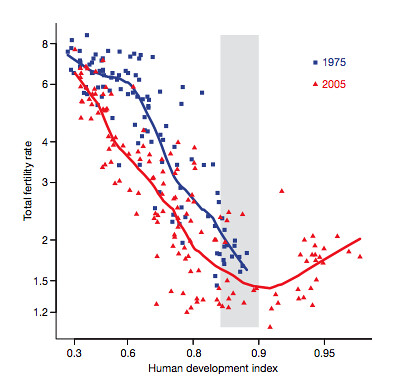
The Fertility J-Curve

Take fertility. This graphic illustrates an argument advanced in Nature in 2009 that human development has a complicated relationship with fertility. "[T]here exists a "J-shaped" relationship between human fertility and development — i.e., that further advances in economic development can reverse the decline in fertility rate[, ...] that, in highly developed countries with HDI above 0.9, further development halts the declining fertility rates. This means that the previously negative development-fertility association is reversed; the graph becomes J-shaped." In such a case, rising human development may well lead to rising fertility as increasingly developed societies provide people with more chances to become parent to more children.

This is a contentious argument, many responding by saying that the correlation between higher human development and lower fertility merely weakens as human development rises. Is this weakening uniform, i.e. in some countries is the weakening more significant (or an actual reversal, even) than in others? I'd be interested in breaking the data apart and seeing whether the countries with the highest levels of human development might form high- and low-fertility clusters. Recent increases in fertility in northwestern Europe in the past couple of decades are at least suggestive.

This question isn't answered by Steyn, who simply wants to reverse things to a supposed ideal scenario that might not even exist. Certainly many European countries have higher rates of completed fertility than most of the North African and Middle Eastern countries that have produced large numbers of immigrants to Europe, as Europe's modernizing neighbours come to share in Europe's modern and post-modern demographic norms. It's a complex picture, and deserves to be treated in its full complexity.

The same goes for immigration. Steyn paints a picture of a low-fertility/high-immigration Europe bordering a high-fertility/high-emigration Muslim world that has been rapidly expanding to the exclusion of all other possibilities. The reality, however, is that things are much more nuanced: many emigrants from the countries supposedly directed towards Europe actually go elsewhere in the world in large numbers, differences in fertility between religious groups have narrowed consistently over time, and immigrants from the Middle East and North Africa are hardly the only immigrants moving to Europe. Europe may no longer dominate the world the way it did a century ago, but Europe--the continent as a whole, its component societies--are high-income countries with global connections that have fostered migrations as diverse as those of Ecuadorians to Spain, Vietnamese to Poland, and Sri Lankan Tamils to Norway. The story with immigration to Europe, again, is substantially more complex.

If you oversimplify a model of a real-world system you're going to come up with not an efficient model of the real world but a broken one. Eurabia as presented by Steyn is like that, no matter how compelling a storyline he weaves about it. We need higher criticism, desperately, for analyses of demographic situations of all kinds.

Monday, July 25, 2011

Demography's misuse, or, going from Eurabia to mass murder

Demography matters so much that one man, Norwegian Anders Behring Breivik, decided to become a mass murderer on account of what demography supposedly told him.

As has been noted worldwide, the tendentious concept of "Eurabia"--a Europe doomed, via Muslim fecundity and the fecklessness or outright self-hatred of its governing elites, to become Muslim--is the single idea most responsible for Breivik's decision to kill as many future potential multiculturalist traitors to Norway and Europe as possible. Journalist Doug Saunders elaborates on this in a video post from Oslo for the Globe and Mail.


Saunders has posted at his website a collection of Breivik's comments posted at the Norwegian blog dokument.no revealing the man to be preoccupied with pop demography of the least analytical sort. (No, Lebanon is not a relevant model for any plausible European future, not least because of the substantial territorial changes coupled with unprecedented history of sustained mass emigration and the numerous bloody, bloody wars.) Going into more detail, blogger P.Z. Myers noted that in his screed, Breivik was concerned with the ridiculously precise micromanagement of fertility along the misogynistic lines described by Margaret Atwood in her 1985 novel The Handmaid's Tale.

1. Limit the distribution of birth-control pills (contraceptive pills): Discourage the use of and prevent liberal distribution of contraceptive pills or equivalent prevention methods. The goal should be to make it considerably more difficult to obtain. This alone should increase the fertility rate by 0,1 points but would degrade women's rights.

2. Reform sex education: Reform the current sex education in our school institutions. This may involve limiting it or at least delaying sex education to a later age and discourage casual sex. Sex should only be encouraged within the boundaries of marriage. This alone should increase the fertility rate by 0,1 points.

3. Making abortion illegal: A re-introduction of the ban on abortion should result in an increased fertility rate of approximately 0,1-0,2 points but would strip women of basic rights.

4. Women and education: Discourage women in general to strive for full time careers. This will involve certain sexist and discriminating policies but should increase the fertility rate by up to 0,1-0,2 points.

Women should not be encouraged by society/media to take anything above a bachelor's degree but should not be prevented from taking a master or PhD. Males on the other hand should obviously continue to be encouraged to take higher education - bachelor, master and PhD.


Adds Myers, "It's all about fertility, ladies, and if only we keep you ignorant and trapped in the home, you'll start pooping out babies for us. Isn't that sweet?"

Demography's a concern of this blog, obviously, as are future population changes. The signal difference is that we at Demography Matters are concerned with fact-based linkages, writing, and research, taking a look at what actually goes on insofar as populations evolve because demography matters enough to be taken seriously. We engage with myths like Eurabia not least since these kinds of catastrophic theories do very little to create informed discussion on the subject. People are not going to talk or act in rational manners about immigration or population aging or anything of the kind of they think that the future of their country is doomed. This may especially be so if they think that their country's doom is indeed that is an intended consequence of their evil political elite.

As a co-blogger of mine over at History and Futility, Jussi Jalonen, wrote earlier today, the whole knot of anger and misunderstandings and conspiratorial mindsets surrounding Eurabia that motivated Breivik exist at the center of an increasingly influential political network.

Following the modus operandi of all publicity-seeking mass murderers, Breivik wrote a manifesto where he openly stated his motives and clarified his political opinions in detail. Published in the internet, the “European Declaration of Independence” – which can be downloaded from here – is essentially a grotesque compendium of blog posts and columns, tied together with Breivik’s own narrative. The quoted writings all have in common an openly islamophobic, anti-immigration theme. According to Breivik’s twisted, but coherent logic, the “multiculturalist Marxist establishment” is attempting to convert the European Union into a “Marxist superstate, the EUSSR”; these “cultural Marxists” are also responsible for the “mass Muslim immigration” and “islamization” of Europe. Breivik is, in other words, a true believer in the so-called “Eurabia”-predictions previously discussed also on this blog, and he also believes that an open discussion of these threats was impossible due to the pervasive European “political correctness”. In his own words, Breivik was using the mass murder as means to “send a message” to the “Marxist, multiculturalist elites”. His chosen method was to wipe out the next generation of the left-wing politicians whom he saw as the culprits of the immigration policy and the destruction of his cherished European civilization.

What’s important to remember is that Breivik’s ideology was not original, and his sick ideas were not of his own making. In essence, he was a product of the internet age, a dedicated consumer of the radical anti-Muslim political propaganda which has circulated around the websites and weblogs ever since the 9/11 attacks and the controversial Muhammad cartoon episode. Breivik maintained a lively interest in the most notable anti-Islam bloggers, such as “Fjordman”, with whom he occasionally seems to have corresponded, advertising his book project; one example of their dialogue can be found here, in the comment section. The title of Breivik’s book, “Declaration of European Independence”, is actually borrowed from a column which “Fjordman” wrote for the cultural-conservative “Brussels Journal”-blog. Breivik describes his ideology by the name “Vienna School of Thought”, which is a reference to another well-known paranoid anti-Islam blog, “Gates of Vienna”.

This internet sub-culture where Breivik spent his pastime has not been without political significance. The very same post-modern, radical, fanatic cultural-fundamentalist atmosphere which produced Breivik has made serious inroads to the mainstream politics in the Western World, basing its success on populism and fear. The writers who inspired Breivik included known Muslim-baiting hate-mongers such as Robert Spencer, Pamela Geller and Daniel Pipes, and he was fascinated by the Tea Party movement. Geert Wilders, the head of the Dutch PVV and the producer of Fitna, was among Breivik’s heroes, and his book even mentions – in one of the quoted posts from “Fjordman” – Jussi Halla-aho, a Finnish anti-Islam blogger who was elected as an MP of the populist “True Finns” party in the last elections and became the chairman of the parliamentary committee in charge of police, border guard and the immigration affairs. Breivik’s book endorses several “anti-immigration, cultural conservative organizations”, ranging from the Sweden-Democrats to the Polish PiS, all of which he saw as the possible salvation of the Continent from the supposed evils of multiculturalism and immigration. The only thing which made Breivik special was his conviction that this parliamentary political activity needed to be supplemented with direct action, and he saw himself as the man who could provide it.


Demography matters too much to be left unchallenged to the sorts of people who would use the study of population--or more precisely, what these people think counts as the study of population--to justify all manner of horrors. Beware.

Tuesday, July 12, 2011

On the very unlikely Eurabianization of southern Europe

David P. Goldman, a writer and economist who first appeared writing for Asia Times under the moniker of "Spengler", has gained a lot of fame on the Internet for his articles, combining as they do hard figures with a pronounced conservatism and interest in pop demographics. Notwithstanding his sketchy past ties with the LaRouche movement, a rather conspiratorial movement claiming to favour a new industrialism and oppose genocidal conspiracies like those of the British royal family--I was told once that if the US and China combined their strengths they could destroy the old system and we'd be on Mars in thirty years--he's worth paying attention to, at the very least because so many people do just that.

A recent post at Goldman's Asia Times blog Inner Workings, "Southern Europe: Hopeless But Not Serious", takes a look at the PIIGS (Portugal, Ireland, Italy, Greece, Spain) and their dire economic future. The dire future of all of them save Ireland, mind; ultra-low fertility and rapid aging will do the rest in.

That is true for the moment, when the elder dependent ratio for Southern Europe stands at around 25%. Between 2020 and 2045, however, the infertility of Southern Europe will catch up with it, and the elder dependent ratio will rise to over 60%–an impossible, unmanageable number. At that point the character of these countries will change radically; they will be overwhelmed with immigrants from North Africa as well as sub-Saharan Africa, who will not have the skills or the habits of civil society to maintain economic life. And their economies will slide into a degree of ruin comparable only to that of classical antiquity. Perhaps the Chinese will operate Greece as a theme park. Spain, which can draw on Latin American immigrants, is likely to be the least badly off.

Strictly speaking, Ireland should not be included among the PIIGS (Portugal, Italy, Ireland, Greece, Spain). Although post-Catholic Ireland has lost its famous fecundity, Ireland’s fertility rate still hovers around replacement. The Irish economy was far too dependent on offshore finance as a source of employment and suffered disproportionately from the collapse of the credit bubble in 2008. But this small country also has high-tech manufacturing and other industries which make the eventual restoration of prosperity possible. The southern Europeans are doomed. They have passed a demographic point of no return. There simply aren’t enough females entering their child-bearing years in those countries to reverse the rapid aging.


I wouldn't necessarily disagree with much of this. The rapid aging of southern Europe's populations and the shrinkage of the cohorts of youth, combined with the effects of the internal devaluation given the region's adoption of the Euro, and a general lack of economic competitiveness, does augur bad things. Edward Hugh has written about the very low trend economic growth rate in Italy (Portugal in passing, too). Absent very unlikely transformations in southern European demographic profiles, things can be problematic. I also think Goldman is right to suggest that Spain, with its well-established links with Latin America, may avoid many of the worst effects.

Where do I disagree? My lesser disagreement relates to the ways in which the effects of population aging may well be mitigated by better health. We've written in the past about longevity, exploring the ways in which longevity is being extended. The intriguing concept of "disability-free life expectancies" may provide a potentially very useful paradigm.

[M]any people over 65 are not in need of the care of others, and, on the contrary, may be caregivers themselves. The authors provide a new dependency measure based on disabilities that reflect the relationship between those who need care and those who are capable of providing care, it is called the adult disability dependency ratio (ADDR). The paper shows that when aging is measured based on the ratio of those who need care to those who can give care, the speed of aging is reduced by four-fifths compared to the conventional old-age dependency ratio.

Co-author Dr.Sergei Scherbov, from IIASA and the VID, states that “if we apply new measures of aging that take into account increasing life-spans and declining disability rates, then many populations are aging slower compared to what is predicted using conventional measures based purely on chronological age.”

The new work looks at “disability-free life expectancies,” which describe how many years of life are spent in good health. It also explores the traditional measure of old age dependency, and another measure that looks specifically at the ratio of disabilities in adults over the age of 20 in a population. Their calculations show that in the United Kingdom, for example, while the old age dependency ratio is increasing, the disability ratio is remaining constant. What that means, according to the authors, is that, “although the British population is getting older, it is also likely to be getting healthier, and these two effects offset one another.”


The new ratio that Sanderson and Scherbov introduce, of the ratio of disabilities in adults over the age of 20 in a population, does seem to make more sense in certain contexts notwithstanding a degree of subjectivity (what will different statistical agencies define as "disabilities"). If this ratio is adopted and if the prediction that most children born today in developed countries will reach the century mark comes true, if there are sufficient reforms conceivably southern Europe might avoid catastrophe. ("If", as the Spartan king said to the Persian ambassador.)

My greater disagreement? His predictions of Eurabian doom: "[T]he character of these countries will change radically; they will be overwhelmed with immigrants from North Africa as well as sub-Saharan Africa, who will not have the skills or the habits of civil society to maintain economic life."

No, no, no.

Let's begin by noting that trans-Mediterranean immigration plays a minor role in southern Europe. Of themore than four million immigrants in Spain, only a bit more than a half-million are Moroccan, with insignificant if high-profile numbers of immigrants from elsewhere in the Maghreb and sub-Saharan Africa. Back in 2006 I noted that there were half again as many eastern European immigrants in Italy as from Africa, and that African immigrants were as numerous as the combined total of Latin American and Asian immigrants. Immigrants in Portugal are overwhelmingly from the Lusophone world and eastern Europe, and of the million-odd immigrants in Greece a large majority are immigrants from neighbouring Albania. There may be large income gaps between the northern and southern shores of the Mediterranean, but income gaps in themselves do not produce immigration. All manner of ties, including human ties, gird immigration, and all of these southern European countries are regional economic and cultural powers, if not global ones (Spain comes particularly to mind, to a lesser extent Italy, Portugal via its Lusophone connections, and Greece relative to impoverished Albania). Why would geography determine everything? It clearly doesn't.

Still more importantly, if we accept Goldman's argument that southern Europe is doomed to impoverishment--easy enough to belief, especially if economic pressures lead to a sustained large emigration of youth from southern to northern Europe--why would immigrants even settle in southern Europe in large numbers? By global standards, Latvia is quite wealthy, and its aging and shrinking population could arguably benefit from immigrants and provide them with sufficient wages. Are large numbers of immigrants settling in Latvia? No: Latvia's economy is too unstable, and arguably lacking enough long-term prospects for various reasons including a contracting workforce and aging population, to keep Latvians at home, never mind attract immigrants. At most, Latvia is/will be a transit country for migrants hoping to make it to rich western Europe.

Back to southern Europe. Migration is fundamentally a rational decision, made by people who want to extract the maximum benefit from their movement from one place to another. If migrants have to decide between a declining southern Europe and a more prosperous northern Europe, I'd bet they'd prefer northern Europe. I know what decision I'd make. You? Even if--if--there are substantially greater flows of North Africans to Europe and of sub-Saharan Africans beyond North Africa, why would they settle in large numbers in countries lacking in any long-term prospects?

Everyone reading this blog and writing here--indeed, everyone interested in demographics generally--likely agrees that migration is a very important phenomenon in the 21st century world. Everyone should also take care not to make the sorts of dramatic predictions of radical clash-of-civilization-themed transformations that never come true, too. Demography matters too much for it to be treated so superficially.

Tuesday, February 08, 2011

On the Pew Forum's disproof of Eurabia

My latest post at my other group blog, History and Futility, was entitled "Why Eurabia?" Why, in the face of the abundant evidence that the prospect of a Muslim majority in any European country--indeed, of particularly large Muslim minorities anywhere--do large numbers of people (like Glenn Beck) predict an imminent caliphate in Europe?


Eurabia's fundamentally an ideology of revenge ("Ha, ha, you didn't support us, now you're going to get raped by Muslims!") as well as an ideology of envy. Muslims, imagined by Eurabianists as beings somehow completely resistant to the influences of modernization and post-modernization etc., are imagined as perfect conservatives, retaining the superfecundity of old and maintaining the traditional family. Why them? some ask. Why not us?

Eurabia's all the more ironic since many sources–the Economist, Douglas Todd’s blog The Search, the Globe and Mail, the New York Times–have reported on a recent report by the Pew Research Group observing that Muslim population growth is slowing, and certainly Muslims won’t become majority populations in any European country.

At the heart of its analysis is the ongoing effect of a “youth bulge” which peaked in 2000. In 1990 Islam’s share of the world’s youth was 20%; in 2010, 26%. In 2030 it will be 29% (of 15-to-29-year-olds). But the Muslim world is slowly heading towards paunchiness: the median age in Muslim-majority countries was 19 in 1990. It is 24 now, and will be 30 by 2030. (For French, Germans and Japanese the figure is 40 or over.) This suggests Muslim numbers will ultimately stop climbing, but later than the rest of the world population.

The authors call their calculations demographic, not political. Drawing on earlier Pew research, they say conversion is not a big factor in the global contest between Islam, Christianity and other faiths; the converts balance out. Nor do they assess piety; via the imperfect data of the United Nations, the European Union and national statistics, they aim simply to measure how many people call themselves Muslim, at least culturally, if asked.

New numbers, they say, will change the world map. As Indonesia prospers, its birth rate is falling; South Asia’s remains very high. By 2030, 80m extra mouths in Pakistan will boost its Muslim numbers to 256m, ousting Indonesia (with 239m) as the most populous Islamic land. India’s Muslim minority will be nearly as large at 236m—though growth is slowing there too. And in 2030 India’s Muslims will still constitute only a modest 15.9% of that country’s swelling total, against 14.6% now.

The report asserts no causal link between Islamic teaching and high fertility rates, although it notes that poverty and poor education are a problem in many Muslim lands. In Muslim countries such as Bangladesh and Turkey, it observes, the lay and religious authorities encourage birth control. Better medical care and lower mortality boost poor-country population numbers too.

[. . .]

The total Muslim share of Europe’s population is predicted to grow from 6% now to 8% in 2030: hardly the stuff of nightmares. But amid that are some sharp rises. The report assumes Britain has 2.9m Muslims now (far higher than the usual estimates, which suggest 2.4m at most), rising to 5.6m by 2030. As poor migrants start families in Spain and Italy, numbers there will rocket; in France and Germany, where some Muslims are middle-class, rises will be more modest—though from a higher base. Russia’s Muslims will increase to 14.4% or 18.6m, up from 11.7% now (partly because non-Muslims are declining). The report takes a cautious baseline of 2.6m American Muslims in 2010, but predicts the number will surge by 2030 to 6.2m, or 1.7% of the population—about the same size as Jews or Episcopalians. In Canada the Muslim share will surge from 2.8% to 6.6%.


The report in question--"The Future of the Global Muslim Population: Projections for 2010-2030"--makes for very interesting reading. Suffice it to say that although Muslim populations are growing more quickly, it is a consequence of relatively higher fertility--declining notably, however, for the same reasons as in Iran or Turkey or Tunisia or any other country where urbanization, the liberation of women, and economic pressures has pushed fertility down--and a relatively large proportion of young people of childbearing age. In the case of Europe, the projections suggest that a tenth of the populations of France, Belgium, and Sweden will be Muslim by 2030, that the proportion in western Europe as a whole will rise from 4.5% now to 7.1%, noting additionally that right now Muslim fertility is below replacement levels in Germany, Italy, and Spain, the gaps between Muslim and non-Muslim populations continuing to close. Russia, notably, is and will be home to one-third of Europe's Muslims, but even there proportions won't change overmuch (~11% to ~15%). And in case you're worried about India, the projections suggest a rise in the Muslim proportion of the Indian population from 14.6% to 15.9%.

The study's methodology looks fine to me: conservative, well-grounded in facts, not making the sorts of sweeping predictions of radical transformation that always merit the most stringent skepticism. Notably, projections are made only two decades into the future, roughly one generation, beyond which point much happens. Are radical changes possible? Sure. Are they likely? No. One may as well predict a huge surge in non-Muslim fertility as not, or mass Christian immigration into Muslim lands. (The latter is possible, by the way; the huge disparities in income between North Africa and the Middle East to the north, and sub-Saharan Africa to the south, could drive interesting population movements.)

Alas, this fine report won't be considered by the prophets of Eurabia. Eurabia is a fantasy, product of an ideology that imagines the punishment of errant nations by a terrifyingly perfect, inhuman conservatism. Envy and revenge fantasies can't be defeated so easily as all that. Pity, not least since these fantasies can lead to any number of horrifying outcomes.

Wednesday, January 05, 2011

On the migration-as-invasion motif

Back in August, a friend of mine, Andrew Barton wrote about the minor fictional sub-genre of invasion literature, which developed in Britain in the late 19th century in response to fears that the country was vulnerable to any number of military threats (first France, then Germany). It spread around the world, adopted in countries which feared their neighbours, adopted and maintained even to this day if less ardently.

The world has changed in the last hundred years; there's no longer a massive groundswell of anxiety in mainstream society about whether the Stars and Stripes or the Union Jack or whatever flag you choose to fly is about to be lowered for the last time. This may be less true in Australia: yesterday I saw a trailer for the upcoming movie Tomorrow When the War Began, which appears to be nothing if not Red Dawn down under, and Red Dawn itself is being remade with the Chinese, not the Russians, as the invaders of America.


Migration is frequently seen as a form of invasion, as an intrusion by one alien population into the domain of another, ostensibly for practical purposes (work, say, or school) but actually hoping to destroy this nation and replace it with their own. Recently, the motif has made it into young adult literature, in Australian writer John Marsden's Tomorrow series, which features an invasion and occupation by a Southeast Asian power that might well be Indonesia, this Indonesia interested in colonizing that island continent.

If invasion literature does come back in a big way, though, it won't be the same as the original nineteenth-century wave; it'll be informed by the fears of the present. What I wouldn't be surprised to see is a new wave of invasion literature based around the idea of the developing world invading the developed.

It was the story of MV Sun Sea, a vessel loaded with hundreds of Tamil refugees that made landfall on Vancouver Island last week, that got me thinking along these lines. Refugees are always a hot-button issue, and there will always be people who agitate for them to just be sent back where they came from - the fear of strange Others coming to your land unbidden from over the sea is, like Michael Valpy wrote in the Globe and Mail, a kind of primal xenophobia. It's also something we're going to have to learn how to deal with, because unless all our projections are off, the incipient climate and food and water crises of the next fifty years are going to generate a massive tide of people desperate to escape the privations of the developing world.

I can easily see a new wave of invasion literature tapping into the undercurrent of xenophobia that this would generate: stories about how these other, impoverished countries are trying to "steal" the developed world's wealth, and probably also their women - because, honestly, invasion literature would probably be a man's genre. Hell, I can even see the possibility of "liberal" invasion literature, tapping into the developed world's culpability in keeping the developing world depressed and vulnerable to climate shocks.


The prototypical migration invasion novel is Jean Raspail's 1973 :Le Camp des Saints/The Camp of the Saints, where weak-willed and excessively humanitarian Westerners do nothing as waves of immigrants from the Third World both domestic and foreign come and take over (Indians in Europe, Chinese in Siberia, African-Americans in the United States).

It goes without saying that migration-themed invasion literature contributes nothing at all good to discussions on migration and population. The simple fact is that migrants are normal people (gasp!), experiencing conditions at home which make them try to take advantage of a better environment elsewhere, whether in another region or another country. Perhaps most of the time migration is intended as a temporary phenomenon, as a way to earn economic or social capital that could be used at home, wether to sustain a community of origin or to make investments. When migrants stay, dDiaspora cultures do endure, but they haven't conquered and do eventually assimilate; even in the course of the great Germanic migrations into the Western Roman Empire, where Germanic-speaking Arian Christians ruled over Romance-speaking Roman Catholics, in the end the ruling elite assimilated to the majority population. Identifying waves of migration that aren't military invasions as attempts to destroy the receiving country is ridiculous, with militarized borders ironically discouraging migrants from leaving, on account of the costs and risks of going to and from the country where they make their living.

All I can say is that the language, the rhetoric used by people matters. Especially in a time when literally unbelievable irredentisms--Greater Mexico, Eurabia, Indian and Russian caliphates, Greater China--are discussed much more by fearful people than by the irredentists' nominal audience, and are acted upon as actually existing threats, honesty counts.

Saturday, November 06, 2010

On projections and predictions and their flaws

I'm a big fan of Canadian journalist Dan Gardner's new book Future Babble: Why Expert Predictions Fail - and Why We Believe Them Anyway. Concerned with examining why so many confident people make so many predictions which tend to almost always be wrong, Gardner examines the many fields in which predictions are made. Demographics feature prominently.

"To look into the future is not always an idle fantasy or a wasteful foolishness," wrote Robert Sencourt in 1925. A nation's power is based on the robustness of its population--in demography "the parchment of fate unrolls"--and so, by looking at fertility rates, it is possible to forecast which countries would be the dominant powers of Europe in 1950. The future belonged to Italy and Spain, Sencourt concluded. In 1922, the American political scientist and journalist Lothrop Stoddard cast a wider gaze and came to a more frightening conclusion. "Ours is a solemn moment," he wrote in his widely read and influential book The Rising Tide of Color Against White World Supremacy. "There is no immediate danger of the world being swamped by black blood. But there is a very imminent danger that the white stocks may be swamped by Asiatic blood." This would mean the end of civilization, apparently.

In the 1930s, as fertility rates continued to decline, experts increasingly worried that fertility would slip below the level needed simply to replace populations. Growth would stop, then populations would shrink. A 1934 projection showed Britain's population falling from 44 million to 33 million by 1976. Fear that the West's political and economic fortunes would follow the population's trajectory became widespread. This was one of the "most critical epochs" in all of human history, wrote Aldous Huxley, author of
Brave New World, in a British magazine. "Will the depopulation of Western Europe and North America proceed to the point of extinction or military annihilation?" (48-49)

It goes without saying that these predictions did not take place. Projections even 40 years into the future--barely two generations, if that--were fundamentally wrong. Assumptions that fertility outside of North America and Western Europe would remain high indefinitely were wrong. Considerations of the effects of technology and organization and levels of economic development and education and health on human capital were barely taken into consideration, if ever. The result of these and other errors was terribly flawed statistics.

I'd like to think that, here at Demography Matters, we've been good about this. The post that comes to mind approaching these errors is this one I made concerning Eurostat metadata projections for populations and population structures in European Union member-states by 2060. The projections are indicative of the ways things are expected to proceed, at least. I think it's possible to make some medium-run projections with some amount of certainty. I expect that those countries and societies which are kindest to women, allowing for a balancing of employment and parenting responsibilities between genders and not forcing women to choose between parenting and family, which tend to postpone family formation (childbirth particularly) and where marital relations tend towards the informal union if that, will experience higher net replacement rates than those societies which don't. I've a shortlist of countries and societies where I expect populations will start declining and aging soon, and societies where the reverse will happpen. I expect that pressure for migration from relatively poor to relatively rich societies will continue, the volumes being limited by the receptiveness of receiving countries and the numbers of people of migrant age in sending countries. I expect that as people live longer and healthier lives, pressure for the reform of social security systems will grow sharply. I'm almost entirely certain that the idea of Eurabia is ludicrous, inasmuch as it overlooks things like changing and converging fertility rates and diverse streams of migrants and the weakness of a common "Muslim" identity (among many other things).

I'd like to think that these are fairly well justified, fairly conservative predictions, with details limited to fairly short timespans and predictions about the effects of cultural and economic dynamics that may continue for longer periods of time. The sort of radical doubt that Gardner identifies as key to making good predictions is something I'd like to think I've adopted for myself, and that I think my co-bloggers here have adopted. I think we've got a good track record. Certainly we're writing and arguing in good faith.

And yet, sometimes there can be radical changes, transformations which occur in very short periods of time. The case of Spain comes quickly to mind. In the 1990s, Spain's population was expected to plateau in the near future at 40 million and to start a sharp decline. Instead, Spain's economic boom led to mass immigration, from societies in Latin America and eastern Europe and North Africa, to the point of reversing population trends entirely and leading to population growth of more than a fifth over 1999-2009. This was an entirely unexpected event that, in a very short period of time, changed the basic trend in Spain. What other trends and events, I wonder, shall appear out of nowhere in the near future?

Friday, September 10, 2010

Will Ceuta and Melilla become Moroccan?

Continuing from yesterday's post examining Morocco as a source of migrants for Europe, recently on my own blog, A Bit More Detail, riffed from Geocurrents' posts on the contested enclaves on the Strait of Gibraltar, examining the positions of British Gibraltar on the Spanish shore and Spanish Ceuta and Melilla on the Moroccan. Now, at Morocco's Yabiladi, Ibrahim Kone's article "Demographics to the rescue of Moroccan Ceuta and Melilla" ("La démographie au secours de la marocanité de Ceuta et Melilla") argues that higher birth rates among Muslims in the Spanish enclaves will lead to their assimilation to Morocco.

[T]here are more and more Moroccans in Ceuta and Melilla. According to data from the Spanish Institute of Statistics (INE), reported by Libertad Digital, in 2008 34% of infants had mothers Melilla Moroccan cons "only 17% of Ceuta." The table of the popular names of children born in Melilla in the 60s [included at the original article], and one of the last decade is revealing.

Melilla enclave would be the first endangered by the demographic peril. Its population is already half Muslim and Moroccan origin. The fertility of Muslims is higher than that of Spanish (not Muslim) and even higher than that of the Moroccans of "Morocco".

[. . .]

The continuous growth of the number of Moroccans will result in a societal and political balance that will go in favor of the majority. There will be more demands from Muslims, most politicians of the Muslim faith, and from there, there will be a government with a Muslim majority. The Spaniards are ready to accept a being a dominant minority, but never will they be a dominated minority. What will happen in the next few years? Will they agree to stay in Melilla as a minority? This is doubtful as misgivings about Islam are important. The return of Ceuta and Melilla on Morocco's lap could happen in the next few decades as predicted by King Hassan II.


As even the author admits, the fact that one's Muslim in one of the two Spanish enclaves does not translate into automatic support for accession to Mexico. The fact remains that living in these two Spanish cities, southern outposts of the European Union, users of the Euro, and territories of a stable and prosperous democracy, is good; if Ceuta and Melilla became Moroccan, then notwithstanding Morocco's recent economic development they would suffer catastrophe. More, as I noted in my blog post, most of the Moroccans in the enclaves are Berbers who appreciated living in a state that, unlike the Arabizing monarchy of Morocco, offers space for their cultural expression. The profoundly bad assumption that demographic trends among the enclaves' different communities will continue as in the past also needs to be looked at quite critically.

Demographics, it's quite worth noting yet again, is not destiny, or at certainly not the simplistic demographics used by the author.

Friday, October 30, 2009

A brief note on demographics and sex and fear and envy

I'd like to thank Conrad from Facebook for pointing me to this Asia Times article, " India lost in 'love jihad'". The Indian state of Kerala, with its population both multiconfessional and well advanced in its demographic transition, is seeing some unusual tensions.

As part of an organized campaign, young Muslim men are deliberately luring women from different faiths into marriage so they will convert to Islam, say radical Indian Hindu and Christian groups in south India.

The alleged plot has been dubbed "love jihad". It first surfaced in September, when two Muslim men from Pathanamthitta town in the southwestern state of Kerala reportedly enticed two women - a Hindu and a Christian - into marriage and forced them to convert to Islam.

The women first claimed to have became Muslims voluntarily, but after being allowed back to their parents' houses said they had been abducted and coerced to convert. The men were reportedly members of Campus Front, a student wing of radical Muslim group the Popular Front of India (PFI).

The Pathanamthitta incident was followed by an avalanche of media reports on "love jihad". Some described it as a movement, others claimed that forced conversions through marriage were actually being run by an organization called Love Jihad, or Romeo Jihad.

Hindu and Christian groups have weighed in with their own "facts" on the "love jihad".

The Sri Ram Sene, a fundamentalist Hindu group, now claims thousands of girls were forcibly converted to Islam in the past few years after marrying Muslim men. It says that after conversion the women were "trained in anti-national activities". India's main opposition party, the Bharatiya Janata Party, has said "love jihadis" have receiving foreign aid - from the Middle East - for the campaign.

Senior Christian leaders are now campaigning against the alleged threat.

"Around 4,000 girls have been subjected to religious conversion since 2005 after they fell in love," Father Johny Kochuparambil, secretary of Kerala Catholic Bishops Council's Commission for Social Harmony and Vigilance, wrote in an article in the church council's newsletter.


One thing that has constantly popped up in scare talk about population trends, not only in the discourses surrounding Eurabia (tackled here and here) and an Islamized India (here) but in relation to other disliked population groups, is the way that the superfecundity and ultratraditional family orientation of these other groups is made an object of fear and envy. The fear comes from a supposed recognition that these outsiders possess a population dynamic that is unstoppable, rooted in an unyielding tradition that is set on the destruction of our culture. The envy, well, it comes from a desire on the part of these terrified commentators to have the old-time family values reinstalled at home, traditional gender relations and economic structures and all. Take the Archbishop of Guam, who recently dispatched a letter praising Islamic fundamentalists, with their fervent belief and attachment to values of family and self-sacrifice, as an example of this sort of phenomenon.

Never mind if the reality fits, of course (people have been known to convert for love, and there are 30 million people in Kerala; methinks a Family Values Panic is ongoing); the threat is at least as effective a way to mobilize followers. Here, claiming that your group's young women are being enticed or worse abducted into the enemy's camp is as good a way of achieving this mobilization as any.

Tuesday, August 18, 2009

A new perspective on Eurabia

The Vancouver Sun's columnist Douglas Todd produced an interesting column, "Do Muslims seek to dominate the West? And could they do it?", with an associated conversation at his blog. It mentions me by name, and perhaps unsurprisingly it also deals with Eurabia.

It is a frightening vision of future Europe, the logic of which Canadians would be wise to monitor.

It goes like this: The population of Europe will be 40-per-cent Muslim by 2020.

Due to high immigration and birthrates, the forewarning declares, Muslims from the Middle East and Africa will soon dominate much, if not all, of European politics, education and the courts.

Some prophets warn Muslims in Europe will impose shariah law on everyone -- banning homosexual relationships, forcing all women to wear headscarves and allowing men (not women) to be polygamous. The continent might as well become known as "Eurasia."

It's a disturbing vision.

Is there anything to it?

- Will hundreds of millions of Muslims soon take over Europe, demographically?

- If they do, would they impose conservative moral values on non-Muslims?


After pointing out the numerous studies demonstrating that Muslims are in fact not taking over Europe demographically, as Muslim immigrants tend to adopt the demographic patterns of their new countries sooner or later, whether through immigration or through completed fertility, Todd--a religion in culture writer--examines the qu

Moderate Muslims are increasingly becoming influential in Europe and North America. I have interviewed Muslim leaders in the Netherlands, such as Turkish immigrant Haci Kraceur, who was encouraging Muslim immigrants to fully embrace the Dutch approach to religious freedom and free speech.

Kraceur's organization, called Milli Gorus or National Vision, was calling on Dutch Muslims to avoid living in all-Muslim neighbourhoods and to open up the country's 400 mosques to everyone with cafes, bakeries and Turkish massage parlours.

I've also talked to the influential European Muslim intellectual, Tariq Ramadan. He's calling on Muslims everywhere to be more "self-critical," while urging Christians, Jews, secularists and others in Europe and North America to resist the temptation to make Muslims the new enemy.

Ramadan, a gracious man and subtle thinker, was recently asked a tough question by a Dutch interviewer: Would Muslim leaders want to ban homosexuality if they ever became a majority in parts of Europe?

Ramadan maintained Muslims don't want to "silently colonize" Europe. As beneficiaries of multiculturalism and human rights, most Muslims, he said, want to respect over-riding Western values, which include tolerating homosexual relationships.


Closer to Canada, Todd also has a long history of interviews with Canadian Muslims.

[T]he Canadian Muslims I have met are a mixed bag when it comes to how seriously they follow their religion. Many Canadian Muslims are basically "non-practising Muslims," like France's Zinedine Zidane.

However, I have talked to many devout Metro Vancouver Muslims, including young people. The teenagers I met are, like many Muslims, left-wing about economic issues, but morally conservative about sex outside marriage, homosexuality and drinking.

They both celebrate and criticize North America's libertarian culture. I was glad they attended public universities and public high schools (even though many others attend separate Muslim schools, which raises legitimate questions).

The Muslim teenagers I met interacted with Canadians from all ethnicities and walks of life. They did so especially through sports teams. Perhaps most important of all, the Muslim teens deeply appreciated the freedom they have in Canada. Most said either they or their parents come from countries in the Middle East and Asia where free speech and association is not at all a given. They were grateful to be in a democratic country.


Douglas Todd is quite right to observe that culture is as much of a factor in Eurabia fantasies as demographics, that Eurabia is the product of an ill-founded existential fear for the future of a culture that can't be explained away by, well, reality. (See the comments at Todd's blog if you don't believe me.) This sort of sloppiness hurts all of us interested in population trends, as I noted last year.

For people like ourselves, interested in researching population trends here at Demography Matters and elsewhere, this sort of rhetoric creates yet another set of myths that have to be debunked. It is interesting to trace out some of the likely population futures of different regions, countries and continents, as is determining the different factors operating in different communities within a given territory. Turning a field that could be filled by an ongoing stream of productive research into an endless cycle of disproved popular mythologies would be boring. More to the point, the constant repetition of myths like the ones enunciated by Romney -- that the European continent is declining, that Europe is threatened by foreigners -- poisons public discourse by legitimating ever more radical statements. If Europeans at large are concerned about the extent to which communities of recent immigrant origin are or are not acculturating to the norms of a wider society and want to influence public policy accordingly, how likely will the debate be calm and rational if many the people who participate seriously believe things scarcely more sophisticated than "OMG the Muslims are going to P3WN Europe"?

Culture certainly plays a role in the study of demographics, especially in multicultural societies like the ones that nearly all of our readers now live in. Understanding the peculiarities of the demographics of the different component groups--the degree and speed of fertility and mortality convergence to national averages, the rate and extent of cultural assimilation, the changing spatial distribution of population, and so on--is very important indeed. But again, we have to make sure that we're not studying their differences all the better to produce alarmist propaganda.

Thursday, July 30, 2009

Matt Carr on Reflections on the Revolution in Europe

I'd like to thank Crooked Timber's Chris Bertram for pointing to a detailed rebuttal of the latest Eurabian tome, Reflections on the Revolution in Europe. Matt Carr's "Christopher Caldwell Dissected"

At first sight it may seem odd that a senior editor of the neoconservative Weekly Standard and an admirer of Enoch Powell should receive such acclaim from such bastions of British liberalism. So what makes Caldwell different and why has his book managed to transcend the conservative/right-wing readership that the 'green peril' sub-genre normally attracts? Firstly, there is his approach to the issues he raises. Unlike Fallaci and Mark Steyn, Caldwell does not rant or sneer. He presents his book as an objective and judicious discussion rather than a polemic, and avoids conspiratorial explanations for Muslim immigration of the type made by Eurabian theorists like Bat Ye'or. His arguments are measured, thoughtful and nuanced, and considerably more sophisticated than the rantings of Melanie Phillips. His authorial persona is that of a puzzled and concerned observer of the European predicament, driven only by a willingness to consider all angles of a serious debate that others are ignoring. He is cultured and knowledgeable.

For all these qualities, there is virtually nothing in his book that would be out of place in any other examples of the 'green peril' genre. Caldwell's essential argument is that Enoch Powell's predictions have been proven to be mostly correct and that European elites naively - and unnecessarily - entered into a new era of mass immigration after World War II, without thinking through its long-term consequences. As a result they have paved the way for the implantation of a Muslim 'adversary culture' in the heart of Europe that now threatens to engulf the continent demographically, culturally, politically and even sexually. To support this thesis, Caldwell roams back and forth across the continent, combining first-hand reportage with a formidable accumulation of statistics and opinion polls from different countries. All the essential elements of Islamic threat narratives are here; the empty church pews versus burgeoning mosques; Europe's decadence and crisis of spiritual values versus the confidence and power of Islam; the dire warnings of an ageing Europe that is being out-bred by more virile and fertile Muslim immigrants; the failure of multiculturalism and the subsequent proliferation of parallel societies and 'ethnic colonies' characterised by female circumcision, honour killings, criminal violence and terrorism, gang rape and the oppression of women.

[. . .]

n Caldwell's estimation, Europe's misguided promotion of multiculturalism is a consequence of a self-loathing and loss of confidence that extends to religious, cultural and even sexual matters. Not only do Europeans no longer believe in anything, but immigration has made them feel 'contemptible and small, ugly and asexual'. Little evidence is offered to prove this ridiculous generalisation, beyond a few quotes from the misanthropic French 'post-humanist' novelist Michel Houllebecq and others. But Caldwell clearly likes to have his Eurabian cake and eat it. If Europeans are asexual and unconfident compared with the more virile immigrant hordes, they are also having too much of the wrong kind of sex, in societies marked by 'the pierced navel, online gambling, a 50 per cent divorce rate, and a huge rate of anomie and self-loathing'.

One minute Caldwell is suggesting that immigrants share a puritanical aversion to Europe's depraved sexual mores that might make them reluctant to integrate. The next he is explaining that 'Europe's Third World immigrants, and particularly its Muslims' might not undergo the 'same demographic transition that their Western hosts did' and have smaller families, because 'Muslim culture is unusually full of messages laying out the practical advantages of procreation'. One of these 'messages' consists of a verse from the Koran, the other is a quote from Yasser Arafat that the wombs of Palestinian women should be a 'secret weapon' against Israel.


Go read Carr's fact-based review, please.

Monday, September 01, 2008

"Murderous identities and population paranoia"

Over at Himal South Asian, Mohan Rao's article "Murderous identities and population paranoia" explores the uses and misuses of popular demography in the wider world and particularly in India, host to a very large and diverse population. Indian Muslims, a population marked by period fertility rates higher than the average for Hindus and consequently a higher rate of population growth--over the 1991-2001 period, the Muslim population grew by 30% while the Hindu population grew by 20%--are the subject opf theories not wildly different from Eurabia claiming that Muslims will outreproduce Hindus and take over the country.

Although the population argument is seen to lend itself to a variety of prejudiced political projects across the world, the 20th century has also witnessed ‘communalisation of demography’ in the Subcontinent. In India, this has helped propel the discursive power of the communal myths (and outright lies) that surround the population question – or what some have termed ‘saffron demography’, an idea that carried particular weight in the election in Gujarat soon after the 2002 anti-Muslim carnage. Ethnic nationalism, combined with various fundamentalisms, gives saffron demography a particularly vicious punch. Of course, the communalisation of the population question is not unique to India. Present within Southasia (and many parts of the rest of the world), it seeks to legitimise offensive policies against minorities in order to build political consensus across newly created political majorities, fixed around ascribed identities that are all too often manufactured. Such a proposition is useful not just in manufacturing these majorities, but also in instilling fear, which is seen to bear political dividends.

There is an offensive slogan currently in use in North India, which is a play on a popular population control slogan of yesteryear – Hum do hamare do; woh paanch, unke pachees, which crudely translates as ‘We [Hindus] are two and have two children; they [Muslims] are five and have 25 children’. The suggestion is simple and beguilingly appealing, but also deeply flawed. The reference is, of course, to the fact that Hindus are not allowed by civil law to have more than one wife, while Muslims in India can have four. What this does not reveal is that data clearly shows that unlawful bigamous or polygamous marriages are more prevalent among Hindus than among Muslims. For example, as per the available data, the percentage incidence of what are called polygynous marriages (in which a man has more than one wife) is 5.8 among Hindus, while it is 5.73 among Muslims. What this also overlooks is that, assuming a situation of relatively equal males and females, a Muslim man with four wives would actually contribute less to population growth than if each of the wives were to be married to different men. Another oversight is that Muslims, like Hindus, are not a monolithic, homogenous community. Muslims in Kerala or Tamil Nadu, indeed in South India in general, typically have smaller families than Hindus in states such as Uttar Pradesh and Bihar in North India. Clearly, then, religion is not the main issue at play.

In response to a recent series of articles in the Indian press attempting to debunk myths about high Muslim population growth rates, this writer received a barrage of vehemently critical letters. Some suggested a change of name and conversion to Islam; others argued that he was an enemy both of Hindus and of India in general, and that he should go to Pakistan. Some others offered some bizarre facts to ‘refute’ what was being said. There was a long letter, enclosing two papers presented at international conferences for non-resident Indians, arguing that Muslims seek, through population growth, to overrun Europe. The correspondent was a retired inspector-general of police, a member of what seems to be a front organisation of the Rashtriya Swayamsevak Sangh (RSS) named the Patriotic Front. What is remarkable among these people is that facts are relatively unimportant; they are useful only if they further prejudice.


Although I'd quibble with some of his arguments on the role on demographics in determining wider political and cultural trends, the article's quite worth reading.