Showing posts with label turkey. Show all posts

Wednesday, November 25, 2015

Some notes on the Turkmen, Turkey, and this diaspora's future


Earlier today, on my personal blog I noted, after a friend's observation on Facebook that the Turkish shootdown of a Russian Sukhoi Su-24 on the Turkish-Syrian border, the pilots successfully escaping in parachutes only to be shot dead was Syrian Turkmen Brigades in Syria. This is obviously a critical issue from the perspective of conflict--Robert Farley's post at Lawyers, Guns and Money, and Leonid Bershidsky's Bloomberg View opinion piece, do good jobs of noting the state things are in. My attention was caught by another issue: Who are the Syrian Turkmen?

Simply put, the Syrian Turkmen are a substantial ethnic minority, apparently concentrated near the Turkish border, amounting to the hundreds of thousands. How many hundreds of thousands? Might it even be millions? There's no firm data, it seems, much as there is no firm data on the numbers of Iraqi Turkmen. What is known is that these Turkish minorities are numerous, that their zones of inhabitation overlap at least in part with that of ethnic Kurds, and that they are politically close to Turkey. As Vox's Zack Beauchamp noted, in the particular case of Syria the Turkmen are opposed to Russia.

The Turkmen arrived in what's now Syria centuries ago, as various different Turkic empires — first the Seljuks, then the Ottomans — encouraged Turkish migration into the territory to counterbalance the local Arab majority. Under Bashar al-Assad's rule, the mostly Sunni Muslim Turkmen in Syria were an oppressed minority, denied even the right to teach their own children in their own language (a Turkish dialect).

However, the Turkmen didn't immediately join the anti-Assad uprising in 2011. Instead, they were goaded into it by both sides. Assad persecuted them, treating them as a potential conduit for Turkish involvement in the Syrian civil war. Turkey, a longtime enemy of Assad, encouraged the Turkmen to oppose him with force. Pushed in the same direction by two major powers, the Turkmen officially joined the armed opposition in 2012.

Since then, they've gotten deeply involved in the civil war, receiving significant amounts of military aid from Ankara. Their location has brought them into conflict with the Assad regime, ISIS, and even the Western-backed Kurdish rebels (whom Turkey sees as a threat given its longstanding struggle with its own Kurdish population). Today, the Syrian Turkmen Brigades — the dominant Turkmen military faction — boast as many as 10,000 fighters, per the BBC, though the real number could be much lower.

The Turkmen role in the conflict has put them directly in Russia's crosshairs. The Russians, contrary to their stated goal of fighting ISIS, have directed most of their military efforts to helping Assad's forces fight rebels. The Turkmen have clashed repeatedly with Assad and his allies in the north — which led to Russian planes targeting Turkmen militants last week.

Turkey was not happy, and called in the Russian ambassador to register its disapproval. "It was stressed that the Russian side's actions were not a fight against terror, but they bombed civilian Turkmen villages and this could lead to serious consequences," the Turkish foreign ministry said in a description of the meeting provided to Reuters.


Could, as Beauchamp suggests, the Turkish attack have been a warning to Russia to avoid attacking Turkey's ethnic kin? It's imaginable, at least.

I'm unaware of research conducted on the propensity of Syrian Turkmen to migrate. I might speculate that, given the intensity of the fighting in Syria, the proximity of Turkmen communities to the Turkish border, and the relatively small cultural distance between Turkmen and Turks, there might be great incentives to migrate. More concretely, British Turkish scholar Ibrahim Sirkeci has conducted research on Iraqi Turkmen, specifically the January 2005 report "Turkmen in Iraq and International Migration of Turkmen" (PDF format) and the January 2011 followup "Turkmen in Iraq and Their Flight: A Demographic Question". In these studies, Sirkeci notes that not only do Turkmen in Iraq have great incentives to leave, but that they can leverage their cultural connections with Turkey to emigrate to Europe and elsewhere. Two press reports from last year note that Iraqi Turkmen have encountered problems crossing into Turkey, but given the mutability of the situation I would not count on this lasting.

At my blog, I said--and still say--that I see a tragic irony in this story. At least in part in an effort to diminish the negative consequences from Russia's support of armed ethnic kin against their parent state in Ukraine, Russia has now come into conflict with Turkey's armed ethnic kin as they fight against their parent state. Terrible conflicts, like the one in Syria or like the lower-intensity conflict in Ukraine, tend to result in permanent dislocations of populations, particularly vulnerable diasporas. After the Second World War, for instance, West Germany's economic success led to the absorption not only of millions of East Germans, but of most of the German diaspora that remained. Less catastrophically, after the fall of the Soviet Union ethnic Russians--and others--emigrated to Russia in large numbers. Curiously, comparatively few Magyars moved to Hungary, perhaps indicating the relative contentment of Magyars in Hungary's neighbouring countries and Hungary's lack of attractiveness as a destination. Especially with demographic and economic changes in Turkey that might make immigration necessary, I find it too easy to imagine that, one day soon, there will not be very many Turkmen left in Syria and Iraq at all.

Tuesday, March 19, 2013

On multicultural Cyprus


The latest stage of the ongoing Cypriot financial crisis, a haircut imposed on depositors in Cypriot banks, has been covered very extensively throughout the blogosphere and the wider news media. We can only be thankful, I suppose, that there hasn't been a general run on banks across southern Europe. (Pessimists would remind me, correctly, that there is still time.)

One thing that has come up in the coverage is the extensive international involvement in the Cypriot crisis: Cypriot banks loaned to Greece and exposed themselves heavily, British expatriates and Russian investors have complained about their losses, and so forth. It's a minor irony that Cyprus, a small island with a total population of a million people, has become so globalized. Its strategic location can be thanked for that--in 1878, as the Ottoman Empire trembled in the aftermath of the catastrophic war over Bulgaria I blogged about earlier this month, Britain took Cyprus on as a protectorate, counting on using its strategic location to help protect the Suez Canal. Evolving after the start of the First World War into a fully-fledged crown colony, old Ottoman traditions of quiet co-existence between two ethnic groups began to evolve into the seeds of ethnonational conflict.

The Ottomans tended to administer their multicultural empire with the help of their subject millets, or religious communities. The tolerance of the millet system permitted the Greek Cypriot community to survive, administered for Constantinople by the Archbishop of the Church of Cyprus, who became the community's head, or ethnarch.

[. . .]

In the light of intercommunal conflict since the mid-1950s, it is surprising that Cypriot Muslims and Christians generally lived harmoniously. Some Christian villages converted to Islam. In many places, Turks settled next to Greeks. The island evolved into a demographic mosaic of Greek and Turkish villages, as well as many mixed communities. The extent of this symbiosis could be seen in the two groups' participation in commercial and religious fairs, pilgrimages to each other's shrines, and the occurrence, albeit rare, of intermarriage despite Islamic and Greek laws to the contrary. There was also the extreme case of the linobambakoi (linen-cottons), villagers who practiced the rites of both religions and had a Christian as well as a Muslim name. In the minds of some, such religious syncretism indicates that religion was not a source of conflict in traditional Cypriot society.

The rise of Greek nationalism in the 1820s and 1830s affected Greek Cypriots, but for the rest of the century these sentiments were limited to the educated. The concept of enosis--unification with the Greek motherland, by then an independent country after freeing itself from Ottoman rule--became important to literate Greek Cypriots. A movement for the realization of enosis gradually formed, in which the Church of Cyprus had a dominant role.


What's more, after the conclusion of the Greco-Turkish War of 1919-1922 led to a near-complete separation of Greeks and Turks into their respective nation-states, Cyprus was the only remaining substantial territory where Greeks and Turks lived mixed. It may have been inevitable that after independence, conflict between the Greeks and the Turks would eventually escalate into full-fledged war, resulting in a 1974 Turkish military intervention that led to the creation of a Turkish North Cyprus separate from the internationally-recognized--and overwhelmingly Greek--Republic of Cyprus.

As noted in the Library of Congress study on the country, published in 1991, Cyprus--like many other island societies--saw substantial emigration in the post-Second World War period, directed towards the colonial metropole of the United Kingdom.

The periods of greatest emigration were 1955-59, the 1960s, and 1974-79, times of political instability and socioeconomic insecurity when future prospects appeared bleak and unpromising. Between 1955 and 1959, the period of anticolonial struggle, 29,000 Cypriots, 5 percent of the population, left the island. In the 1960s, there were periods of economic recession and intercommunal strife, and net emigration has been estimated at about 50,000, or 8.5 percent of the island's 1970 population. Most of these emigrants were young males from rural areas and usually unemployed. Some five percent were factory workers and only 5 percent were university graduates. Britain headed the list of destinations, taking more than 75 percent of the emigrants in 1953-73; another 8 to 10 percent went to Australia, and about 5 percent to North America.

During the early 1970s, economic development, social progress, and relative political stability contributed to a slackening of emigration. At the same time, there was immigration, so that the net immigration was 3,200 in 1970-73. This trend ended with the 1974 invasion. During the 1974-79 period, 51,500 persons left as emigrants, and another 15,000 became temporary workers abroad. The new wave of emigrants had Australia as the most common destination (35 percent), followed by North America, Greece, and Britain. Many professionals and technical workers emigrated, and for the first time more women than men left. By the early 1980s, the government had rebuilt the economy, and the 30 percent unemployment rate of 1974 was replaced by a labor shortage. As a result, only about 2,000 Cypriots emigrated during the years 1980-86, while 2,850 returned to the island.

Although emigration slowed to a trickle during the 1980s, so many Cypriots had left the island in preceding decades that in the late 1980s an estimated 300,000 Cypriots (a number equivalent to 60 percent of the population of the Republic of Cyprus) resided in seven foreign countries.

Now, however, Cyprus has become a major destination for immigration. The politically most critical immigration has been in North Cyprus, where migration from Turkey--permanent and otherwise--has occurred on a politically controversial scale. Some estimates suggest that half of the population of North Cyprus, numbering something on the order of a quarter-million people, is of first- or second-generation Turkish immigrant background. This alleged high proportion was one reason why Greek Cypriots rejected the 2004 Annan plan for reunification of the island: a North that was substantially or maybe even mostly populated by immigrants wasn't a legitimate negotiating partner. Turning to the Norwegian International Peace Research Institute (PIRO), however, Mete Hatay's 2007 report "Is the Turkish Cypriot Population Shrinking?" makes a compelling case that this proportion is a large overestimate, product of authentic measurement errors and judgements of bad faith all around. I don't feel qualified to make any judgement on these figures apart from observing that a neutral third-party could be very useful.

Less politically controversial has been the substantial immigration into the Republic of Cyprus, amounting to a quarter of the total population of the European Union member-state. Attracted by the island-state's pleasant climate and (until recently) dynamic economy, tens of thousands of people have immigrated to Cyprus, from distant Britain (stereotypically retirees and other expatriates), from Balkan countries like Bulgaria, Romania and Greece, and from Russia. I've been following Russian interest in Cyprus for a bit at my blog. Suffice it to say that Cyprus' status as an offshore financial centre for Russians, its pleasant environment, and sentimental bonds of Orthodox Christianity shared with Russia helped make Cyprus a destination on par with Montenegro in the Balkans and Latvia. (Apparently the European Union is now in the process of making sure that the financial system of Latvia, slated to accede to the Euro next year, is free from Cypriot excesses.) Early in February, a Guardian report claimed that the Chinese were starting to come to Cyprus.

It will soon be carnival time in the city of Pafos on the south-west coast of Cyprus – and this year theme is China.

"Everything will be Chinese," says Pafos mayor, Savvas Vergas, in his office in the pretty, whitewashed city hall, fronted by classical Greek pillars. "Meals … folklore … Everything will be on Chinese culture."

The carnival will be a way of celebrating a most unusual boom in a country which, like others in southern Europe, has been stricken by the eurozone crisis. Property prices in Cyprus have fallen by around 15% since 2007. Yet an official survey published last month found that between last August and October more than 600 properties were sold to Chinese buyers, 90% of which were in Pafos.

"The real growth came after August because that was when the government made clear the terms and conditions for third country nationals to get permanent residence," says Giorgios Leptos, a director of the Leptos property group and president of the Pafos chamber of commerce and industry.

The opportunity to secure permanent residence in an EU member state is a huge attraction for Chinese because it offers them visa-free travel throughout the union. Almost 4,500 miles away, Lisha Tang, a young client at a Beijing property firm, is relishing the prospect.

"A house in Cyprus means travelling freely in Europe, which is great for young people," she says.

[. . .]

To obtain permanent residence in Cyprus, investors from outside the EU have to spend at least €300,000 (£260,000) on a property. They must also prove that they have no criminal record and are in good financial standing and agree to deposit €30,000 for a minimum of three years in a local bank account. Their permit normally arrives in about 45 days.

Cyprus is not the only EU state to be exploring this way of reinvigorating a stagnant property market. Last year, Ireland and Portugal also offered residency to foreigners who bought property worth more than a certain amount. In November Spain's trade minister, Jaime Garcia-Legaz, said his country was intending to follow suit in an attempt to clear his country's vast backlog of unsold homes.


Some of Cyprus' super-rich immigrants will fall prey to the bank levy.

A band of super-rich foreign tycoons who took Cypriot citizenship in recent decades – lured by a favourable tax regime – are expected to be among the hardest hit by the island's surprise deposit tax as several are believed to have been required to deposit at least €17m of their fortunes on the island to qualify for citizenship.

Billionaires attracted to the island by the controversial citizenship scheme, designed to court super-rich figures, include Norwegian-born oil tanker tycoon John Fredriksen, Israeli internet gambling entrepreneur Teddy Sagi, and Alexander Abramov, the Russian steel magnate who chairs FTSE 100 group Evraz.

Cyprus's then interior minister, Neoclis Sylikiotis, explained the rules to local newspaper Cyprus Weekly in 2010: "Cypriot nationality is given in special cases, following approval from the council of ministers … on the basis of specific criteria, including the applicant being over 30, having no criminal record, owning a permanent home in Cyprus and travelling to the island."

Further criteria include depositing at least €17m with a local bank over five years, direct investments of €30m, or registering a large business on the island.

Between 2007 and 2010 some 30 foreign nationals, mostly Russians, were reportedly granted Cypriot citizenship. Most prominent among them was Abramov. "Mr Abramov is considered to be offering high level services to the Republic of Cyprus, taking into account his business activities," explained Sylikiotis. "Therefore, reasons of public interest justify his naturalisation as a special case."


Whether or not any of this immigration will survive in the aftermath of the bank levy is open to question. In the case of Russia, initial outrage seems ready to lead to disengagement for stabler economic climes. A resurgence of Cypriot emigration, perhaps from both halves of the island, can't necessarily be excluded. I wonder what contingency plans the United Kingdom might have.

Friday, March 01, 2013

Three notes on historical patterns of migration from Bulgaria


Edward Hugh's essay earlier this week at A Fistful of Euros, "The Shortage of Bulgarians Inside Bulgaria", got a non-trivial amount of attention, including linkage by Marginal Revolution's Tyler Cowen. (See also Economonitor which mirrors the post though not the comments, and, of course, here at Demography Matters.) Within the European Union, Bulgaria really does constitute an exceptional case: among the poorest European Union member-states, with one of the lowest fertility rates of any European Union member-state, and with some of the highest rates of emigration, Bulgaria is quite likely because of its rapidly shrinking population to experience the serious economic and other problems other countries are likely to experience in the near future. The country's population has fallen by a sixth from its peak in 1985, in fact.

Bulgaria has lost 582,000 people over the last ten years, a nationwide census has revealed. The EU newcomer, who has now 7,351,633 inhabitants, has lost 1.5 million of its population since 1985, a record in depopulation not just for the EU, but by global standards too.

Bulgaria, which had a population of almost nine million in 1985, now has almost the same number of inhabitants as in 1945 after World war II, the Bulgarian media writes.

The census also found that the Bulgarian population is ageing fast, that the number of young people is declining and that villages are becoming depopulated as big cities grow.

People of more than 65 years of age in 2001 constituted 16.8% of the population, while this year their rate has grown to 18.9%. At the same time, the number of children has declined, which is a clear sign that ever fewer employed people will have to provide for a growing number of elderly people[.]


Bulgaria of some interest to me in that it's a new country, in many respects newer than my Canada. Yes, Bulgarians have lived in Bulgaria for centuries without any experience of historical discontinuity as severe as that experienced by Canada, which has been almost completely repopulated by Old World migrants. Still, the Bulgarian state is a young entity: the Principality of Bulgaria was established by the Great Powers in 1878; Bulgaria was unified with adjacent and autonomous Eastern Rumelia in 1885; Bulgaria declared its independence from the Ottoman Empire in 1908; Bulgaria's current borders were only definitively settled in 1946 as the Cold War began. As much as Bulgaria is a modern European nation-state now, its history--including its migration history--bears the marks of its recent past.

1. Let's start with the migration patterns of Bulgaria's Turks and Muslims.
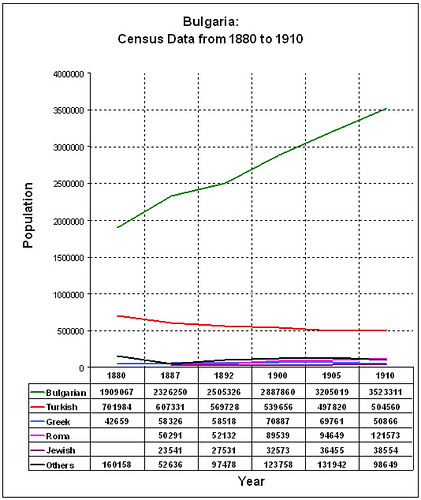
Bulgaria Census Chart (1880-1910)


Taken from here, this chart shows basic census results by ethnicity between 1880 and 1910 in Bulgaria. Noteworthy is the near-doubling of the Bulgarian population over this timeframe while the Turkish population falls by a third. The Turkish population of Bulgaria may have fallen further, in fact: one estimate in the Wikipedia article on Turks in Bulgaria claims that in the Danube Vilayet, which occupied most of northern Bulgaria along with parts of what are now coastal Romania, Christians of all ethnicities formed barely half of a population of almost 2.4 million people. The high proportion of Muslims in mid-19th century Bulgaria makes sense if you think of Bulgaria not as a peripheral European nation, but as a collection of provinces which formed part of the core of the Ottoman Empire, in the hinterland of the capital, even.

Muslims in Bulgaria, like Muslims elsewhere in the independent states emerging from the Ottoman Empire in the Balkans, and in the lands conquered by the Russian Empire in the Caucasus, were generally unwelcome presences in these newly Christian lands. As detailed by--for instance--Berna Pekesen in the essay "Expulsion and Emigration of the Muslims from the Balkans", Muslims of all backgrounds--people of indigenous Balkan background like Slavs and Albanians, members of Turkic groups, and peoples of the Caucasus like the Circassians--were subjected to what would be called ethnic cleansing. Millions of muhajir ended up settling in the Turkish core of the Ottoman Empire, starting off that country's modern tradition of immigration. (Various estimates claim that a high proportion of Turks, some up to one-third, are descended from these refugees.) In Bulgaria's case, Pomaks--people of Bulgarian language but Muslim religion--were separated from the Turkish population by various governments, which hoped to assimilate the Pomaks into a Bulgarian ethnic identity.

Bulgaria kept a larger Turkish and Muslim population that many other Balkan countries, but towards the end of the Communist period a variety of violent policies mandating the assimilation of all Muslims, including forced renamings and closing down specifically Muslim facilities, culminating in the May 1989 expulsion of most Bulgarian Turks from their country of birth into adjacent Turkey. The terrible international reaction and the economic consequences of the mass expulsion helped bring down the Communist government and fairly quick restitution made to the Turks (and Pomaks) as part of the democratization process. Today, Turks and Muslims in Bulgaria seem--some concerns aside--to be well-integrated in their homeland as respected players, with their political party, the Movement for Rights and Freedoms, being a major political player. Even so, perhaps a third of the million people claiming an identity as Bulgarian Turks currently live in Turkey, a country where they have put down roots. The Bulgarian emigrant community in Turkey, in fact, is the largest community of Bulgarian emigrants, the half-million Bulgarians in Turkey outnumbering registered Bulgarian emigrants in the rest of the European Union combined.

2. Bulgaria's borders are not what many had hoped.
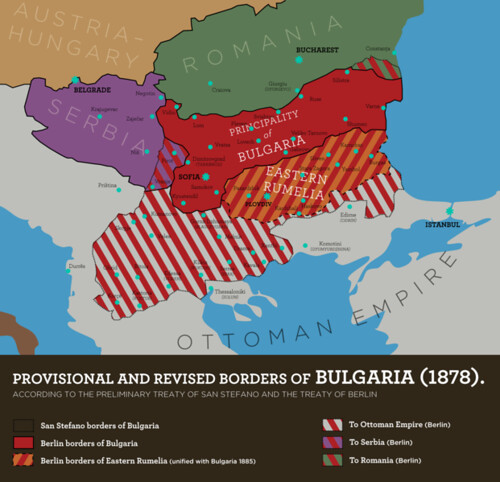
Bulgaria according to the Treaty of San Stefano (1878)


Initially in 1878 Bulgaria under Russian sponsorship would have been a large country indeed, including within its borders not only modern Bulgaria but almost all of the historical region of Macedonia. The negative reaction of other powers to such a large Bulgaria, seen as a Russian pawn threatening Constantinople and the Straits, led to the creation of a smaller Bulgaria. Despite fighting numerous wars at great cost with the aim of gaining these territories, Bulgaria never did manage to gain more than a small piece of Macedonia. After multiple ethnic cleansings all around which saw the deportal of most of the region's Muslims to Turkey and the eventual expulsion and forced assimilation of most Slavs in an Aegean Macedonia that received many of the Greeks expelled from Turkey in 1922, and the creation in Tito's Yugoslavia of a Macedonian national identity separate from the Bulgarian, Bulgaria was left with only a portion of eastern Macedonia. As for Bulgarian communities scattered further afield, whether in neighbouring Balkan countries or in old immigrant communities on the northern shore of the Black Sea (Moldova, Ukraine, Russia), they were left out of the Bulgarian national project.

After 1989 and the collapse of Yugoslavia, Bulgarian citizenship laws were slowly transformed so as to give people claiming an identity as ethnic Bulgarians, including those living in countries immediately adjoining Bulgaria as well as those living in the Black Sea diaspora. This was merely the most prominent part of a policy of outreach to these diasporids that includes gifts of school books in Serbia or vice-presidential visits in Ukraine. As noted by Marko Žilović in an essay at the website Citizenship in Southeastern Europe, citizenship in Bulgaria--a country on track to join the European Union, no less--could be a potent economic advantage.

On a usual working day in the village of Ivanovo in Serbia there are three cars with Bulgarian license plates parked in front of the small elementary school. This is not because a delegation from Bulgaria is visiting this village of little more than 1000 inhabitants. Importing used cars licensed in Bulgaria was a well-known scheme to circumvent restrictive Serbian regulations that protect the Zastava company, the only domestic car producer. The scheme worked best if the buyer had a Bulgarian passport. It is thus no coincidence that several cars with Bulgarian license plates found their way into the Ivanovo, for it is one of the few places where fleeing Roman Catholic Slavs from northern Bulgaria settled in the 18th century. Today, about a fifth of Ivanovo’s population declare themselves ethnic Bulgarians, though probably only a handful of them have obtained Bulgarian passports. However, among the owners of the Bulgarian-licensed cars, and passports, is also a local math teacher who declares himself an ethnic Serb. He tells of having some ethnic Romanians in his family tree a few generations ago, but no Bulgarian connections whatsoever.


By far the biggest number of people claiming Bulgarian ethnic identity to get Bulgarian citizenship are from Macedonia. While Bulgaria recognizes Macedonian independence, it does not recognize the separate existence of a Macedonian nationality, leaving open the possibility for Macedonian Slavs--of which there are 1.2 million in the former Yugoslav republic--to declare themselves Bulgarians. Given Macedonia's likely continued exclusion from the European Union owing to the name dispute with Greece and an emergent history dispute with Bulgaria, claiming a Bulgarian ethnic identity makes sense. Joanne van Selm's June 2007 profile of Macedona notes this.

It goes without saying that this is exceptionally controversial in Macedonia.

The Bulgarian case is fairly represented in Milena Hristova's February 2010 article for the Sofia News Agency, "Bulgarian Passports for Macedonians: Debunking Myths".
Macedonians strive to obtain Bulgarian citizenship for a number of reasons – to migrate to Bulgaria, to travel and work freely across the European Union and also due to the faith in the protection that the Bulgarian state can give them. “I would risk saying that this emotional factor is the most important and most often cited reason,” says Mandzhukova. She vehemently denies that the real motives are more pragmatic. “To say that Macedonians obtain Bulgarian citizenship as a passport to Europe is a stereotype that gives a very distorted reflection of the truth,” she says. According to her the influx of Macedonians to Bulgaria did not increase significantly after the country's accession to the European Union on January 1, 2007. “The first signs f the hype came much earlier when Bulgarian institutions agreed that the document our agency issues is enough to claim Bulgarian origin. This is when the real increase in applications came due to the streamlining of the process.” While in Macedonia many Macedonians try to cover the fact that they have signed such a declaration. “Well, certainly nobody will shout it at the top of his lungs. But first of all if someone considers what the Macedonian authorities think important, he would not sign the declaration in the first place, “ Mandzhukova says.

(A April 2012 essay by the Sofia News Agency argues the Bulgaria gives Bulgarian nationality to many fewer Macedonians than Romania gives Romanian nationality to many fewer Moldovans, and is more moderate.)

The Macedonian International News Agency, meanwhile, doesn't address directly the denial of Macedonian nationhood, instead challenging via articles like "Bulgarian citizen: Should my wife become Macedonian to get Bulgarian Passport?" (published earlier this month) the justice of a citizenship policy that makes it difficult for long-time residents to naturalize.

"Practically none of the Macedonans who have obtained a Bulgarian passport lives in Bulgaria. A large majority of them obtain the passport so they can work in EU countries. My wife on the other hand lives in Bulgaria for 11 years, speaks perfect Bulgarian, pays taxes, however is unable to obtain a citizenship" explains Bulgarian citizen Stefan Rusenov in an interview with Dnevnik.

In Bulgaria, you need to be a Macedonian so you can obtain a Bulgarian citizenship or passport overnight.

Macedonians in Bulgaria don't speak Bulgarian, they don't pay taxes here, but when it comes to obtaining our citizenship, they do it in record time, within a year - says Stefan Rusenov whose wife is from the Ukraine and is unable to obtain Bulgarian citizenship for years. According to Bulgarian laws, she would need to give up her Ukrainian passport to become citizen of Bulgaria.

- Instead of receiving a response in a year, we got our response in three years - that my wife can obtain a citizenship in three years, but, the condition was she must give up her Ukrainian citizenship. Then more problems. From the Ukrainian Embassy we were told she must register to fulfill her request of giving up her Ukrainian citizenship (which lasts 8 months), and only after that she can submit her request to give up her Ukrainian passport - explains Rusenov in frustrating fashion.


3. Bulgaria has long been a European periphery.
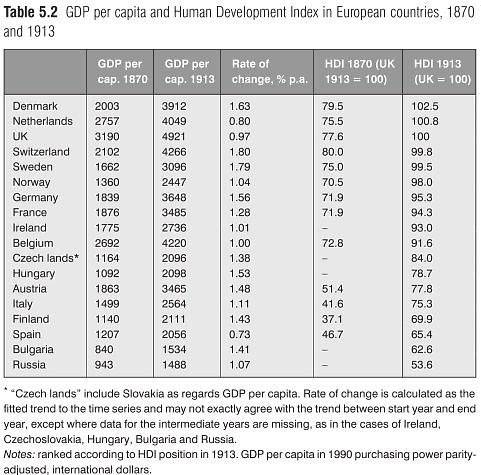
GDP per capita and Human Development Index in European countries, 1870 and 1913
Taken here, from the online version of the second volume of the Cambridge Economic History of Europe by Broadberry and O'Rourke, this draws upon the historical statistics of Arthur Maddison to come up with a ranking of European countries by economic and human development in the belle époque. Of note is the fact that Bulgaria's relative underdevelopment is a fact of long-standing, one that isn't a relatively recent artifact of Communism as in central Europe. Although income and development gaps have narrowed in the subsequent century, they are still quite large. Attempts at enforcing an agricultural specialization via Comecon's doctrine of an "International Socialist Division of Labour" never were very successful, but neither was (for instance) the attempt to develop a computer industry in the 1980s (that led, mainly, to computer viruses). The catastrophic breakup of the former Yugoslavia further hit Bulgaria. Bulgaria, now in 2013 as in 1913, is one of the poorest countries in Europe.

There is an abundant literature about migration from post-Communist Bulgaria, for instance the Open Society Bulgaria 2005 report "Bulgarian Migration: Incentives and Constellations", a 2013 fact sheet from the same organization "Is There A Threat of Bulgarian Migration to the UK?" (quick answer: no), Fatma Usheva's 2011 thesis "Emigration from Bulgaria: 1989 - Today", or Eugenia Markova's 2010 report for the Hellenic Observatory, "Effects of Migration on Sending Countries: Lessons from Bulgaria". Suffice it to say that after the end of the Soviet Union, Bulgarian migrants went first to adjacent and relatively prosperous Greece, then starting to move in large numbers to Spain in the late 1990s, with Germany recently emerging as a destination of choice. Bulgarian migrants went to places where they could find jobs easily, often in the informal sector, usually in countries that were relatively close to their homeland. Bulgarian foreign minister Nikolay Mladenov was quite right to tell The Telegraph that Bulgarians are not especially likely to move to the United Kingdom in large numbers.

These three patterns of migration, driven by ethnic identity and relative underdevelopment, seem likely to endure. The odds of Bulgaria transforming sufficiently to not be a relatively poor country with low fertility and very high rates of emigration are not, as Edward noted, high at all. Individual Bulgarians have every incentive to continue to leave their country, and with Bulgaria's full integration into the European Union's single market in labour, very few institutional barriers. It's also fair to wonder whether Turkey, just next door with relatively strong economic growth and a recent history of receiving large numbers of Bulgarian migrants, might also emerge as a destination for Bulgarians regardless of whether Turkey joins the European Union or not. Inasmuch as Macedonia, and the adjacent countries with large Bulgarian communities (Serbia, Moldova, Ukraine)

Thursday, February 11, 2010

A few more news links

For your reading pleasure, here's some population-related news links that I thought might interest you.

  • Radio Free Europe/Radio Liberty's Nikola Krastev observes that even though populations are aging, fiscal issues and social isolation is making the lives of the elderly difficult.

  • Turkey's Today Zaman observes that Turkey's population is aging swiftly, its elderly population growing more quickly than its youth population.

  • Ha'aretz' Lily Galili notes that ex-Soviet Jews, by virtue of their removal to the very different environment of Israel, have enjoyed a much greater lifespan than they otherwise would have and are being assimilated to Israeli norms.

  • The CBC comments that Nova Scotia's rapidly aging has led to serious and growing economic problems in a depopulating rural Nova Scotia.

  • Billboards in Atlanta claiming that relatively high abortion rates among African-American women is threatening the survival of that community are as controversial as you'd expect.

  • Kenya's Daily Nation reports that remittances to Kenya, about half from North America and one-quarter from Europe, reached $609 million dollars in 2009.

  • French Pearce in the Guardian suggests that the sharp decline in Bangladeshi fertility rates can be explained by a combination of a Green Revolution that reduced the need for labour on farms and the economic empowerment of women.
  •