Writer
Mark Adomanis has an
extended review of Eurabia theorist Mark Steyn's latest book, the subtly-titled
America Alone: Get Ready for Armageddon. Adomanis is critical of Steyn's thesis, since despite his undeniable skill as a raconteur with a good grasp for compelling narratives, it's fundamentally confused if not outright self-contradictory. The core of Adomanis' argument deserves to be quoted at length.
Steyn’s parallel attempts to prove that "statism" is the source of all of the world’s problems (from increasing obesity to stagnating median wages) and that the Islamic world, particularly Iran, is ready to run roughshod over an effeminate and degenerate West, relies on such a tendentious and selective presentation of facts that it actually winds up subtracting from his readers’ understanding of what is actually going on in the world.
According to Steyn, Europe is in a demographic death spiral caused by statism and, at a deeper level, the loss of religious belief and "civilization confidence." Iran, on the other hand, is on the fast track to becoming the dominant power in the Middle East.
Yes, in reality, in 2009, Iran’s fertility rate, which Steyn uses as a heuristic for a society’s overall health, was actually lower than that of Brazil (barely mentioned in "After America"), the United States (doomed, according to Steyn), France (even more doomed, according to Steyn), or the United Kingdom (which is well and truly f*****). If an Islamic revolution and the full-fledged implementation of hardcore Shariah enforced by "morality police" can’t keep Iran’s fertility rate from rapidly collapsing, perhaps the "problem" of declining fertility is actually better explained by the basic pressures of modernity than by the craven adoption of liberalism.
Consider the experience of Muslim countries like Morocco, Algeria and Tunisia. Despite not being "liberal" in any recognizable sense of the word (indeed, being almost the exact opposite of the coddling social-democratic "nanny states" that Steyn blames for the West’s decline), these countries all experienced sustained and rapid decrease in fertility over the past 20 years. Today, according to the CIA World Factbook, Tunisia and Algeria are below replacement rate (the number of children required to keep a population at a constant level) and several other Muslim-majority countries are right on the cusp. Steyn avoids the problems these facts present for his thesis through the simple and effective tactic of not mentioning them.
Steyn’s knowledge of demographics is remarkably confused. In the concluding chapter, for example, he argues that "much of America is now in need of an equivalent to ... post-Soviet Eastern Europe’s economic liberalization in the early nineties."
He seems unaware that fertility rates collapsed during Eastern Europe’s experiment with economic liberalization. Indeed, not a single post-communist Eastern European country has yet regained the level of fertility it had at the time of communism’s collapse: Once again, Steyn avoids the problems this presents for his thesis by simply leaving it unmentioned.
What I take away from Steyn’s sincere but confused attempt at comparative demographics is the following: He confidently predicts the future supremacy of countries (Iran) that are doomed according to metrics of his own choosing (the total fertility rate) while simultaneously making policy prescriptions (radical economic liberalization) that, when implemented in other countries, have had the effect of exacerbating the trend (decreasing fertility) he’s attempting to reverse.
Admonis makes an
additional interesting note at his Forbes weblog.
[I]f, like Steyn, you consider all first-world countries to be irredeemably corrupt, and doomed by excessive debt and insufficient fecundity, what other real-world options are there? There are no free-market wonderlands where the people are rich, the government is small, and everyone is constantly popping out babies – we can only look at what actually happens in observed reality and judging by that there would seem to be (at the absolute least!) strong tensions between economic development, fertility, and political liberty.
We've blogged here in the past about an
Iran that has the sort of age structure that could drive an economic boom if the country had better government, or about the demographic transition in the
Maghreb and Libya that may soon make most of North Africa a labour-importing area. (We haven't, unfortunately, written at all about a Turkey that's also well advanced in the demographic transition and has already become something of a magnet for its neighbours. Later, we promise.) If the demographic transitition from high-fertility labour-exporting demographic systems to low-fertility labour-importing systems is so far advanced in Europe's neighbours, it's not obvious how these regions will be able to take over a much larger and wealthier continent with more impermeable barriers to entry.
Steyn writes a compelling, direct story (with, agreed, an engaging style of prose): as a result of any number of bad political, economic, and social choices, the West (starting with Europe) has become fatally weakened and is going to be taken over by a civilization that is hostile to the West and antithetical to the values of liberal and conservatives alike. He writes in a time when dystopias if not outright apocalypses are pretty common, being arguably the
biggest growth area in young adult fiction. The problem with his particular dystopia is that it oversimplifies things hugely.
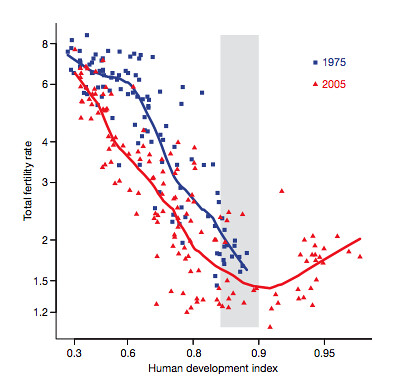
Take fertility. This graphic illustrates an argument
advanced in Nature in 2009 that
human development has a complicated relationship with fertility. "[T]here exists a "J-shaped" relationship between human fertility and development — i.e., that further advances in economic development can reverse the decline in fertility rate[, ...] that, in highly developed countries with HDI above 0.9, further development halts the declining fertility rates. This means that the previously negative development-fertility association is reversed; the graph becomes J-shaped." In such a case, rising human development may well lead to rising fertility as increasingly developed societies provide people with more chances to become parent to more children.
This is a contentious argument, many responding by saying that the correlation between higher human development and lower fertility merely weakens as human development rises. Is this weakening uniform, i.e. in some countries is the weakening more significant (or an actual reversal, even) than in others? I'd be interested in breaking the data apart and seeing whether the countries with the highest levels of human development might form high- and low-fertility clusters. Recent increases in fertility in northwestern Europe in the past couple of decades are at least suggestive.
This question isn't answered by Steyn, who simply wants to reverse things to a supposed ideal scenario that might not even exist. Certainly many European countries have higher rates of completed fertility than most of the North African and Middle Eastern countries that have produced large numbers of immigrants to Europe, as Europe's modernizing neighbours come to share in Europe's modern and post-modern demographic norms. It's a complex picture, and deserves to be treated in its full complexity.
The same goes for immigration. Steyn paints a picture of a low-fertility/high-immigration Europe bordering a high-fertility/high-emigration Muslim world that has been rapidly expanding to the exclusion of all other possibilities. The reality, however, is that things are much more nuanced: many emigrants from the countries supposedly directed towards Europe actually go elsewhere in the world in large numbers, differences in fertility between religious groups have narrowed consistently over time, and immigrants from the Middle East and North Africa are hardly the only immigrants moving to Europe. Europe may no longer dominate the world the way it did a century ago, but Europe--the continent as a whole, its component societies--are high-income countries with global connections that have fostered migrations as diverse as those of Ecuadorians to Spain, Vietnamese to Poland, and Sri Lankan Tamils to Norway. The story with immigration to Europe, again, is substantially more complex.
If you oversimplify a model of a real-world system you're going to come up with not an efficient model of the real world but a broken one. Eurabia as presented by Steyn is like that, no matter how compelling a storyline he weaves about it. We need
higher criticism, desperately, for analyses of demographic situations of all kinds.


