Showing posts with label egypt. Show all posts

Saturday, March 19, 2011

How many Copts are there? or, More on questionable population figures

The Copts, Egypt's Christian minority with a population numbering in the millions, has taken on a fair amount of importance in recent years as the largest non-Muslim religious minority in the Middle East, in the Middle Eastern and Arab country with the largest population and the greatest amount of cultural and political heft. This potted history gets the details.

The Copts, an indigenous Christian sect, constituted Egypt's largest religious minority. Estimates of their numbers in 1990 ranged between 3 million to 7 million. The Copts claimed descent from the ancient Egyptians; the word copt is derived from the Arabic word qubt (Egyptian). Egypt was Christianized during the first century A.D., when the country was part of the Roman Empire. The Coptic Church claims to hold an unbroken line of patriarchal succession to the See of Alexandria founded by Saint Mark, a disciple of Christ. Egyptian Christianity developed distinct dogmas and practices during the more than two centuries that the religion was illegal. By the fourth century, when Constantine made Christianity the official religion of the Roman Empire, Coptic traditions were sufficiently different from those in Rome and Constantinople (formerly Byzantium; present-day Istanbul) to cause major religious conflicts. Dissension persisted for 150 years until most Copts seceded from the main body of Christianity because they rejected the decision of the Council of Chalcedon that Christ had a dual nature, both human and divine, believing instead in Christ's single, divine nature.

[. . .]

Following Islam's spread through Egypt, Muslims alternately tolerated and persecuted the Copts. Heavy taxation of Christians encouraged mass conversions to Islam, and within two centuries, Copts had become a distinct minority. By the tenth century, Arabic had replaced Coptic as the primary spoken language, and Coptic was relegated to a liturgical language.

The Ottoman millet system of drawing administrative divisions along religious lines reinforced Coptic solidarity. The dismantling of the millet system during the nineteenth century helped open new career opportunities for the Copts. Egypt's Muslim rulers had traditionally used minorities as administrators, and the Copts were initially the main beneficiaries of the burgeoning civil service. During the early twentieth century, however, the British purged many Copts from the bureaucracy. The Copts resented this policy, but it accelerated their entry into professional careers.

In the twentieth century, Copts have been disproportionately represented among the ranks of prosperous city dwellers. Urban Copts tended to favor careers in commerce and the professions, whereas the livelihoods of rural Copts were virtually indistinguishable from their Muslim counterparts. Urban Copts were stratified into groups of long-time residents and groups of recent migrants from the countryside. The latter group was often impoverished and fell outside the traditional urban Coptic community. The former group included many university professors, lawyers, doctors, a few prominent public officials, and a substantial middle echelon of factory workers and service sector employees.

Anti-Coptic sentiment has accompanied the resurgence of Islamic activism in Egypt. Since 1972 several Coptic churches have been burned, including the historic Qasriyat ar Rihan Church in Cairo. Islamist groups frequently and explicitly denounced Copts in their pamphlets and prayer meetings. The increasing tensions between Copts and Muslims inevitably led to clashes in Upper Egypt in 1977 and 1978 and later in the cities and villages of the Delta. Three days of religious riots in Cairo in 1981 left at least 17 Copts and Muslims dead and more than 100 injured. Isolated incidents of Muslim-Coptic violence continued throughout the 1980s and during 1990.


Since the revolution, sources have been suggesting that the ousted Mubarak regime was responsible for some anti-Copt atrocities, apparently operating with a strategy of tension in mind ("Look, we can barely protect the Copts as is, how bad would a democracy be?"). I only hope that a more democratic Egypt will move decidedly away from that decidedly cynical tack.

How many Copts, members of the largest non-Muslim religious minority in the Middle East, are there? That's a major problem. Wikipedia's three-line entry on the number of Copts gives an idea.

Living in a country of Muslim majority, the size of the population of Copts is a continuously disputed matter, frequently for reasons of religious jealousy and animosity. Some official estimates state that Christians represent from 5% to 10% or less of a population of over 83 million Egyptians[21][22][23][43][44][45][46][47][26][14][15][17][24] while other independent and Christian sources estimate much higher numbers, up to 23% of the population.[14][15][17][21][22][23][24][25][26]


Yes, that's 22 different in-text citations, pointing to different estimates. The estimates do run from a low of four million (~5% of the Egyptian population of nearly 80 million) to a highs of 12 and even 16 million quoted by Coptic Orthodox Church authorities.

How many are there really? Philippe Fargues' 1998 essay "The Arab Christians of the Middle East: A Demographic Perspective" provides a good sober look at the numbers, and he concludes that the low numbers--the ones closest to official numbers--are the most likely ones.

Among the seven Middle Eastern countries which currently have an Arab Christian community - Egypt, Lebanon, Syria, Iraq, Jordan, Israel, and Palestine -Egypt is the only one to meet the two conditions which enable its Christian population to be examined over the course of time. One of these conditions is the recording of religious affiliation as a variable, individual characteristic in all the population censuses since 1897; the other is the geographical consistency of the territory covered by these censuses. The latest, carried out in 1986, showed 2,829,349 Christians, 5.9 per cent of the whole population of the country. Updated to 1995, this percentage would give a figure of 3,300,000 people. The Coptic authorities, some politicians, and a number of Coptic or Muslim intellectuals consider this figure to be a gross underestimation of a community which may actually number between 6,000,000 and 12,000,000 people, in other words between 10 per cent and 20 per cent of Egyptians. The statistic is thus alleged to be false, both directly - the results of the census are said to have been manipulated at the top before being published - and indirectly, as it is claimed that some Christians tend to declare themselves Muslims, due to pressure from their environment. Contrary to these allegations however, the statistic seems to be reliable, with the margin of error that all statistics carry. This argument, developed in another essay, is based on the observation that the Egyptian figures are consistent in two respects: both over the whole period of time and at each individual moment in time. The graph formed by the nine Egyptian censuses over a period of ninety years is quite regular, both as regards the whole country, where the percentage of Christians falls in a gradually sloping straight line from 1927, and in the different provinces. If there had been any manipulation, this pattern would not have been constant. On the contrary there would have been variations in the numbers and perhaps also in the consistency of the graph, according to the changing attitude of political forces, of regimes, and of society towards the Christian part of the population. Furthermore, censuses are not the only source of religious statistics in Egypt. The registration of births, marriages, and deaths provides another source. The two operations are carried out by completely separate branches of public administration using quite different methods. They nevertheless provide results which are completely consistent with each other. For example, the birth rate of 30 per thousand, obtained by matching the 85,000 Christian births recorded every year throughout the 1980s to the 2,800,000 Christians counted in the census of 1986, would only be 11 per thousand if the number of Christians were 8,000,000. 17 With such a low birth rate their percentage of the whole population would have undergone a very sharp fall, instead of showing just a slight drop, which clearly contradicts the numbers claimed. So we might as well admit the plausibility of the published statistics.


Fargues' argument is supported by the Pew Research Center's Conrad Hackett in a February 2011 note.

The highest share reported in the past century was in 1927, when the census found that 8.3% of Egyptians were Christians. In each of seven subsequent censuses, the Christian share of the population gradually shrank, ending at 5.7% in 1996. Religion data has not been made available from Egypt's most recent census, conducted in 2006. But in a large, nationally representative 2008 survey -- the Egyptian Demographic and Health Survey, conducted among 16,527 women ages 15 to 49 -- about 5% of the respondents were Christian. Thus, the best available census and survey data indicate that Christians now number roughly 5% of the Egyptian population, or about 4 million people. The Pew Forum's recent report on The Future of the Global Muslim Population estimated that approximately 95% of Egyptians were Muslims in 2010.

Of course, it is possible that Christians in Egypt have been undercounted in censuses and demographic surveys. According to the Pew Forum's analysis of Global Restrictions on Religion, Egypt has very high government restrictions on religion as well as high social hostilities involving religion. (Most recently, a bombing outside a church in Alexandria during a New Year's Eve Mass killed 23 people and wounded more than 90.) These factors may lead some Christians, particularly converts from Islam, to be cautious about revealing their identity. Government records may also undercount Christians. According to news reports, for example, some Egyptian Christians have complained that they are listed on official identity cards as Muslims.

Even if they are undercounts, the census and survey data suggest that Christians have been steadily declining as a proportion of Egypt's population in recent decades. One reason is that Christian fertility has been lower than Muslim fertility -- that is, Christians have been having fewer babies per woman than Muslims in Egypt. Conversion to Islam may also be a factor, though reliable data on conversion rates are lacking. It is possible that Christians have left the country in disproportionate numbers, but ongoing efforts by the Pew Forum to tally the religious affiliation of migrants around the world have not found evidence of an especially large Egyptian Christian diaspora. For example, in the United States, Canada and Australia, the majority of Egyptian-born residents are Christian, but the estimated total size of the Egyptian-born Christian populations in these countries is approximately 160,000. In contrast, there are more than 2 million Egyptian-born people living in Saudi Arabia, Kuwait and the United Arab Emirates, the overwhelming majority of whom are likely to be Muslims.


Elena Ambrosetti and Nahid Kamal note in their brief paper "The relationship between religion and fertility: the case of Bangladesh and Egypt" that not only has the Egyptian Christian TFR been consistently 15% lower than the Egyptian Muslim TFR in the 1988-1995 period, but that over the 1944-1980 period crude birth rates among Muslims did not fall to the level of the crude birth rates among Christians at the beginning of this period. Thus, even though the Egyptian Christian population more than tripled from 1907 to 1996, from 913 thousand to 3 321 thousand, the Egyptian Muslim population grew more quickly.

If the low numbers are the more accurate ones, why are the higher ones offered? The key lies in the fact that the estimates are offered by the Copts, a minority that has suffered not-inconsiderable persecution to the point of fearing for its survival. The very highest estimates would suggest that there are more Copts in Egypt than there are Dutch in the Netherlands. Security in numbers always appeals. Compare the situation in the United States, where disputes over the size of that country's Muslim population have produced a variety of estimates ranging as high as six or even seven million people. The Pew Research Center's of the United States latest estimate, part of the larger survey of global Muslim populations I've mentioned here earlier, is that there were 2.5 million Muslims in the United States in 2009. Their rationale?

This is a survey-based estimate that has been augmented with an analysis of census data. Let me just describe briefly what the steps were. When I say it's a survey-based estimate, what we have to work with here is what percentage of all the people we screened, from a national random sample, self-identified as Muslim. All of the survey-based scientific evidence we reviewed is lower than our number. As Andy mentioned, the average of the survey-based incidences have been between 0.2 percent and 0.5 percent.

Our own history with this in screening hundreds of thousands of people over the years has been that among the English-speaking public, about 0.5 percent, or slightly under, are Muslim. That number can then be projected against the total adult population of the U.S. All of that would come up with a lower number than we got.

What we got, however, was in incidence rate of 0.61 percent, largely, I think, because we were interviewing not only in English but in other languages. This is a landline telephone survey. We take the incidence number from the landline telephone survey, and we multiply it not times the landline population but times the total adult population because there are people who do not have landlines; they have cell phones - that number is over 10 percent now - and there are a few people in the country, still a couple of percent, who do not have any telephone service at all. We take that into account in the projection.

As far as it goes, that number gets you to about 1.35 million or 1.4 million, but we take a second step, which was done by Jeffrey Passel, a demographer with the Pew Hispanic Center. He's been recognized for his work in estimating the size of the undocumented immigrant population in the United States. He took the survey evidence I've just described to you, and also the 59,000 screening interviews we did in which we asked everybody we reached, Muslim or not, if they were born in the U.S., and if not, where they were born; if they were born in the U.S., where were their parents born. He took that information and knowing then what percentage of each of the nationalities we talked to identified as Muslim, multiplied that times the census numbers for the size of those groups. Let's say eight out of 10 Pakistani Americans that we spoke to said they were Muslim. That could be multiplied times the census data on the size of the Pakistani-born population in the U.S.

He then accumulated all of that, made an estimate on the size of the child population, which also can be taken partly from the survey, because we asked people how many children and how many Muslim children they had, and summed it all up.

We think this is a good estimate. It might be low because Muslims may be more likely to be cell-phone only than the rest of the population. There certainly may be some reluctance to identify as Muslim. We didn't pick up people who maybe were born Muslim but have lost their identity and are completely secular. We don't include those. But we think this is a defensible number, and it's scientifically based. The numbers we reviewed that are 3 million or more do not have a scientific basis in estimation, according to our review of the evidence.


See here for more on the methodology used in the group's 2007 survey of Muslim Americans.

Consider the stories surrounding these two populations just two more data points demonstrating the need to be careful when making specific claims, about populations or about anything else.

Tuesday, March 01, 2011

On Libya as an immigration country

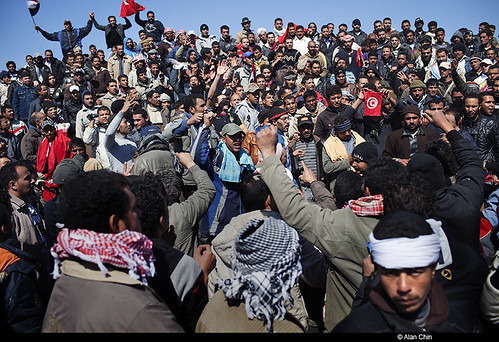
The large numbers of refugees crossing from Libya into Tunisia or Egypt has been prominently featured in international news media. Over at BAG News photographer Alan Chin has a couple of photoessays from the border-region up (1, 2), the below evocative picture being located at the second post.

tunlibcrowds


A very high proportion of these refugees aren't Libyan citizens, but rather, immigrants of greater or lesser permanency, illustrating the extent to which Libya's oil-driven economy made it a society of mass immigration.

The refugee agency says some 55,000 people have arrived in Egypt in the last 10 days, one-third of them Asian workers. Fifty thousand others, including 2,000 Chinese, have entered Tunisia. And it said a group of people from Bangladesh, Thailand and Pakistan were marooned without papers in a no-man’s land between Libya and Egypt.

Meanwhile, UN humanitarian chief Valerie Amos said those who remain in the Libyan capital Tripoli may not get badly needed aid because it’s too dangerous there. Aid groups fear that food stocks will run out as the violence continues between President Moammar Gadhafi and rebels who are fighting to oust him.

“Libya’s economy was strong compared with countries further south,” said Jean-Philippe Chauzy, an IOM spokesman in Geneva. “A guesstimate would be about 1.5 million migrants in Libya before the current trouble. They were working overwhelmingly in the informal sector.”

Migrants from countries like Bangladesh and the Philippines, he added, were usually registered and came with documents and contracts. But now they, too, are scrambling for the borders and begging for help to get back home.

Those who have fallen through the cracks the most, Chauzy said, are West and Sub-Saharan Africans lured by Libya’s relative prosperity.


The millennia-old migrants' routes connected the west African interior with the Libyan coast were supercharged via Gadaffi's pan-Africanist flirtations, as described in a 2004 Washington Post article.

During the 1990s, in the name of African unity, Gaddafi opened the borders to tens of thousands of sub-Saharan Africans to live and work in Libya. For the past four years, resentment over the policy has led to occasional riots and frequent bitter confrontations between the immigrants and Libyans.

In effect, the problems mark the end of an officially ordained dream.

Last month participants at an African Union meeting in Libya's coastal city of Sirte, Gaddafi's home town, rejected his proposal for a continent-wide army. A few days later, the General People's Congress, a consultative assembly that meets annually, ratified laws to restrict immigration and to expatriate Africans and other immigrants who live in Libya but have no steady jobs.

"You have work, you stay. You don't, you go home," said Giuma Abulkher, a government spokesman. "There will be strict controls."

The closed door is part of a shift in Libyan priorities. After decades of presenting himself first as a leader of the Arab world and then the African continent, Gaddafi has turned to the West. He is giving up chemical and nuclear weapons programs and declared that Libya would no longer support rebel movements across the globe. The United States is moving to restore diplomatic and trade relations cut off during decades of hostilities. Libya plans to privatize its state-dominated economy.

Shutting out other Africans will probably prove popular. In a closed, politically fearful society, opposition to Gaddafi's immigration policy is one of the few outward signs of discontent with his government. While Libyans are usually reluctant to openly discuss such issues as democracy, succession and economic policy, the immigration question provides a vent for complaints that quickly spill over into expressions of general unhappiness.

"It's about time. How can we have all these poor people here when we are poor ourselves?" said Osama Tayeb, a tout at a chaotic taxi stand in the old city. "First we help revolutionaries everywhere, then we give Libya to the Africans. Enough of this. Libya for the Libyans."

Mohammed Mabrouk, a waiter, blamed immigrants for a wide variety of societal problems -- crime, prostitution, dirty streets. "Look, they get away with everything. We could not touch our African brothers. They bring drugs, they smuggle people. We don't need this," he said.

[. . .]

About 600,000 sub-Saharan Africans are estimated to live among Libya's population of 5.5 million. They were lured by a relatively stable currency and jobs that many Libyans, in their highly socialist economy, decline to do. They sweep streets, work in restaurants and peddle a dizzying collection of merchandise -- cosmetics, pirated recorded music, clothes and secondhand auto parts. Raggedy men selling single articles of clothing and knit caps stand in line inside an arched stone gateway to the old city.

Their headdresses and wool or cotton robes indicate origins across a wide swath of Africa: Nigeria, Ghana, Chad, Mali, Somalia, Sudan and Congo. Some of the migrants come to make the perilous journey to Europe across the Mediterranean Sea. Last summer, 200 Africans traveling to Italy by fishing boat drowned when their rickety craft capsized. During peak summer season last year, as many as 2,600 Africans arrived each month by boat on the Italian island of Lampedusa, an isolated stop between Libya and Sicily.


Later on, as part of his turn to3wards the West Gadaffi later signed accords with Italy which triggered the regime's very harsh controls over illegal migrants. The marginalization faced by this community was dramatically worsened when Gadaffi, not trusting his regular army, instead recruited thousands of sub-Saharan Africans as mercenaries to use against his subjects. These seem to have been pawns.

"A man at the bus station in Sabha offered me a job and said I would get a free flight to Tripoli," said Mohammed, a boy of about 16 who said he had arrived looking for work in the southern Libyan town only two weeks ago from Chad, where he had earned a living as a shepherd.

Instead of Tripoli, he was flown to an airport near the scruffy seaside town of Al-Bayda and had a gun thrust into his hands on the plane.

[. . .]

In halting Arabic, Mohammed, the young Chadian, tried to explain how he had ended up on the wrong side in somebody else's revolution.

Mohammed drifted into Libya looking for casual work, like many sub-Saharan Africans, perhaps with the hope of eventually finding people smugglers who would take him across the Mediterranean to Europe.

"I wanted a better life, not war and destruction," he said. He insisted that he had been treated well since his surrender, with regular meals, and said he hoped he would be allowed to return home soon.

"I didn't really know what was going on. They told me to do these things and I was really scared when the shooting started."


Al Jazeera and All Africa both carry reports of sub-Saharan African immigrants, whether legal or otherwise, being subject to attack by angry Libyans.

The Egyptians seem less vulnerable, likely becaquse of their perceived similarities to the Libyans, their lack of involvement in the revolution, and perhaps because of the concentration of this Egyptian migration beginning in the 1960s professional categories of employment. These Egyptians are still returning to their homes, however, hitting the economy of their homeland further.

"Losing these remittances will of course make the situation worse here," Rashad Abdu, a professor at the University of Cairo, said. "Libya is an important and close destination for hundreds of thousands of Egyptian workers who could not find jobs in their country."

About 1.5 million Egyptians work and live in Libya, and send an estimated 1.5 billion Egyptian pounds (US$254 million) in remittances back home every year, according to the Egyptian labour ministry. Many sought work in Libya because the local economy could not absorb them.

"The sorry thing is that it will take most of these people a long time to find jobs in their home country," said Saleh Naser, chairman of the Labour Section at the independent Egyptian Chamber of Commerce. The chamber is composed of company owners and businessmen who try to coordinate the government and the business community.

"The only way out now is for the government to try to open new markets in the Gulf for these people," he said. According to the Chamber of Commerce, an estimated 10 percent of Egypt's 26 million working population are unemployed.

Egyptians working abroad remit about US$12 billion annually to their country. The state-run National Planning Institute, however, expects a decrease during the third quarter of the current financial year because of political turbulence in the Middle East.

Protests against the Hosni Mubarak regime in Egypt forced the Central Bank to shut banks for more than three weeks; they only resumed normal operations on 20 February.

The sorry thing is that it will take most of these people a long time to find jobs in their home country

"Egypt has a budget deficit and a government debt load that are teetering on the edge of sustainability," says think-tank Stratfor and the fall-off in remittances will only make matters worse.

Some of those who have returned are the family's sole breadwinner. According to 59-year-old Youssef Fawzi, his son Marwan, used to work in Libya, and household would now struggle without that financial support.


The Egyptians working in the east of Libya, adjoining their homeland, seem to have been able to escape. The Egyptians working in the west, along with other migrants, seem less fortunate.

More than 100,000 people have fled Libya in the past seven days. As the final battle for Libya looms, the crowds of escapees become bigger and more desperate.

Almost half of them have come through this narrow stretch of road leading across the northern Sahara into Tunisia. There are teams of Chinese oil workers in identical uniforms, large packs of Bangladeshis, scatterings of Japanese, and mostly thousands and thousands of Egyptians, who have provided the bulk of Libya’s labour force for years.

“We’re getting out because we’re scared, but also because there won’t be any paycheques for a long time. We know there won’t be work until there’s a new government, which could be months from now,” said Haji Abasi, who took his wife and two small children on the frightening road journey from Libya.

At this point, there is no violence along the three-hour drive from Tripoli to the border. Only at the border crossing is the solid green Gadhafi flag visible, a last stand for the regime, held by some of Col. Gadhafi’s most loyal security staff.

But the border guards – who systematically seize cellphones from refugees, strip them of their memory cards, and sometimes harass and humiliate the escapees – are not the final threat to the exhausted people carrying their possessions in oversized bags.

That came after the Libyan border, when on Sunday the Egyptians were blocked by aggressive crowds of Tunisian protesters who tried – usually successfully – to stop or sharply slow the flow of Egyptians, allowing only families and injured people through.

The protesters include residents of the nearby border town of Ben Gardane, who feel that they are being overrun with tens of thousands of homeless Egyptians, and members of the local revolutionary committee who believe they are helping the Egyptians by drawing attention to their plight and encouraging the Cairo government to send rescue airlifts.

“We don’t have any more space to accept the Egyptians – we are blocking the border until the Egyptian authorities find a solution for their transportation,” said Lutfi Tabeth, a member of the Ben Gardane revolutionary committee.

It became a frightening and dangerous scene on Sunday afternoon as several thousand Egyptians charged the border, pushing through the Tunisian protesters and attempting to charge into the camps, only to be stopped by Tunisian soldiers who raised their rifles and forced them to sit on the street, closing the border again.


At this point, assuming the stabilization of the Libyan situation I feel safe only in predicting the gradual return of the Egyptians and the further marginalization of sub-Saharan Africans in Libya. With these communities' association with a hated leader's brutality, however unearned and unfair, it seems safe to assume that sub-Saharan Africans will not do well at all.

Thursday, February 03, 2011

On illegal immigration in Israel

The ongoing revolution in Egypt is a concern to Israel, since regardless of the peace treaty theirs is a "cold peace". War's unlikely, but a regime that expressed popular dislike for Israeli policies and for Jews wouldn't be a very good Israeli partner. The Globe and Mail has pointed out a perhaps-unexpected consequence of a deteriorating Egypt-Israeli relationship: there could be more illegal immigrants.

Israel is by far the most affluent nation to share a land border wi Africa and is a magnet for refugees – more than a thousand refugees make it across the Israeli-Egyptian border every month. In the past, Egypt’s army has attempted to stop them, but a hostile regime in Cairo, or an ineffective one, could turn this steady trickle into a flood that inundates Israel’s welfare systems.


As one would expect given the importance of displacement and migration in the history of Israel and the diasporas of Jews and Palestinians, immigration is a sensitive topic, illegal immigration more so. Notwithstanding the close links between Palestinians within and without Israel and geography, after the flight of Jews from the Middle East the region is of little, and decreasing, importance. When the post-Gulf War peace process began, Palestinians played a major role in the Israeli economy, provided unskilled labour at significant benefit to the Israeli economy and to Palestinian living standards. Ironically, when the peace process began, even before the post-2000 wave of suicide bombings Palestinians were displaced by less expensive foreign guest workers.

There were three hundred thousand foreigh workers in 2003, of fairly homogeneous background, half from Asia (China, Thailand, Philippines) and 45% from eastern Europe (mainly Romania and Moldova). The largest share work in construction, domestic service, and agriculture, but they can be found throughout the Israeli economy. (This collection of articles) goes into greater detail.) Many overstayed visas, and this, along with the standard concerns of immigrants debasing the national character and harming the economy, etc., has caused a recent crackdown on foreign guest workers.

A new Interior Ministry regulation would bar certain foreign nationals, who had illegally lived in Israel and then left of their own volition, from entering Israel again. This severely tightens immigration policy in Israel, as it bars the entry of foreign nationals from 60 countries exempt from visa requirements, including Russia, Romania, Colombia and the Philippines, for at least a year and up to a lifetime. It will affect tens of thousands of people, including the families of immigrants from the former Soviet Union and of former foreign workers, who were granted Israeli citizenship according to an arrangement for foreign workers' children.

According to the regulation, foreign workers from visa-exempt countries who remained in the country illegally for more than 30 days and then left on their own volition would be subject to a two-year "cooling-off" period. The price to be paid by foreigners who arrived as tourists but remained in the country illegally for a period of up to 30 days is slightly lower - a no-entry period of just one year. However, a foreign worker who is caught and deported from Israel will be barred from entering the country for a period of 10 years. A tourist or foreign worker residing in the country for over a year without a permit will be barred from returning for the rest of his or her lifetime, unless he or she receives a special permit from the immigration authorities in advance. According to the regulation, foreign workers who remained in Israel legally and departed as required will not be allowed to return for a year following their departure.


The notable thing about the illegal migration noted in the Globe and Maoil is that it actually does come from Israel's region. African refugees have a growing presence.

Most Africans [. . .] climb in through the window of the long, sprawling and largely open border with Egypt and then knock on the door for asylum. About 15,000 African hopefuls have entered the country this year, roughly double the amount of last year.

The government is determined to stop the influx. For starters, it is fencing off its 150-mile border with Egypt. Work began last month.

The border fence will cost about $370 million, but government indecision on immigration matters is costing dearly. Fear of the impact on politics, religion, demography, diplomacy and the economy has paralyzed decision-makers, negating a cohesive immigration policy. Years of Band-Aid solutions have produced a situation that is rapidly approaching a crisis.

All non-Jewish foreigners challenge Israel's aspirations for a Jewish majority and character while treating others fairly. But the African issue offers a test of humanitarianism and international law -- and social tolerance too.

Largely lumped together as "infiltrators," many of the Africans come from war-torn regions. Most come from Eritrea; Sudan is a close second, with a number from Ivory Coast and other countries. All asylum seekers undergo a process of "refugee status determination, " or RSD, except for Sudanese and Eritreans, who enjoy a temporary sweeping protection.


The Eritreans are predominantly men of military age, fleeing their country's military draft, while the Sudanese tend to be refugees from Darfur and southern Sudan. Both these populations certainly have any number of incentives to flee their homelands and to try to find new lives in Israel, while the older migration route to Libya is now profoundly unsafe. The size of future influxes of Sudanese and Eritreans into Israel--and, perhaps, of other migrants from the Middle East--depends on the enforcement of border controls by Israel and its neighbours.

Will Israel's neighbours keep illegal migrants out from Israel? Who knows. Leaving their general dislike for Israel aside, they do have incentives not to have large refugee populations accumulate in their own countries. Blind eyes are quite imaginable.