Friday, December 01, 2006

CFR and TFR in Sweden

by Edward Hugh

This post is related to both the one which comes before it and the one which follows. CFR refers to cohort fertility rate and TFR to total fertility rate.

Fertility can be measured in a number of ways, and two of the most important of these are the total fertility rate and the cohort fertility rate. The total fertility rate (TFR) is an estimate of periodic fertility and is defined as the sum of number of children born by women in a defined age range (16-49) extrapolated to the lifetime fertility of the total number of women in that age group. The cohort fertility rate (CFR) is the average number of children which women actually give birth to during their lifetime fertility cycle, and is only known when the women in the cohort end their fertile life. CFR is an accurate and important indicator since it measures whether the completed fertility for women achieves replacement level or not. The replacement level is the number of children per woman (approximately 2.1) needed in order to hold the population constant.

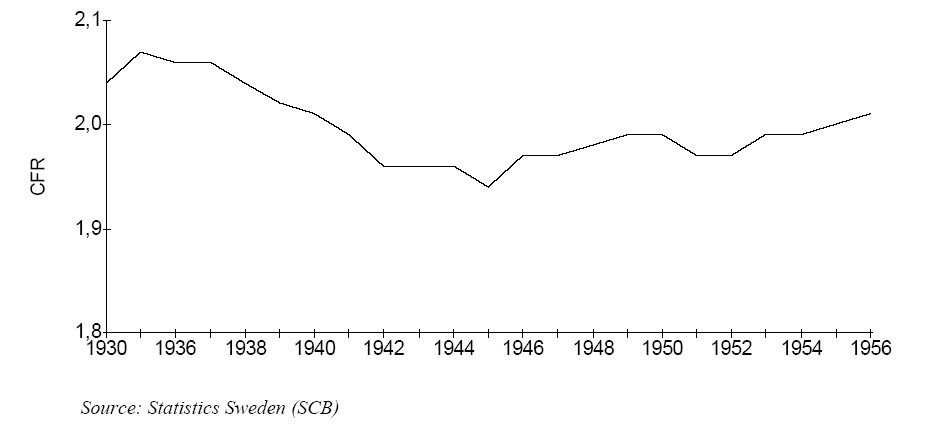
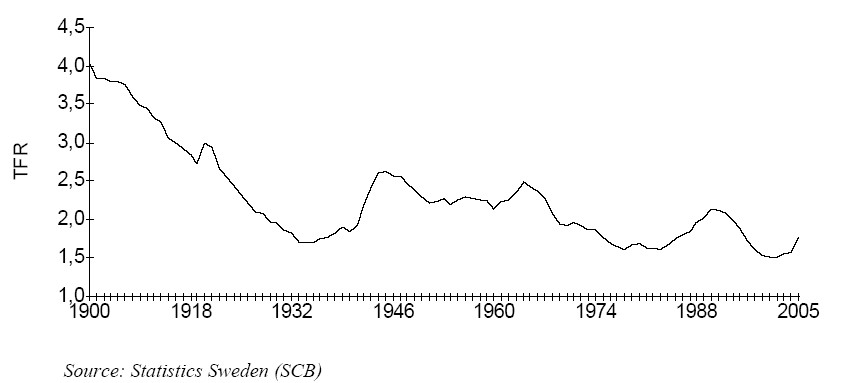
In periods of rapid birth postponement significant differences may exist between the Tfr (estimate) and the final Cfr. This is clearly indicated in the case of Sweden by the two graphs below.

As can be seen while recorded Tfrs were continuously well below replacement level, Cfrs for cohorts up to the 1955-59 cohort have been quite stable, and at more or less the 2.0 level quite close to replacement level.

This is not to say that the postponement phenomenon is entirely benign, as the 'missing births' do of course influence the shape of the population pyramid.


Thursday, November 30, 2006

Sweden, Pro-Natalism, Baby Booms and Demographic Transitions, Continued

by Edward Hugh

This is a continuation of my last post, since looking again at what I said, and examining the Swedish experience a bit more closely, I think I may have overdone things a little. This point was made clear to me by a comment from Stefan Geens who drew attention to the rather complicated picture which the Swedish case offers us. The core of the problem is to be found in this statement from Mark Ammerman:

"Despite all the effort Sweden has never since then risen over or even near replacement fertility."

Now as Stefan points out, this statement, as it stands is too strong, and undoubtedly an oversimplification. In support of his assertion Stefan points us to an earlier post on his blog which examined the recent evolution of Sweden's population, and he draws attention to the fact that the number of live births in Sweden has been rising steadily since 1999. In fact detailed information on live births and deaths in Sweden can be found on this page.

Now as I point out to Stefan in comments, one of the problems in looking at this data is to get an accurate measure of what it actually means in terms of the issue which concerns us here, replacement rate fertility. This is normally considered to be a fertility rate of 2.1tfr, but it is just here that we find the problem since TFRs may not be an accurate enough measure of completed fertility, and in particular during periods of rapid birth postponement when many women displace having children to ever later ages.

The total fertility rate is a measure of periodic fertility and uses the sum of the number of children born by women in a specific age (between 16-49) during a given time period in relation to the total number of women in the age group to make an estimate of the fertility rate. The cohort fertility rate (CFR) is a much more accurate measure since it is based on the average number of children which women give birth to during their entire lifetime fertility cycle. Now CFR is important since it measures whether the completed fertility for women is above the replacement level or not, but it has the important disadvantage that it becomes available only after women in any given cohort have completed their fertile life, and in periods of significant fertility fluctuation may reflect more what WAS happening, rather than what the current situation is.

In Sweden, for example, the latest available data is for the 1955-1959 cohort, but we may be rather interested in how fertilty behaviour may have changed when this group is compared with the behaviour of those born in the years 1965-69. Since data for this cohort only becomes available around 2015 this means that it is hard to take policy decisions based on CFRs, or, at least, it is possible, but important details may be missed, and hence the fairly widespread use of TFRs to try and get a handle on the process of fertility change.

To cut a long story short the reading on CFRs for Sweden to date have been not far short of replacement level, since they have been around the 2.0 mark. See, for example, this paper:

Why does Sweden have such high fertility?


By current European standards, Sweden has had a relatively high fertility in recent decades. During the 1980s and 1990s, the annual Total Fertility Rate (TFR) for Sweden undulated considerably around a level just under 1.8, which is a bit lower than the corresponding level in France and well above the level in West Germany. (In 2004 the Swedish TFR reached 1.76 on an upward trend.) The Swedish completed Cohort Fertility Rate (CFR) was rather constant at 2 for the cohorts that produced children in the same period; for France it stayed around 2.1 while the West-German CFR was lower and declined regularly to around 1.6.

So if the question we want to answer is: does Sweden currently have replacement (or near replacement) fertility, the only honest answer is that we don't really know. Having said that it does appear that Mark's original statement is a bit too strong, even if the current cohorts do not turn in replacement level fertility, they may well be not too far short of it.

So, in completing my mea culpa, I would make the following points:

1/ The important issue which I wanted to stress was that what we are dealing with here is not a simple boom-bust phenomenon, but rather a steady and continuous decline in fertility, which (if we strip out the US and Israel) seems to have taken place across the entire developed world, and which is now also rapidly occuring in the parts of the third world which are developing economically. In this context many countries which understandably seek to place an emphasis on reducing their fertility to replacement levels will almost certainly find it difficult to stop the decline at that point, and will in all probability move to fertility levels which are well below replacement level.

2/ Pro-natalism is important, but even in the society where most effort has been placed on a systematic pro-natal welfare system sustaining fertility at replacement levels has not proved easy (if indeed it has in fact been achieved).

3/ The quantity of resources necessary for the kind of policy Sweden has pursued are significant, and whilst they may be feasible in a comparatively rich society like Sweden, with a high level of awareness of the issues involved, introducing such a policy and devoting the quantity of resources required in less economically affluent societies, and in particular in the context of the situation that below replacement fertility and rapid increases in life expectancy both tend to occur simultaneously, will not be easy. Simple lump-sum cash payments - which of course are not unwelcome - are unlikely to make a substantial impact and in particular not in those societies which have already fallen below the 1.5tfr level.

4/ The Swedish (and Scandinavian in general) case also draws our attention to the critical difference between those societies with "near replacement" fertility (where pyramid sustainability is not resolved, but at least the relatively higher fertility makes the transition easier) and those who have fallen into the lowest-low fertility category. The need to avoid the critical drop below a TFR of 1.5 cannot be over-emphasised. Many societies already find themselves in this uncomfortable position (and the list of these is a lot longer than many imagine, including most of Souther Europe, Eastern Europe, the Asian Tigers, Japan and now possibly China), but it is important to try and prevent others meeting the same fate, which is why there is an urgent need in the developing third world to draw attention to the urgency of putting pro-natalist policies in place as these societies approach replacement level. The lesson of Southern Europe and the Tigers seems to be that if you do not do this you will almost certainly overshoot and find yourself in the lowest-low category. Bottom line: in trying to raise this awareness the Swedish model is, in fact, not without some importance.
Tuesday, November 28, 2006

Sweden, Pro-Natalism, Baby Booms and Demographic Transitions

by Edward Hugh


A commentor on my Bonobo Land blog has been poking around the fertility issue and coming up with some interesting points. Now I'm sure Mark Ammerman is far from being in 100% agreement with what I am saying in general about fertility, but he is making what seems to me to be a genuine attempt to sort out for himself what it is that actually lies behind the phenomenon of low fertility.

Now if we start with a point made in a link Stefan Geens put up (as also mentioned by Claus yesterday):

The current baby boom-bust cycle implies severe welfare losses for the baby boom generations, even under optimal policy.


Now this is one interpretation of what is happening, we have a baby boom-bust process. But as Ben Bernanke indicated in a recent speech (as linked to here, and as elaborated on even further by Claus):

This coming demographic transition is the result both of the reduction in fertility that followed the post-World War II baby boom and of ongoing increases in life expectancy. Although demographers expect U.S. fertility rates to remain close to current levels for the foreseeable future, life expectancy is projected to continue rising. As a consequence, the anticipated increase in the share of the population aged sixty-five or older is not simply the result of the retirement of the baby boomers; the "pig in a python" image often used to describe the effects of that generation on U.S. demographics is misleading. Instead, over the next few decades the U.S. population is expected to become progressively older and remain so, even as the baby-boom generation passes from the scene.

So what we have is not a boom-bust but a continuous and ongoing transition wherein below fertility replacement and increasing life expectancy combine to steadily push up population median ages (of course the US currently has more or less replacement level fertility, but this is just one of the issues which worries Mark - who is a US citizen - how sustainable is this given the fact that the relatively high Latino fertility may well fall at some point?).

So Mark has found himself getting into a number of issues which are of interest to us here at Demography Matters, and this will be the first of two posts which discuss these issues.

Mark has been scratching around and has come up with the point that in fact fertility in Sweden (as in France) first went below replacement level in the 1930s, but that the extent of the problem which was about to arrive was in fact *masked* by the existence of the baby boom in the post war world and not created by it.

From here on in, until I indicate, it is mark who is talking:

"Sweden seems a good empical test of what laws favoring mothers can do. quoting the author, Allan Carlson:

"The Myrdals fleshed out this program in their best selling 1934 book, Crisis in the Population Question, a brilliantly argued volume which substantially transformed Sweden. While Swedish conservatives continued to fret over sexual immorality, the Myrdals pointed directly at the contradictions created by an incomplete welfare state. Prior government actions such as mandatory school attendance, the ban on child labor, and state old age pensions, they admitted, had stripped away the value of children to parents. But the costs of children remained at home. In consequence, children had now become the chief cause of poverty. Given the incentives set up by the state, the very persons who contributed the most to the nation's survival by having children were dragged down into poverty, shoddy housing, poor nutrition, and limited recreational opportunities. A voluntary choice between poverty with children or a higher living standard without them was what young couples now faced. Young adults were forced to support the retired and the needy through the state's welfare system, and also the children to which they gave life. Under this multiple burden, they had chosen to reduce their number of children as the only factor over which they had control."


"If we are to believe Carlson's account, and I see no reason not to, the real motivation for Sweden's "universal state allowances for children's clothing, a universal health insurance plan, a universal entitlement to day care, state-operated summer camps for children, free school breakfasts and lunches, state-funded family housing, birth bonuses to cover the indirect costs of having babies, marriage loans, the expansion of state maternity and midwife services," etc., was to encourage people to have babies."

"So already in the 30s Sweden had this problem and were struggling with it mightily. I'm sure this the only example we have of seventy years of trying to deal with the problem. Despite all the effort Sweden has never since then risen over or even near replacement fertility."

"Although Sweden today has a higher fertility than most of europe, they also have a significant immigrant population. Without knowing the fertility rate of ethnic swedes we can't put a number on how effective the fertility promotion effort has been. Since the swedish government refuses to collect that information it hints that the situation is probably not good."

OK, now its me again (Edward).

Now I think Mark is absolutely spot on here. This is a problem which was identified 70 odd years ago, and which social policy (in the pro-natalist sense) has failed to resolve. So this is something we need to come to terms with.

It is also worth noting that Nobel Economist Gunnar Myrdal was the first to really start to investigate the *economic consequences* of declining and ageing populations (in the so called Godkin Lectures, the most economically relevant of which I have online here) and people in Japan would do well to go and read this if they want to understand why consumption is currently so weak there. Myrdal got though to this at the end of the 1930s, but as I said, the baby boom sent everyone astray and economic theory effectively lost 70 years when the issue could have been conceptualized and policies developed to enable the transition to be lived with less rather than greater difficulty.

Well I would like to thank Mark for being stubborn and digging around (even while not agreeing with me) and coming up with this most interesting of arguments. Of course, what we can now do is either follow the example of Marcel Proust, and go off in search of lost time, or we can make the best of what we have, and get down to the still outstanding task of coming to terms with the issue. This is what I suggest we do.

Meantime more arguments from Mark tomorrow.