Monday, October 30, 2006

Auf Widersehen, Pet

by Edward Hugh


This, as many readers may well know, used to be the title of a UK TV sit-com about British building workers seeking to improve their fortunes by working in Germany, but now the times, it seems, have changed.

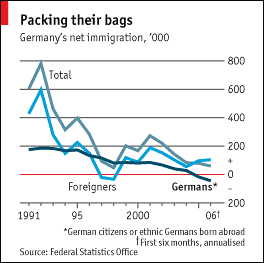
In 2004 more than 150,000 Germans reported to their town halls that they were going abroad—the highest number since 1884. The real figure is almost certainly much higher. Germany, once the economic engine of Europe, is on the point of becoming a country of net emigration. The museum in Bremerhaven may soon need a new wing with an aeroplane cabin or high-speed railway carriage, today's mode of departure.

This turn of events is not without irony. Until recently, politicians bickered about too many immigrants. Now it is emigrants they worry about. “A terrible development,” said Roland Koch, the premier of the state of Hesse, who once won an election by opposing a proposal to allow dual citizenship for Turks living in Germany. Business leaders are even more anxious. “More and more young people are turning their backs on Germany,” fretted Ludwig Georg Braun, president of the German Chamber of Industry and Commerce.

On the surface this may look like a case of overdone German angst. In the first six months of this year 69,000 Germans left the country, but 47,000 came back. The net outflow was 22,000 people, almost insignificant in a country of 82m people. However, according to Simone Eick, director of the Bremerhaven museum, emigration is likely to become a long-term trend.

The modest figures mask a more serious problem: brain-drain. Hard numbers are difficult to find, but anecdotal evidence suggests that many more academics are leaving Germany than are arriving, in contrast with countries such as the United States and Sweden that have a net “brain-gain”. According to a German medical organisation, about 12,000 German doctors now work abroad, many of them in Britain and Switzerland, which last year replaced the United States as the workplace of choice. Austria now ranks as the third-favourite destination.


What is curious about this situation is that the Economist doesn't seem to connect this outflow with the general demographic situation of Germany. This is, unfortunately, a lose-lose situation. Lack of internal demand inside Germany (which I argue is very much age related) produces slow growth and a stagnant labour market. Germany is suffering from a shortage of young people, and ironically this shortage is leading to more of them emigrating, and so the circle it seems continues. And as the Economist notes this outflow is even greater is you take cerebral cubic capacity (or, in economists terms, effective labour hours) into account.

Again, this situation is quite simply not sustainable: something at some point will break. This is not the first time we have here, at Demography Matters drawn attention to the knife-edge character of the situation Germany finds itself in, unfortunately I fear it will aslo not be the last.

The overall picture is however rapidly becoming clearer: in this 'population' game there will be winners and losers. Those who succeed in attracting population will be the winners, and those that don't, those whose population actually declines, will become the losers. Would that more people would stop trying to suggest that 'Demography Doesn't Matter' and started to do something before some of these countries enter an irreversible process of decline.

Sunday, October 29, 2006

US: The Coming Demographic Tsunami

by Edward Hugh

Well, reading through this account of a recent speech by David M. Walker, head of the US Government Accountability Office, I have only one thing to say: Demography Really Does Matter.

Walker has committed himself "to touring the nation through the 2008 elections, talking to anybody who will listen about the fiscal black hole Washington has dug itself, the "demographic tsunami" that will come when the baby boom generation begins retiring and the recklessness of borrowing money from foreign lenders to pay for the operation of the U.S. government".

Walker is, it seems, more or less auditor general for the United States. Personally I couldn't speak with any authority about the dynamics of the US deficit, but I imagine Charles Walker can, and he should know what he is talking about, and if he doesn't, then he shouldn't be in the job he is in. T

The interesting thing about all this is that the US is one of the better cases (in terms of the general sustainability of its economic path). So is France, and look what Michel Pébereau recently said in his recent authoritative report for the French government:

Pébereau does not mince words: over a quarter of a century century French public policy has accumulated for itself a national debt has neither supported economic growth nor reduced unemployment. The debt is “asphyxiating” and unless the State acts to reduce its spending now France will “lose control of the financial situation” before the end of the decade.

And these are the moderate cases, there are far worse ones, Italy for example.

And as Walker himself says:

"You can't solve a problem until the majority of the people believe you have a problem that needs to be solved".

And it seems that the majority of people, in the US and elsewhere, are in denial on the problem:

Polls suggest that Americans have only a vague sense of their government's long-term fiscal prospects. When pollsters ask Americans to name the most important problem facing America today — as a CBS News/New York Times poll of 1,131 Americans did in September — issues such as the war in Iraq, terrorism, jobs and the economy are most frequently mentioned. The deficit doesn't even crack the top 10.

So the big fear is that something, somewhere will end up 'happening', and then people will start to wake up. I simply hope that the 'happening' in question will not be prove to be too dramatic and devastating for those history has appointed to serve as example. Meantime, here's some more from the Walker speech:


Walker's challenge is to get people not just to think about it, but to pressure politicians to make the hard choices that are needed to keep the situation from spiraling out of control.

To show that the looming fiscal crisis is not a partisan issue, he brings along economists and budget analysts from across the political spectrum. In Austin, he's accompanied by Diane Lim Rogers, a liberal economist from the Brookings Institution, and Alison Acosta Fraser, director of the Roe Institute for Economic Policy Studies at the Heritage Foundation, a conservative think tank.

"We all agree on what the choices are and what the numbers are," Fraser says.

Their basic message is this: If the United States government conducts business as usual over the next few decades, a national debt that is already $8.5 trillion could reach $46 trillion or more, adjusted for inflation. That's almost as much as the total net worth of every person in America — Bill Gates, Warren Buffett and those Google guys included.

A hole that big could paralyze the U.S. economy; according to some projections, just the interest payments on a debt that big would be as much as all the taxes the government collects today.

And every year that nothing is done about it, Walker says, the problem grows by $2 trillion to $3 trillion.

People who remember Ross Perot's rants in the 1992 presidential election may think of the federal debt as a problem of the past. But it never really went away after Perot made it an issue, it only took a breather. The federal government actually produced a surplus for a few years during the 1990s, thanks to a booming economy and fiscal restraint imposed by laws that were passed early in the decade. And though the federal debt has grown in dollar terms since 2001, it hasn't grown dramatically relative to the size of the economy.

But that's about to change, thanks to the country's three big entitlement programs —
Social Security, Medicaid and especially Medicare. Medicaid and Medicare have grown progressively more expensive as the cost of health care has dramatically outpaced inflation over the past 30 years, a trend that is expected to continue for at least another decade or two.

And with the first baby boomers becoming eligible for Social Security in 2008 and for Medicare in 2011, the expenses of those two programs are about to increase dramatically due to demographic pressures. People are also living longer, which makes any program that provides benefits to retirees more expensive.


One last point. This is not simply a question of a 'boomer generation'. The whole point of this blog is to examine why the phenomenon is much bigger than this, and to examine the implications of this fact. As Ben Bernanke says, we are in the midst of a demographic transition


As a consequence, the anticipated increase in the share of the population aged sixty-five or older is not simply the result of the retirement of the baby boomers; the "pig in a python" image often used to describe the effects of that generation on U.S. demographics is misleading. Instead, over the next few decades the U.S. population is expected to become progressively older and remain so, even as the baby-boom generation passes from the scene.

Indeed here even the phrase "and remain so" may itself be misleading, since the median age may well rise and rise and rise, depending on the future evolution of fertility and longevity in the US. So of this transition all we are able to say at this point is destination uncertain, end-point unknown.

Monday, October 23, 2006

Accounting For The Costs of Ageing

by Edward Hugh

This article which appears in todays FT seems to me to raise issues which are extremely important, indeed it gets to the heart of the matter:

A radical new approach to government accounting that would require the US administration to account for the cost of future social security payments year by year as people build up entitlements will be proposed on Monday.

The proposal by the federal accounting standards advisory board (FASAB) – which would also require the government to account for benefits accrued under Medicare and other social insurance programmes in the same way – is unprecedented internationally. It would radically change the presentation of US government finances, in effect bringing forward the cost of rapidly increasing social security and Medicare obligations and greatly increasing the reported fiscal deficit.


As the FT notes the proposal is unprecedented internationally, but is exactly what is needed. Assessing sustainability in public finances involves having relatively accurate knowledge of two things: accumulated liabilities, and future rates of economic growth. The 'unprecedented' component in the FASB proposals would go a long way towards improving the situation vis-a-vis the first item, the second one, of course, still needs a lot of thought and work.

The FT has obtained a copy of the FASAB preliminary views paper which will be released on Monday. In it, the independent board majority argues that “for social insurance programmes an expense is incurred and a liability arises when participants substantially meet eligibility requirements during their working lives”.

By contrast, the government representatives argue that the liability arises only when the benefit amount is “due and payable” as under current accounting rules.

The majority independent directors want the government to start providing for the future cost of social security and other benefits when workers become fully insured after 10 years in covered employment.

They say the current arrangement is “flawed” because it “fails . . . to recognise the accruing cost of social insurance programmes in each reporting period”.

Adopting the proposed new rule would bring the government more into line with the private sector, an approach that has considerable support within a section of the Republican party and may in this instance be of interest to Democrats too.

However, it would break with international public accounting practice, which essentially treats social insurance offered by sovereign governments as a political commitment to pay future benefits rather than a financial liability.

The Organisation for Economic Co-operation and Development has written to the FASAB saying it is “very concerned” about the proposed rule change.

The letter, signed by Barry Anderson, head of the OECD’s budgeting and public expenditures division, says that “classifying these transactions the same as private sector liabilities is wrong” and could confuse the public.